You receive push notifications every day on your phone and your browser. However, on the marketing side, it is still an under-exploited channel by the majority of French companies. It’s a shame, because it’s probably one of the most profitable levers that I have been able to test in recent years.
With an opening rate that often exceeds the 30% and a sending cost close to zero, push notification literally crushes the performance of an average email campaign. You still have to know how to do it.
In this guide, I offer you a journey in 5 concrete steps: how to set up your first campaign, why this channel is worth the detour, how to segment your audience, write your messages and measure your results. At the end of reading, you will have everything you need to launch your first campaign with confidence. Here we go!
1. How to create a push notification campaign that converts?
Before throwing yourself at the first tool that comes along, take 10 minutes to install the business objective of your campaign. A notification is neither an email nor an Instagram story. It is a short, intrusive message that should trigger immediate action. Without a clear objective, you will tire your audience for nothing.
I systematically follow these 5 steps when I launch a campaign:
- Set the goal : conversion (purchase, registration), re-engagement (inactive users), information (product announcement, hot content)
- Choose technology : browser push (web push) to reach your visitors without an app, mobile push (iOS/Android) if you have a native application
- Select a platform capable of managing opt-in, segmentation and tracking without requiring you to code
- Design the opt-in : the authorization request window must arrive at the right time, never upon raw arrival on the site
- Prepare the first message with a short title, a clear promise and an explicit call-to-action
When it comes to choosing the platform, you have several serious players on the French market. To help you create a push notification campaign without starting from scratch, you can rely on specialists in the subject. The latter manage both the ccollection of opt-ins, targeting, sending and analysis.
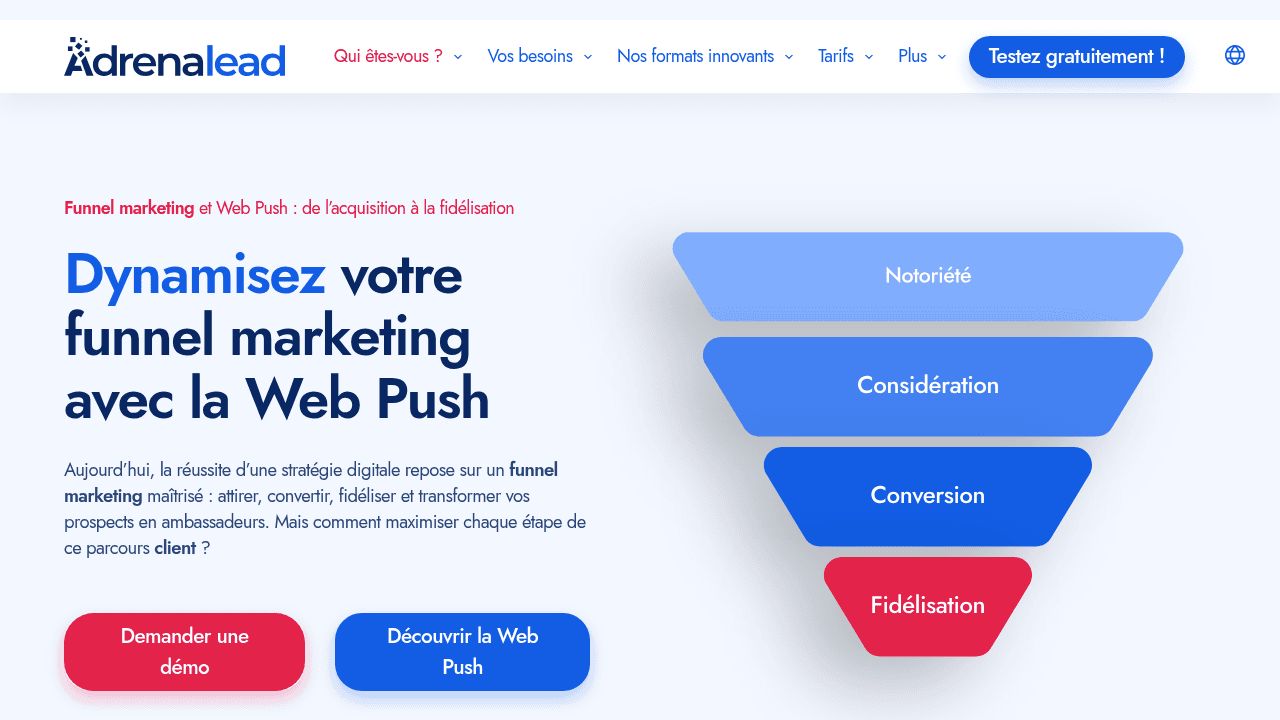
My advice: start small. One campaign, one objective, one segment. You will then iterate by analyzing the first results.
2. Why are push notifications a key lever for digital marketing?
The first reason is raw efficiency. Where an email campaign displays on average 20 to 25% open ratea push notification frequently exceeds 30 to 40%, and its click rate can reach 8 to 10% depending on the sector. You read correctly: 10 times more than the average click for a standard email.
Second advantage, and it is probably the most strategic: you do not have no need for the visitor’s email address. A simple click on “Allow” in the browser is enough. This changes everything in an era where email collection is increasingly complicated (GDPR, Apple ITP, gradual elimination of third-party cookies).
I see many concrete benefits with each deployment:
- Immediacy : the message is displayed in real time, even when the browser is closed
- Total visibility : no spam folder, no social algorithm that filters your message
- Marginal cost close to zero : most platforms charge by volume, with no shipping fees per message
- Native GDPR compliance : the opt-in is explicit and managed by the browser itself
- Ability to reach an anonymous person : you don’t need to know the visitor’s identity to re-engage them
Compared to SMS marketing (expensive) and email (saturated), push notification stands out as the most effective channel for relaunch an abandoned cartannounce a flash promotion or bring an inactive user back to your site.
3. Segment your users for truly personalized push messages
Sending the same notification to all your subscribers is the best way to generate cascading unsubscribes. Segmentation is what separates an average campaign from a successful campaign. The more targeted your message is, the more it converts. I work on 4 criteria as a priority.
Behavior on the site
Pages visited, products viewed, actions performed, time spent. Someone who has visited a product page 3 times without purchasing does not expect the same thing as someone who has just finalized an order. Adapt your push accordingly.
Geolocation
The country, the region, even the city for local uses (restaurants, businesses, events). A geolocalized message can multiply the engagement rate by 2 or 3 in retail.
Declared interests
Ask your subscribers, upon opt-in or via a quick poll, what they want to receive: promotions, new products, advice, price alerts. You avoid sending unsolicited content and you keep your audience healthy.
Frequency of engagement
Very active users tolerate a sustained cadence. Inactive people need rarer, but more impactful messages. Adapt your pace to each segment to avoid fatigue.
Concretely, on an e-commerce store, you can create segments such as: “abandoned cart < 24 hours”, “visitor interested in category X for 7 days”, “VIP customer with more than 3 orders”, “subscriber sleeping for 30 days”. Each segment receives a tailor-made message.
4. Write impactful messages to boost your subscribers’ engagement
A push notification is a title, a message body, sometimes an image and a button. You have less than 3 seconds to convince the recipient to click. Suffice to say that there is no room for the superfluous.
Respect character limits
The title must 40 to 50 characters maximumthe message body 90 to 120 characters. Beyond that, your message is truncated depending on the user’s system. Systematically test mobile rendering before sending.
Be direct and profit-oriented
Put the value as the first word. Banish soft wording like “Discover the new collection”. Prefer “ -30% on your favorite brand, until midnight ». The reader must instantly understand what they gain by clicking.
Use emojis wisely
A well-placed emoji increases click-through rates, it’s proven. But stuffing your message with emojis will make you look like a spammer. A simple rule: maximum one emoji per messageand always linked to the content.
Personalize when possible
Insert the first name, the last product viewed, the city. A personalized push notification can generate up to 4 times more clicks than a generic message.
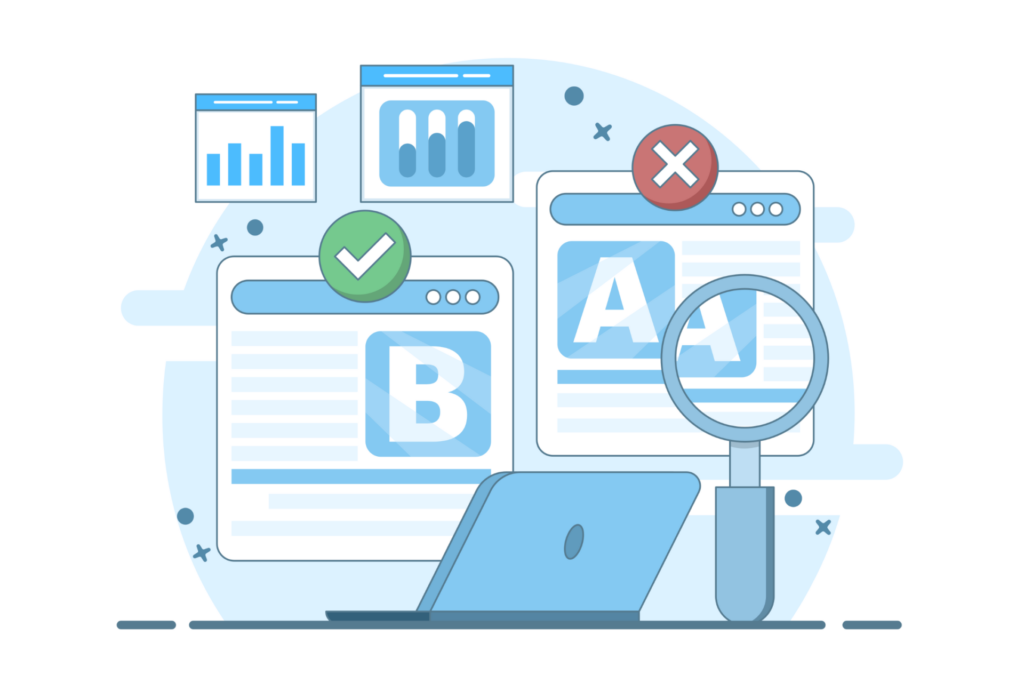
A/B test every important send
Before sending a notification to your entire base, test 2 variants on 10% of your audience. You will quickly identify what works for your target, and you will accumulate useful data for your next mailings.
Some examples of effective messages that I have seen run:
- “Still 3 items in stock in your size — order soon”
- “Your basket is waiting for you, we will keep the free shipping costs for you”
- “Marie, the weekend weather is great: here are 5 ideas for walks near you”
5. Measure and optimize the performance of your shipments to continuously improve
Launching a campaign without measuring its results is throwing marketing budget out the window. The strength of push notifications is precisely their native trackability. Enjoy it.
I systematically follow 5 indicators after each sending:
- The deliverability rate : how many notifications actually arrived on the screens, without being filtered by the browser
- The opening rate : how many recipients clicked on the notification
- The click rate towards the objective : how many have completed the journey on your site
- The conversion rate : how many performed the targeted action (purchase, registration, download)
- Unsubscribe rate : a valuable warning signal about the marketing pressure of your program
Beyond the raw numbers, two variables make all the difference: sending time And the frequency.
When it comes to sending times, forget generalities like “Tuesday at 10 a.m.”. Test on your own audience. For a BtoC target, the 12 p.m. to 2 p.m. and 7 p.m. to 9 p.m. slots often work very well. For BtoB, preferably Tuesday and Thursday morning between 9 a.m. and 11 a.m.
On frequency, stay reasonable: 2 to 4 push notifications per week maximum for a general public program, never more than 1 per day. Beyond that, the unsubscribe rate explodes and your list becomes empty.
Set up a continuous optimization cycle : you test, you measure, you learn lessons, you iterate on the next campaign. It’s the mechanics that make the difference between a team that suffers from its push channel and a team that makes it a real pillar of growth.
My final opinion on push notifications
Push notifications are probably the marketing channel that offers today the best effort/result ratio. You have unbeatable open rates, zero marginal cost, easy GDPR compliance and an ability to reach an anonymous person that you won’t find anywhere else.
If you had to remember 3 things from this guide:
- Start small: one campaign, one objective, one segment
- Segment and personalize systematically, otherwise you kill your list
- Measure everything, adjust with each shipment, and stay reasonable on frequency
If you are already workingemailingtake a look at my comparison of the best emailing software to orchestrate your channels together. The strength of a modern marketing strategy is to use each lever in the right order: push notification for rapid reactivation, emailing for substantive communications, SMS for emergency peaks.
It’s your turn now. Launch your first campaign this week, measure the results within 7 days, and write to me to tell me what you learned!