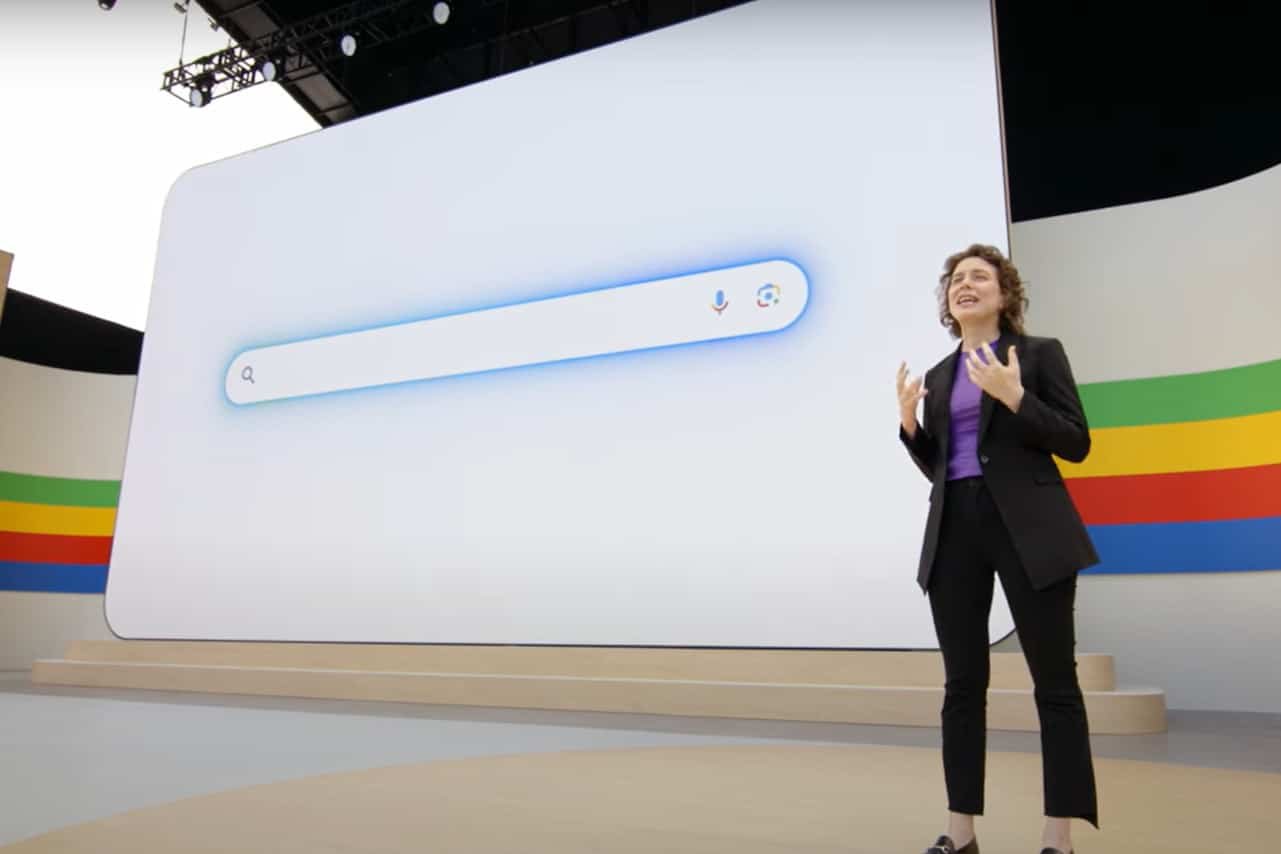
After having recently mentioned the future of Google Searchits director, Liz Reid, lifts the veil on how artificial intelligence is redefining the uses, queries and economic model of the search engine. No sudden break, but a profound and assumed evolution.
What to remember:
- AI Overviews do not eliminate clicks to websites, they mainly eliminate “bounce clicks”, that is to say quick visits to a page to retrieve a single fact.
- Queries become longer and more natural: users describe their real problem rather than translating it into keywords.
- “Slop” (low quality content) existed before generative AI. This has simply industrialized it, and Google says it has experience in combating it.
- Google Search, AI Mode and Gemini will not necessarily merge, they serve distinct uses and users switch from one to the other according to their needs.
AI doesn't kill clicks, it sorts them
This is one of the most debated points in the world of SEO since the arrival of AI Overviews: would these AI-generated summaries at the top of results pages cannibalize publishers' traffic? Liz Reid, vice president in charge of Google Search, provides a nuanced response in a recent interview.
According to her, AI Overviews mainly reduce what she calls “bounce clicks” : these visits where an Internet user clicks on a link, consults a number or a date, then immediately returns to Google because he only needed this information. These clicks disappear, and it’s assumed.
On the other hand, if a user intended to read a feature article for five minutes, this intention remains intact. AI Overview can even help it identify the right page more quickly, reducing bad clicks, not good ones.
The message is therefore: AI does not replace the web, it works with it. “ People want AI on the web, together », Summarizes Reid.
Requests that change in nature
One of the most interesting signals mentioned by Liz Reid concerns the evolution of the queries themselves. Since the deployment of AI Overviews, Google has observed queries “ significantly longer » and more formulated in natural language.
This change is not trivial. For years, Internet users have learned to “ speak the language of Google »: remove unnecessary words, reduce their question to a few impactful keywords. This reflex gradually disappears.
Now users describe their real problem, in their own wordsand expect Google to do the translation work. This reversal is fundamental: it is the machine that must adapt to humans, and not the other way around.
Liz Reid sees this as a return to the roots of Google’s mission: “ organize the world's information and make it universally accessible and useful “. With AI, the focus shifts from accessible to useful.
AI Overviews, AI Mode, Gemini: three tools, three uses
Google is not trying to centralize everything in a single product. Reid emphasizes the complementarity of the different tools, and the fact that many users switch from one to the other according to their needs.
The distinction is articulated as follows:
- Google Search and AI Mode are more oriented towards informational queries, that is to say when the user seeks to understand something or to connect to a web source.
- AI Mode stands out with longer, more complex and more conversational queries. This is the entry point for questions that require further treatment.
- Geminifor its part, is more oriented towards productivity, creation, writing. When the task is creative, users naturally turn to Gemini.
As for whether Search and Gemini will eventually become one, Reid admits he doesn't know. Both share the same underlying models and work together to improve them, but their full convergence is not a given.
The advertising model remains strong, but it is evolving
Another regularly expressed fear: if AI answers questions directly, how does Google continue to make money? Reid partly dismantles this reasoning.
- First, the ads only appear on less than a quarter of requests. A large portion of research has never been monetized, especially those that do not have a commercial dimension.
- Second, for transactional queries, the click remains essential. Knowing the best shoe model is not enough: the user still has to go to a site to buy them. The AI gives the answer, but it does not place the order.
- Third, more detailed and precise queries theoretically allow create more targeted and relevant advertisements. The more clearly a user expresses their need, the more possible a match with a relevant ad becomes.
“Slop”: an old problem, a new scale
The term “AI slop” refers to low-quality content generated massively by AI tools to occupy search results. It's a hot topic in the industry, and Liz Reid isn't shying away from it.
But she places it in its historical context: slop is not an invention of generative AI. There existed before, produced by humans, content farms, spam techniques. AI has simply made it scalable, that is to say reproducible on a large scale without additional effort.
Google says it has acquired solid experience in combating this type of content. The aim is not to eradicate slop, which is impossible given the financial incentives involved, but to maintain a very low rate of spam in the results displayed to users.
Reid also points out the responsibility of publishers : producing quality content remains the best strategy, especially as users are increasingly turning to authentic sources, audio, video, or content generated by communities.
Personalization, the next frontier
An area that is still underdeveloped but mentioned several times by Reid: personalization. Google Personal Intelligence represents a first step towards results tailored to the individual preferences of each user.
The idea goes further than just suggestions based on history. It includes the ability for the user to declare their trusted sources, indicate the sites they like, and obtain results that take into account the paid subscriptions they already have. If a user is subscribed to a media, Google should be able to offer them as a priority the content of this media to which they have access.
It is a project that raises as many opportunities as questions about the information bubble, but Reid clearly sees a strong direction for the coming years.