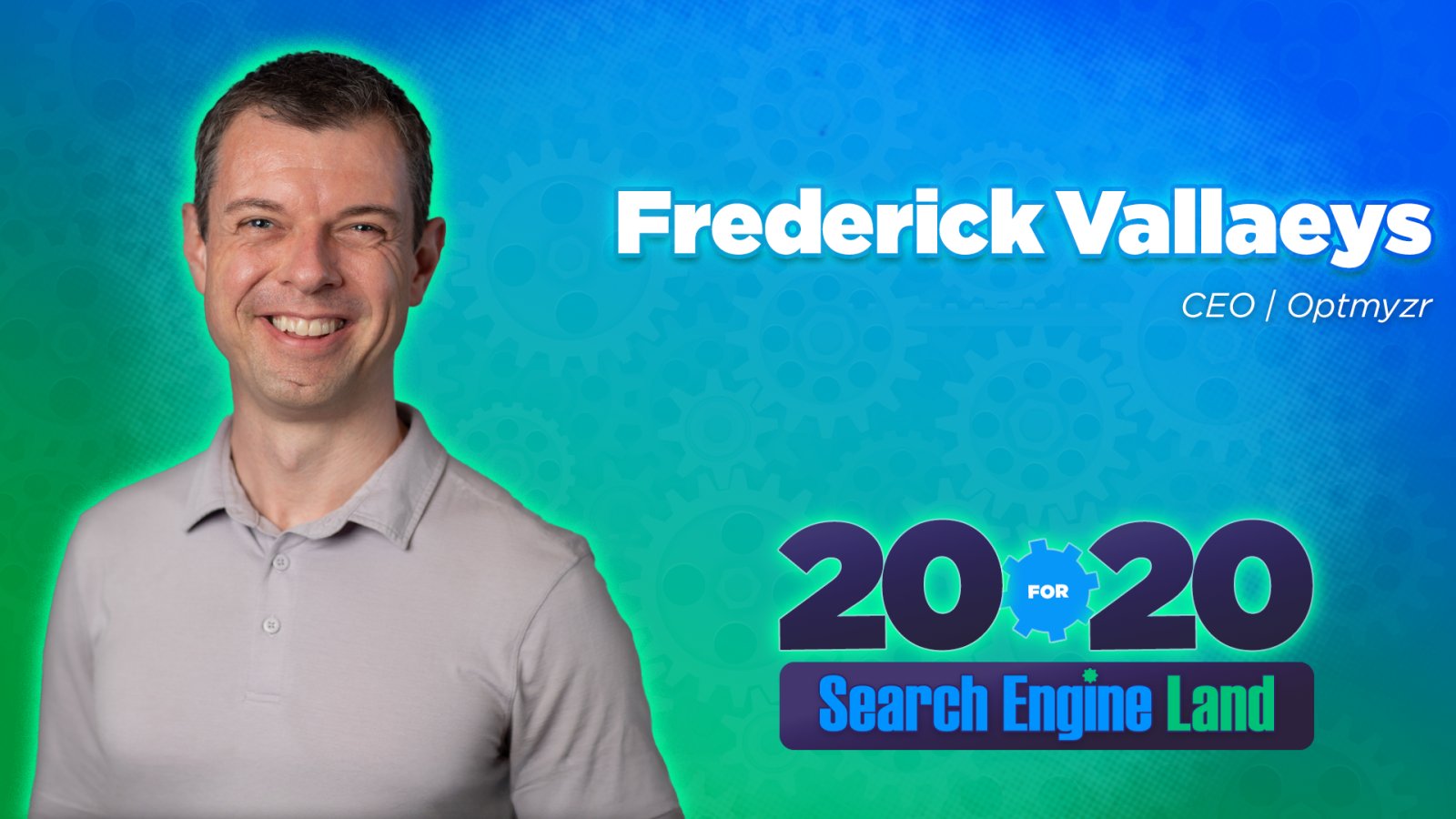
Frederick Vallaeys’ route into PPC started with a student side hustle, not a career plan.
While at Stanford in 1998, he spotted a resale opportunity in used Blockbuster video cassettes and needed a way to find buyers. That led him to GoTo, an early search engine where advertisers could bid on keywords – and gave him his first glimpse of the power of paid search.
More than 20 years later, Vallaeys has become one of the best-known voices in PPC, a former Googler, one of the early builders in the Google Ads ecosystem, and founder of Optmyzr.
In this interview, he looks back at the early days of Google Ads, how automation changed everything, and what marketers need to remember as search moves from keywords to prompts.
Paid search started with a simple idea
Vallaeys’ first “aha” moment came before Google Ads became the giant it is today.
Goto showed him that you didn’t need a huge budget to reach an audience. You could buy a keyword, get traffic and test whether something worked.
That was a major shift from traditional advertising, where budgets were bigger and measurement was weaker.
Paid search made advertising accessible.
Google Ads made performance measurable
When Vallaeys joined Google in 2002, he helped launch Google Ads in Dutch, the sixth language supported by the platform.
At the time, a top-tier advertiser was spending around $30,000 a month — a number that feels modest today, but was significant then.
What made Google different was not just traffic. It was proof.
The acquisition of Urchin, which became Google Analytics, and the development of conversion tracking gave advertisers visibility into what happened after the click.
That changed paid search from something that seemed to work into something advertisers could prove worked.
Search Engine Land helped shape the industry
By the time Search Engine Land launched in 2006, paid search had already become a serious advertising channel.
For Vallaeys, Search Engine Land became more than a news source. It became a place to share ideas, learn from others and build connections.
In fact, Optmyzr started because of a Search Engine Land article.
Vallaeys had written about quality score and shared a script to calculate account-level quality score. His future co-founders commented on the article, they connected, and within half an hour of talking, decided to build what became Optmyzr.
Quality score was always about relevance
Quality score has been one of the defining features of Google Ads.
In the earliest days, Vallaeys said, it was essentially click-through rate. Google needed a way to make sure ads were not just high-bid, but relevant.
That balance between bid and quality became foundational to the auction.
Before machine learning handled much of that work, humans were heavily involved. Vallaeys even reviewed keywords himself and could disapprove them for relevance.
Search has always moved in cycles
Vallaeys sees the history of paid search as cyclical.
At first, advertisers had very little data. Then Google gave them more visibility through analytics, conversion tracking and search query reports. Later, privacy changes reduced some of that visibility again.
Performance Max followed a similar pattern. It launched with limited controls, then Google gradually added more as advertisers asked for them.
The industry often treats each “black box” moment as new, but Vallaeys argues that paid search has always moved between simplicity, control, automation and transparency.
Smart Bidding changed the business
One of the biggest turning points, according to Vallaeys, was when Smart Bidding became good.
That changed how advertisers worked and forced tool providers like Optmyzr to rethink their value.
If Google could automate bidding well, advertisers no longer needed tools simply to adjust bids. They needed “PPC insurance” — ways to monitor automation, set guardrails and understand when systems went wrong.
That became a key part of Optmyzr’s role in an increasingly automated world.
AI is the next existential shift
For Vallaeys, the next major shift began when ChatGPT launched publicly.
It pushed Google to accelerate Gemini and forced the industry to think beyond keyword-based advertising.
Google Ads was built on keywords. But users are increasingly searching through prompts, conversations and AI assistants.
That raises a bigger question: should the old Google Ads system be rebuilt for prompts, or should something entirely new replace it?
AI search is not just search anymore
Vallaeys believes AI is blurring the line between searching and doing.
People no longer just ask for information. They ask AI tools to create spreadsheets, draft posts, build slides and solve problems.
That changes what advertisers are trying to interrupt or support.
The opportunity is no longer just matching one keyword to one ad. It is understanding the user’s broader goal and finding the right moment to be useful.
Marketers need to give AI better context
One mistake Vallaeys sees is that people use AI like old search.
They ask a narrow question, get a weak answer and decide the tool is bad.
His advice: give AI the real goal.
If you want to be healthier, don’t just ask for the best mattress. Explain the broader problem and let AI help work through the options.
The same applies to marketing. If you want a LinkedIn post, explain whether the goal is leads, hiring, education or brand building.
The next 20 years will reward problem solvers
Vallaeys believes marketers need to stop defining themselves by old mechanics.
If your job was “keyword manager,” the future may feel threatening. But if your job is to find customers and solve business problems, the tools are simply changing.
The next phase of search will reward people who understand customers, communicate value and adapt to new ways people discover information.
What he would tell his younger self
His first answer was simple: buy more Google stock.
But beyond that, Vallaeys said he is happy with the path he took.
His advice is to be purposeful, think in systems and join communities that give you meaningful insight.
For him, Search Engine Land, SMX and Silicon Valley communities helped surface problems worth solving.
What he is proudest of
Vallaeys is proud of joining Google early and contributing to the infrastructure that helped shape modern digital life.
While he is also proud of Optmyzr, he sees Google’s impact as operating on a much larger scale — from Google Ads to Maps, Docs and Drive.
His work in monetization helped fund products that changed how people access information and manage everyday life.
One thing PPC marketers won’t admit
Vallaeys joked that PPC experts never admit they don’t know the answer.
Instead, they say: “It depends.”
And in fairness, that is often true.
Paid search has always been full of caveats, context and changing systems. That is what makes the industry challenging — and why people who keep learning tend to last.
Search Engine Land is owned by Semrush. We remain committed to providing high-quality coverage of marketing topics. Unless otherwise noted, this page’s content was written by either an employee or a paid contractor of Semrush Inc.