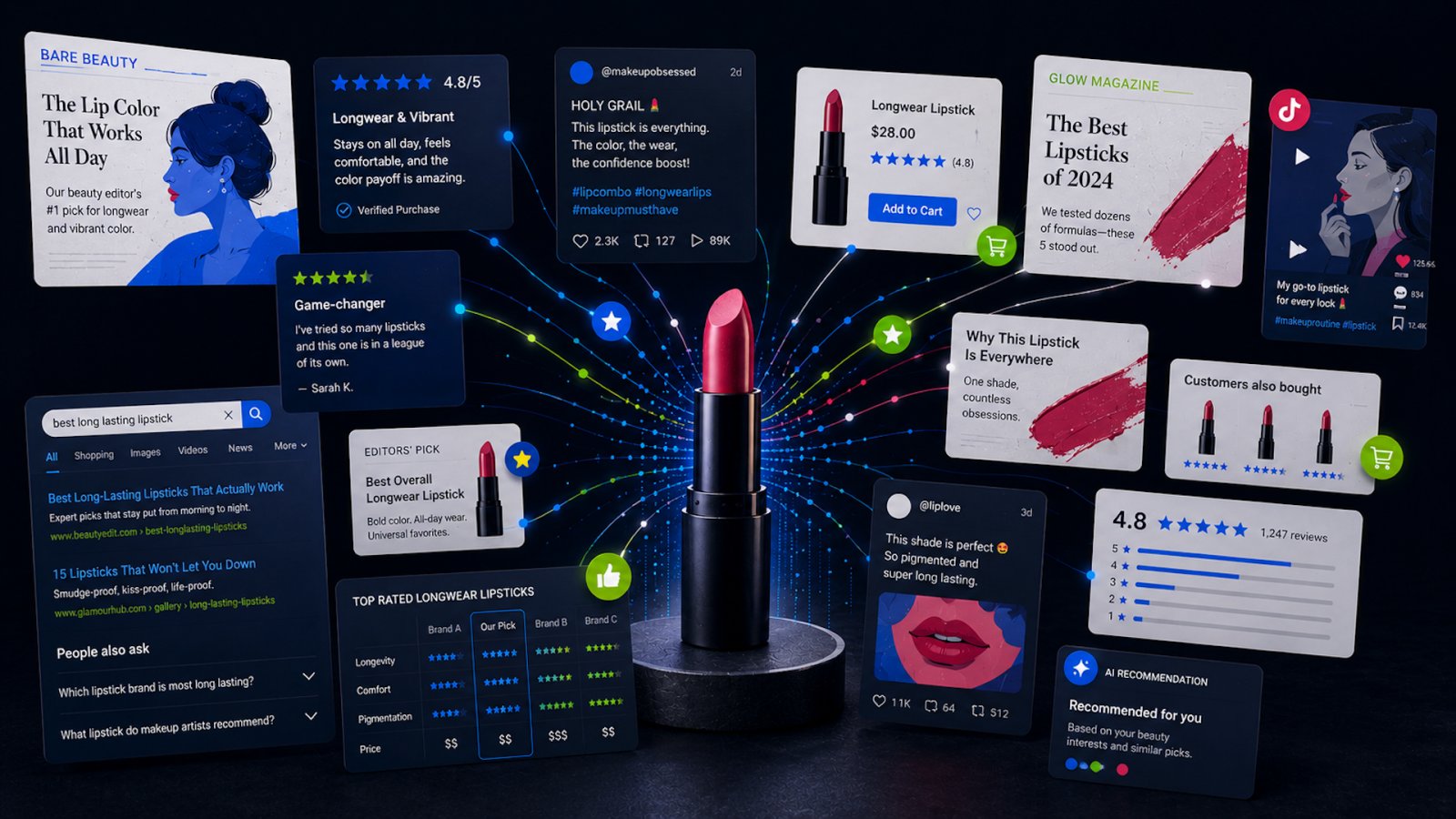
Getting cited in AI answers is becoming a common visibility metric. But citations alone don’t explain why certain brands consistently appear in ChatGPT, Google AI Mode, Perplexity, and other AI search systems.
Citations reflect visibility outcomes, not the underlying systems that produce them. AI platforms prioritize brands with strong semantic presence across training data, reviews, media coverage, search systems, and interconnected web entities.
That’s why GEO is really two visibility challenges happening at once: building long-term brand weight inside AI systems while also creating content that survives modern retrieval pipelines.
AI recommendations are shaped during both retrieval and synthesis. Brand depth is what increases your odds in both systems.
GEO means playing two games at once
Each layer influences visibility differently.
Game 1: Parametric weight
Brands act as coordinates in an LLM’s embedding space, defined by the density and consistency of signals in training data.
This parametric weight is built slowly over months and years through consistent presence across the web. If messaging is inconsistent, the brand’s vector becomes fuzzy, reducing recall and confidence.

A brand with little parametric weight is functional, forgettable, and interchangeable. You can’t easily alter what a model has already internalized during training, so most efforts are directed toward future training cycles.
Focusing exclusively on citations for months means neglecting the structural foundation that eventually makes those citations unavoidable.
Your customers search everywhere. Make sure your brand shows up.
The SEO toolkit you know, plus the AI visibility data you need.
Start Free Trial
Get started with

Game 2: Retrieval survival
When a system like Google AI Mode or ChatGPT Search fires its retrieval pipeline, does your content make it through?
About 85% of brand mentions in AI search come from external domains, not the brand’s own site. Every major AI search system starts with retrieval, but each handles it differently:
- Perplexity retrieves, ranks, and embeds citations into the context window before the LLM generates a single token. The model synthesizes answers from retrieved evidence rather than directly from training data.
- Google AI Mode decomposes a single query into 8-12 parallel subqueries across the live web, Google’s Knowledge Graph, and specialized data sources before synthesizing a response. Google calls this query fan-out.
- ChatGPT search expands a query into five or six semantic variations, retrieves 35 to 42 candidate URLs, disqualifies 83% before extraction, and synthesizes three to five citations in the final response. Retrieval is typically skipped only for nonfactual prompts, such as creative writing or basic math.
In fan-out systems, you compete across 8-12 parallel subqueries simultaneously.
Citations are receipts
Only 6% to 27% of frequently mentioned brands are also top-cited sources. Models can know a brand without citing it.
Citation frequency tracks output presence, not the retrieval and synthesis decisions that surfaced the brand in the first place. Optimizing for citations focuses on the receipt rather than the underlying driver.
Brand depth, built through density, consistency, and cross-source coverage, is what makes a brand the statistically low-risk answer before a citation is ever generated.
Brand depth: How human brains and LLMs default to the familiar
The human brain operates similarly to LLMs. We manage a massive volume of daily decisions by relying on mental frameworks and heuristics that have been built over time.
This idea is rooted in predictive processing theory, which describes the brain as a forecasting engine that uses past information to minimize errors.
LLMs and human cognition handle ambiguity in similar ways: Both prioritize information that is most densely established within their respective systems.
| Brand element | Human brain | LLM |
| Memory and recall | Episodic and emotional, triggered by sensory cues. | Statistical frequency and co-occurrence density in training data. High frequency increases recall. |
| Brand identity | Sensory and visual: logo, typography, and packaging. | Semantic proximity: adjectives, reviews, and articles associated with the brand name. A coordinate in embedding space. |
| Building trust | Social proof, word-of-mouth, and personal trial. | Parametric authority: training data weighted toward high-authority sources. |
| Handling mistakes | Forgiveness through empathy. An apology can repair the relationship. | Data permanence: models consolidate patterns, not intent. Negative signal floods persist until newer data outweighs them. |
| The recommendation | Impulsive and bias-driven: scarcity, FOMO, and halo effect. | Synthesis-weighted: shaped by what’s most densely represented in parametric memory and retrieved sources simultaneously. |
Getting technical about branding with brand depth
AI models and Google’s Knowledge Graph learn from many of the same trusted websites. AI models learn by identifying which words frequently appear together, while Google uses that same information to build a network of connected facts.
Google’s systems specifically evaluate entity salience, entity coherence, and inter-entity relationship density.
Entity salience
How prominent and distinct your brand is within a specific topic cluster. Entity salience influences citation probability.
- Google asks: How prominent is this brand within a topic cluster?
- LLMs ask a similar question at inference time: Which entities have enough statistical weight to surface when a topic is queried?
Low salience means you’re retrievable only through exact branded queries. High salience means you appear when the topic comes up, not just when your name is searched.
Google evaluates salience through systems like RepositoryWebrefLatentEntities, which maps the latent entities a brand co-occurs with, and RepositoryWebrefKGCollection.
Entity coherence
The consistency of your brand’s identity across all retrieved contexts.
Inconsistent naming, conflicting positioning, and contradictory dates signal that an entity is unreliable. LLMs trained on that same corpus learn a fragmented, low-confidence representation.
The model fills gaps created by entity incoherence, leading to brand drift, where the model’s version of your brand slowly diverges from reality because the training signal was never stable enough to anchor it.
Inter-entity relationship density
The strength and number of connections between your brand and other authoritative entities, including products, concepts, and proofs.
Inter-entity relationship density influences associative retrieval paths.
In agentic systems like Deep Research, AI Mode, and Perplexity Pro, each reasoning step is a retrieval event. Relationship density determines whether your brand survives hop two and hop three.
A brand that only exists at the center of its own graph disappears the moment the query moves one step sideways. GlobalLinkInfo and LatentEntity in Google’s Content Warehouse map these inter-entity edges.
The RAG layer is where site quality becomes a gate
Mark Williams-Cook documented a site quality score in December 2024. The score uses a 0-to-1 scale, and sites scoring below roughly 0.4 are not retrieved as candidates, regardless of optimization efforts.
That matters because retrieval eligibility influences which entities and sources repeatedly enter AI systems in the first place. Brand integrity becomes an infrastructure problem. You can’t optimize your way into LLM citations if you haven’t first built the entity coherence and relationship density that make your brand consistently retrievable.
Get the newsletter search marketers rely on.
Why AI systems repeatedly surface Black Honey

The more co-occurrences you have, the higher your mutual information score, and the more often you appear in answers.
Clinique’s Black Honey lipstick is a good example of how this works in practice because of its strong entity depth:
- Concept: Co-occurs with “universally flattering” and “my lips but better” (MLBB) value propositions.
- Trend: Co-occurs with “TikTok virality,” driven by high velocity in 2021.
- Competitors and dupes: Co-occurs with “e.l.f. Black Cherry dupe,” reinforcing benchmark status.
- Proof: Co-occurs with “Liv Tyler” and “Arwen,” creating a cultural anchor.
- History: Co-occurs with “1971,” reinforcing longevity.
Because of this density, AI systems repeatedly surface Black Honey when answering questions about universally flattering lipstick.
- High recall: AI models are more likely to recall and mention Clinique Black Honey across a wide range of relevant queries, including “best universally flattering lipsticks,” “viral makeup trends,” and “iconic ’90s beauty.”
- High authority: The depth of co-occurrence, including historical evidence, cultural context, and product variants, provides AI models with sufficient information to generate detailed, authoritative, and multifaceted answers.
Building for retrieval, recall, and recommendation
Preference is what survives. Build for the layer that determines synthesis weight and for what happens inside the retrieval funnel.
When your brand is specific, consistent, and densely connected across topical clusters, it becomes easier for AI systems to retrieve, synthesize, and recommend.
Focus on what survives the retrieval funnel
Specific, data-rich, hard-to-reproduce content gets retrieved and cited. Academic literature refers to this as adaptive retrieval.
Generic, predictable content gets skipped because the model can generate it on its own.
| Low entropy gets ignored | High entropy gets cited |
| “Our coffee is smooth and delicious.” | “The Gesha variety from Hacienda La Esmeralda in Boquete, Panama. Grown at 1,700 meters. Water at 94 C. Brew ratio 1:16.” |
The second version anchors named entities, including a variety, an organization, a location, and quantitative values. These are details the model can’t plausibly generate without a source.
Actionable tip: Add high-density assets, including company history, team bios, and ISO certifications, designed to serve as grounding data for retrieval-augmented generation (RAG) systems.
Build AI navigation maps
Your website functions like a knowledge graph. AI systems use internal links to build a semantic map of your domain.
Embed links that define logical relationships between entities and create clear paths for crawlers to follow. Structure links around the user’s decision journey, which often mirrors AI retrieval paths:
- Topic → Subtopic (broad context)
- Subtopic → Product (specific solution)
- Product → Review (social proof)
- Review → Return policy (trust signal)
- Return policy → Organization (entity credibility)
Avoid orphan pages
Pages with no meaningful incoming anchors are likely demoted in processing. They don’t accumulate siteAuthority or NavBoost signals.
The fix is to give these pages strategic internal links that connect them to the graph, or delete them. If a page isn’t worth linking to, is it worth human or bot attention?
See the complete picture of your search visibility.
Track, optimize, and win in Google and AI search from one platform.
Start Free Trial
Get started with
Visibility starts before the citation
Citation frequency studies are symptom trackers, not diagnostic tools. They can tell you that certain brands appear more often. They can’t reliably explain whether that visibility comes from training data, RAG retrieval, entity salience, or category dominance.
Build the thing that causes citations, not the thing that imitates them.
Contributing authors are invited to create content for Search Engine Land and are chosen for their expertise and contribution to the search community. Our contributors work under the oversight of the editorial staff and contributions are checked for quality and relevance to our readers. Search Engine Land is owned by Semrush. Contributor was not asked to make any direct or indirect mentions of Semrush. The opinions they express are their own.