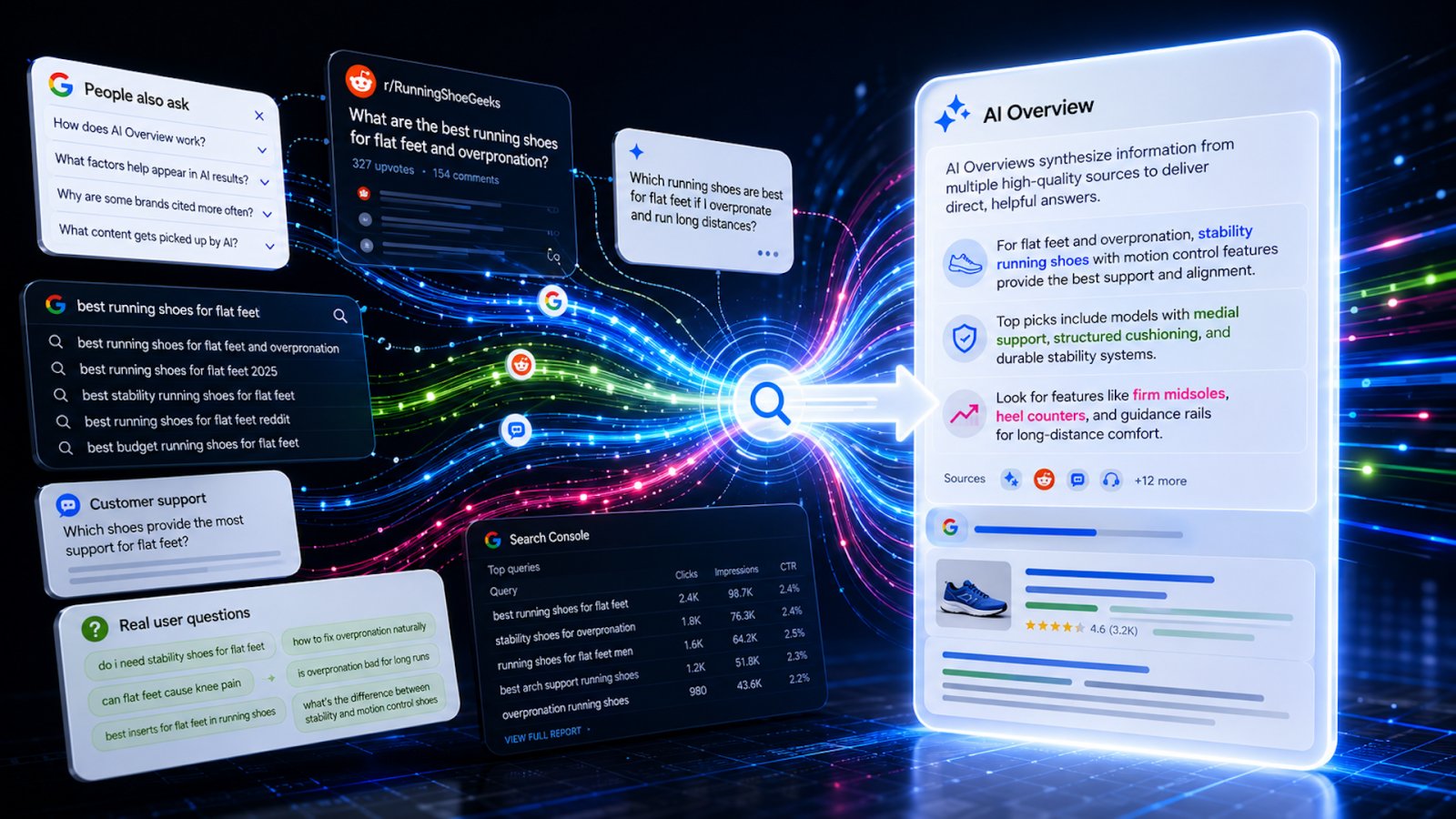
Frequently asked questions (FAQs) used to sit quietly on support pages and product hubs. Now they influence visibility across AI Overviews, People Also Ask results, and AI search engines that prioritize direct answers to user questions.
More than 80% of AI Overview queries are informational, and 82% have average monthly search volumes under 1,000, Semrush research found. That means longer-tail, lower-volume queries are increasingly driving AI visibility opportunities.
As search behavior becomes more conversational, the quality of your FAQ strategy increasingly depends on the quality of the questions behind it.
The problem is that many brands still rely on the same limited sources for FAQ ideation, even as search behavior evolves. The strongest FAQ opportunities often come from the places where customers are already asking questions naturally — across search, support channels, communities, and AI platforms.
Here are five sources to help you find and prioritize better FAQ content opportunities.
1. Google Search Console data
To some people, this may seem obvious. But it’s also easily overlooked.
Before you begin ideating new FAQ content, audit what’s already gaining traction. Google Search Console (GSC) is the perfect place to do that. It’s an underutilized FAQ research tool because many SEOs filter for their highest-impression or highest-clicked queries, not their highest-intent ones.

To zero in on intent queries, start by filtering your query data for question-based search patterns using this regex:
^(who|what|where|when|why|how|which|whose|whom|is|are|was|were|do|does|did|can|could|will|would|should|has|have|had)\b
Then, cross-reference average position against CTR. For queries ranking from the middle of page one through the bottom of page two with low CTR, you’ve likely found a candidate for dedicated FAQ content.
If you rank too low, you may not be relevant enough. If you already rank highly, you probably don’t want to disrupt what’s working. Positions 4-20 can be a sweet spot, although it’s always worth looking outside that range just in case.

To expand from there, use this regex to filter for long-tail queries with eight or more words:
^(\S+\s+){8,}\S+$
If eight-plus-word queries don’t produce enough results, try lowering the threshold to five to seven words. This can be another GSC gold mine for uncovering FAQ opportunities from existing traffic.
It can also turn up a ton of great queries worth tracking in your AI visibility software.
Dig deeper: How to use Google Search Console to unlock easy SEO wins
Your customers search everywhere. Make sure your brand shows up.
The SEO toolkit you know, plus the AI visibility data you need.
Start Free Trial
Get started with

2. People Also Ask data
The People Also Ask SERP feature is a valuable signal for understanding how your audience’s questions relate, cluster, and evolve. It’s also one of the few publicly available windows into Google’s understanding of search intent relationships.

Some PAA questions may warrant an entire page, depending on the topic and the value you can provide by going deeper. But they’re also a strong way to identify related FAQs that can strengthen pages you already have.
Tools like AnswerThePublic and AlsoAsked surface these branching question trees at scale, helping you map how topics are explored across search behavior.

There’s still value in doing manual SERP research, too. Search your target topics on Google and expand PAA results across five to 10 priority terms. Look for recurring questions that are relevant to your customers.
Those recurring questions are high-signal candidates that reflect broad informational intent. They’re also more likely to earn AI citations because they represent genuine, repeated user demand.
Exploding Topics doesn’t specifically surface PAA queries, but it’s another valuable research tool for spotting topics that are gaining search interest before they peak. That gives you an opportunity to build FAQ content ahead of demand, anticipating the questions your audience may soon start asking more frequently.

3. Customer-facing teams and internal data
The richest source of FAQ ideation is your own data.
Your customer service team fields real questions from real people every single day. Those questions reveal genuine confusion, hesitation, what gets people excited, what pushes them toward conversion, and the specific language your audience uses.
That matters even more now because AI language models are trained to understand natural, conversational language. Yet somehow, this is one of the data sources we rarely receive when working with agency clients.

Getting this kind of direct customer insight isn’t difficult. It can be as simple as creating a communication channel between teams using tools you already have:
- Build a Google Doc where customer service teams can drop in questions.
- Create a Slack or Teams channel dedicated to customer questions and concerns.
- Periodically ask customer service teams for the top or newest questions they’ve received.
- If calls are recorded, and your company’s AI policy allows it, use AI to analyze those calls and surface recurring themes and questions.
Internal site search data is also valuable and similarly underused. If your site has a search function, the queries people type into it are direct signals of intent that weren’t fully satisfied by your existing content, either because the information was difficult to find or didn’t exist.
Pull your site search queries monthly and filter for question-based phrasing or longer queries. These are especially useful for FAQ content on product, service, and support pages where questions tend to be highly specific.
Together, these internal sources can produce FAQ content that performs well at the bottom of the funnel, where specificity and accuracy can significantly impact search visibility, user experience, and conversions.
Dig deeper: How to use first-party data to find high-impact content ideas
Get the newsletter search marketers rely on.
4. Reddit
Unlike keyword tools that aggregate search behavior, Reddit shows you exactly how people phrase their questions, feedback, and opinions.

To start your research, search topics related to your products or services on RedditAnswers or Google to identify the subreddits where your audience gathers. Then search within those communities using your target keywords.

Sort results by Best, Top, and New, and pay close attention to the questions people ask in those threads. You’ll likely uncover topics relevant to your audience that you can incorporate into your content strategy.
Reddit threads are also valuable because they often surface follow-up questions after an initial answer. Those discussions reveal the “OK, but what about …” layer of audience curiosity that PAA data and keyword tools often miss.
Building FAQ content that addresses those secondary questions can improve topical depth and strengthen the topical authority signals that AI models tend to favor.
Dig deeper: A smarter Reddit strategy for organic and AI search visibility
5. AI prompt volumes
One of the newest signals for understanding what questions your audience is asking comes from prompt volume data within AI platforms themselves.

The datasets are still imperfect, much like traditional search data. But AI visibility tools like Writesonic and Profound do surface aggregated data on the prompts users enter into AI tools. That gives you insight into questions people may be asking before they turn to traditional search.
Because AI searches tend to be longer, more conversational, and more specific than traditional Google searches, prompt volume data can uncover FAQ opportunities that keyword research tools may miss.
See the complete picture of your search visibility.
Track, optimize, and win in Google and AI search from one platform.
Start Free Trial
Get started with
FAQs are an ongoing process
It’s important to remember that FAQ creation isn’t a one-time activity. The questions your audience asks will continue to evolve as your products change, competitors evolve, and the search environment shifts.
For example, a company that sells phone cases will need updated FAQs each time Apple announces a new iPhone. A SaaS brand will need to revisit FAQ content with every product update. A tax software brand has clear triggers for new FAQ content, such as new tax laws or updated forms. A plumber, by contrast, operates in a more established field and may not need to update FAQ content as frequently.
Find a cadence that makes sense for your business, and revisit your research and content regularly. The brands winning search visibility aren’t the ones that created strategic FAQ content once. They’re the ones that keep showing up with the right answers as customer questions evolve.
Contributing authors are invited to create content for Search Engine Land and are chosen for their expertise and contribution to the search community. Our contributors work under the oversight of the editorial staff and contributions are checked for quality and relevance to our readers. Search Engine Land is owned by Semrush. Contributor was not asked to make any direct or indirect mentions of Semrush. The opinions they express are their own.