On April 17, 2026, Anthropic launched Claude Designa new product that could well shake up Figma, Canva and Adobe. The idea: you describe what you want in natural language, Claude Opus 4.7 generates the designand in one click, you can transform your model into a functional application via Claude Code. In short, a bridge between creation and code, without ever changing tools.
Concretely, what does that look like? Who can use it? How much does it cost? And above all, is it worth letting go of Figma, v0 or Canva? I analyzed in detail this new brick of the Claude ecosystem to give you a clear opinion.
What is Claude Design?
Claude Design is a AI-driven visual creation tooldeveloped by Anthropic Labs (the R&D branch of Anthropic which launches experiments before integration into main products). Launched in research preview April 17, 2026it is part of a broader Anthropic strategy: transforming Claude into a real production platformfrom the idea to putting it online.
Where Claude Code supports devs in code generation, Claude Design targets the entire aspect visual creation : interfaces, brand identities, marketing materials, presentations, interactive prototypes. All in a conversational interface driven by Claude Opus 4.7Anthropic's most successful model in vision and creativity.
The real strength of the product is the integration with the rest of the ecosystem: you can go from design to code in one click via Claude Code, export to Canva for finalization, or automatically apply your graphic charter to all your projects.
The functionalities of Claude Design
Claude Design does not just generate visuals: it offers a complete workflow, from the first prompt to delivery.
High Fidelity Initial Generation
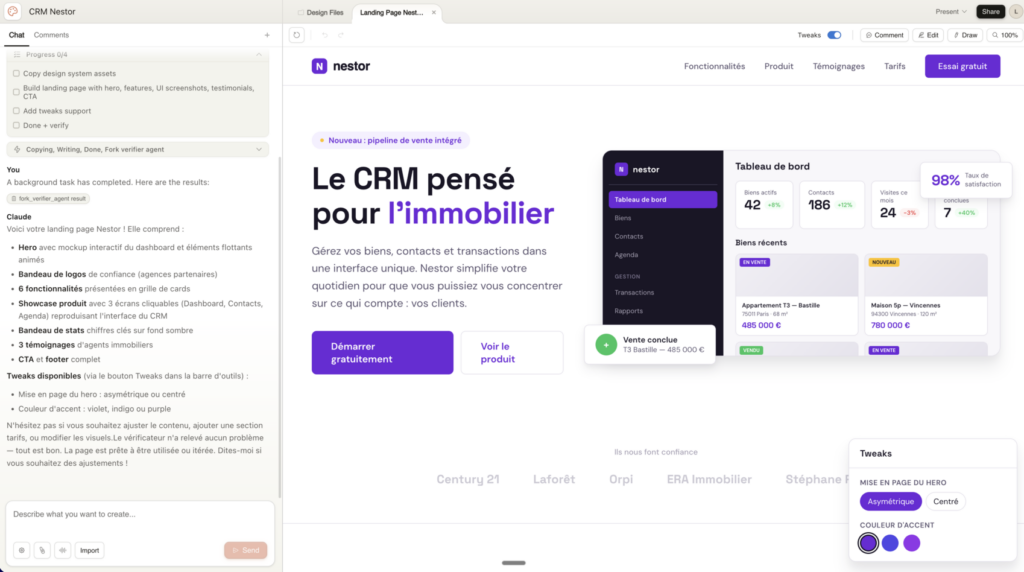
You describe what you want in text — “a landing page for a meditation app, Apple style, calm, with a registration button at the top” — and Claude Design generates a first high fidelity version in seconds. Not a basic wireframe, but a finished design ready to be refined.
Conversational refinement
Once the first version is generated, yourefine by discussing with Claude : “Change the main color to sage green”, “Move the form to the bottom”, “Replace the hero image with something more minimalist”. You can also use targeted comments on specific areas or custom cursors to adjust density, colors, typographies.
Direct gateway to Claude Code
This is the functionality that changes everything: one clickyou send your design to Claude Code which transforms it into a functional application (React, Next.js, Tailwind, etc.). No more ping-pong between designers and developers: the model is already code-ready.
Automated design system
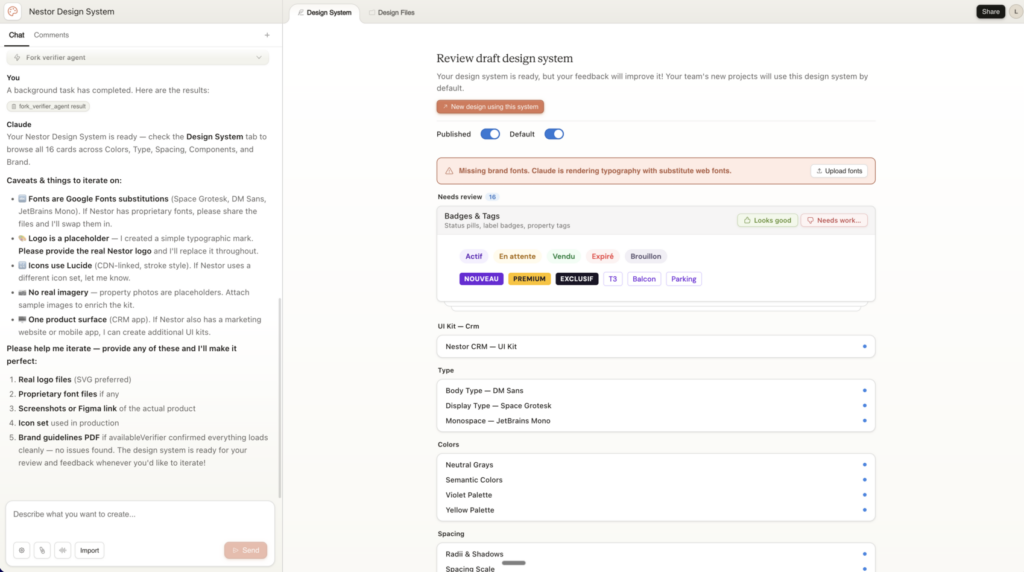
Upload your graphic charter (logo, colors, typography, components) and Claude Design automatically applies it to all your future projects. Result: perfect visual consistency, without configuration effort.
Interactive prototypes without code
Beyond static visuals, Claude Design allows you to create clickable mockups with interactions, video, voice, and even 3D elements. Ideal for customer presentations or validating a user journey before developing.
Multi-format export
The designs can be retrieved in PDF, PPTX or HTML. A partnership with Canva also allows you to send your creations directly to Canva for finalization and publication.
What types of projects with Claude Design?
The tool covers a very wide range of use cases:
- User interfaces : SaaS dashboards, mobile applications, landing pages
- Visual identity : logos, graphic charters, artistic directions
- Marketing materials : banners, newsletters, social media posts, landing pages
- Presentations : pitch decks, one-pagers, reports
- Prototypes : clickable models, animated user journeys
In other words, just about anything an SME, startup or freelancer could need to create visually.
Who is Claude Design for?
The positioning is clear: Claude Design is not a tool reserved for professional designers. It aims several profiles at the same timewhich explains its disruptive potential.
Professional designers
To quickly explore multiple creative directions, generate variations, refine via dialogue. AI does not replace their critical eye, but it increases their iteration speed.
Product managers and product managers
For outline user journeys without waiting for a designer to be available. Particularly useful in the discovery phase or to validate a hypothesis before moving on to the final design phase.
The founders and salespeople
To quickly create pitch deckscustomer support, one-pagers — without having to master Figma or Canva thoroughly. This is probably the profile where Claude Design can save the most time.
Marketers
To produce large-scale campaign assets : banners, emails, social media, landing pages. With the automatic application of the graphic charter, the industrialization of creation becomes trivial.
How much does Claude Design cost?
Good news: Claude Design is included in existing Claude subscriptions. No additional price expected.
Concretely, research preview access is reserved for subscribers:
- Claude Pro (23 €/month)
- Claude Max (103 €/month)
- Claude Team (team rates)
- Claude Enterprise (on quote)
The deployment is gradual: all Pro and Max users will have access over the coming weeks. Please note: Claude Free does not yet have access to the product, which forces the curious to switch to Pro to test.
The strengths of Claude Design
After a few days of use, this is what clearly stands out:
- The quality of generations — Claude Opus 4.7 produces surprisingly successful designs from the first prompt
- Claude Code integration — the bridge to code actually works, it's not a gimmick
- Conversational refinement — modifying a design while discussing is a real break in experience compared to traditional tools
- The automated design system — a huge time saving for marketing teams
- No additional cost — included in your Claude subscription, it’s almost impossible to beat
- The Canva partnership — makes adoption easier for existing Canva users
Current limits
Claude Design is still in research preview — which can be seen on several levels:
- Gradual deployment — not all Claude Pro subscribers have access yet, it may take a few weeks
- No Free access — you must be a subscriber to test
- Less mature ecosystem than Figma on the real-time collaboration side
- Perfectible PPTX export on complex presentations
- Learning curve on the most advanced workflows (complex design systems, conditional components)
These are normal limits for a product that has just been released – and which will probably disappear very quickly, given the pace of Anthropic's development.
My opinion on Claude Design
Claude Design is not just an “AI clone of Figma”. It's a new way of approaching visual creation : conversational, integrated into the code, designed for non-designer profiles as well as for professionals. For entrepreneurs, founders, marketers and product managers, it is probably the most relevant tool launched in 2026 so far.
Will this kill Figma? No, not immediately — Figma remains essential for professional design teams with complex collaboration. But Claude Design will probably reduce the need from Figma for everything that involves rapid exploration, models, marketing materials and validation prototypes. And for a founder who wants to pitch his next MVP? Claude Design + Claude Code allows you to go from an idea to a functional app in a few hours.
My advice: if you are already a Claude Pro or Max subscriber, enable access as soon as it is available and test on a real project. If you are hesitant to subscribe, Claude Design is an additional argument in favor of Pro — at €23/month, you get a premium AI chat + a design tool + Claude Code. Difficult to do better in value/price ratio.