
Do you have a site or blog that’s attracting traffic, and you’re wondering how to turn it into revenue? THE advertising agencies are the simplest answer. Their principle: they create the link between advertisers who want to broadcast advertisements and you, the publisher, who sell your spaces. You place a few locations on your pages, the agency fills them with targeted ads, and you receive a share of the revenue generated.
But not all agencies are equal. Some are open to all, others reserved for large sites. Some optimize your income to the extreme, others focus on simplicity. Between display, native advertising and AI optimization platforms, it’s difficult to navigate.
I compared the best solutions on the market to offer you this top 10 advertising agencies in 2026. For each one, I give you the positioning, the minimum traffic required, the remuneration model and the site profile to which it is suitable. Whether you’re just starting out or looking to take the next step, you’ll find the network that suits your audience. Here we go!
Google AdSense remains the essential starting point for monetization. It is the most accessible network on the market: no official traffic threshold, integration in just a few minutes on almost all CMS, and the payment reliability of Google. You get started effortlessly and you quickly understand the advertising mechanics. Its limits appear as soon as your audience grows: lower RPMs than premium agencies, no native multi-source header bidding and fairly rigid formats. Many publishers start here before migrating to a more profitable solution.
Minimum traffic: no official threshold. Remuneration: approximately 68% of display revenue, at CPC and CPM.
Ezoic goes much further than a simple management: it is an optimization platform. Its artificial intelligence continuously tests ad placements, formats and sizes to maximize your RPM, without manual intervention on your part. It supports header bidding and puts many buyers in competition, which often drives revenue well beyond AdSense. In return, Ezoic now requires significant traffic and somewhat technical configuration at the start. This is an excellent intermediate step for sites that are gaining momentum.
Minimum traffic: approximately 250,000 active visitors per month. Remuneration: publisher share which can approach or exceed 70%.
Mediavine is THE benchmark premium network for content blogs: cooking, lifestyle, travel, parenting. It replaced its old threshold of 50,000 sessions with a revenue requirement. Its big advantage is the transparency of its scale and the strategic support that goes with it. For sites created from 2026, the publisher share starts at 75% and increases up to 90% depending on your income, across the Official, Select, Signature and Premiere tiers. In return, expect a fairly high advertising density. If your traffic is strong, Mediavine often boosts your revenue.
Minimum traffic: at least $5,000 in annual advertising revenue. Remuneration: from 75% to 90% for the publisher.
Raptiveborn from the merger ofAdThrive and CafeMedia, is Mediavine’s great rival in the premium niche. This managed agency targets established creators and publishers, with comprehensive support: data science, partnerships with brands, advertising engineering. Its entry threshold is lower than that of most premium networks, provided that your audience comes mainly from five English-speaking countries: United States, Canada, United Kingdom, Australia and New Zealand. If this is your case, Raptive is among the highest paying options on the market.
Minimum traffic: 25,000 page views per month, mainly English-speaking audience. Remuneration: around 75% for the publisher, increasing with traffic.
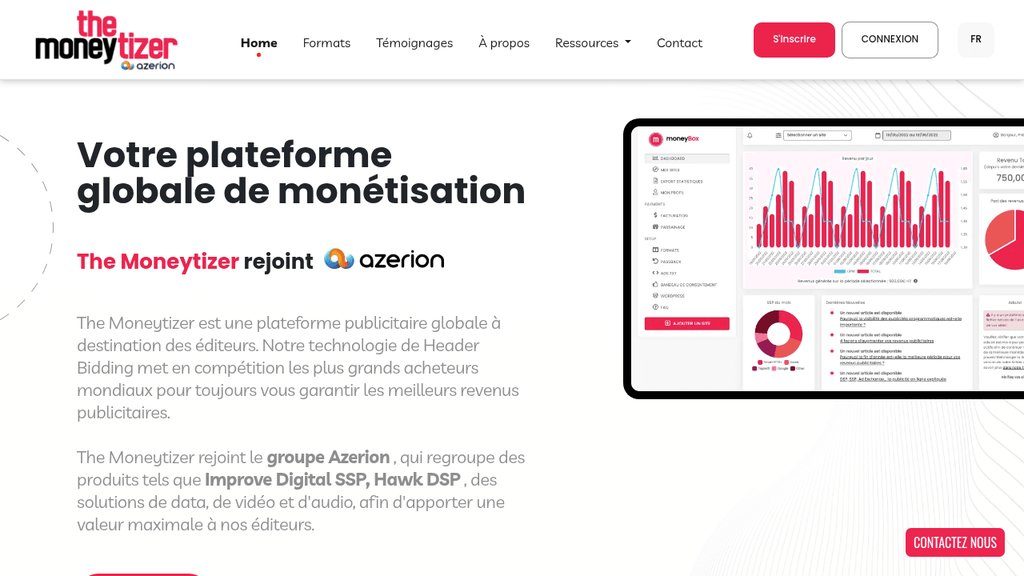
The Moneytizer is a premium network of French origin, which makes it a natural choice for French-speaking publishers. It aggregates the demand of numerous partners to increase your CPM, with real brand-safety filtering. The entry fee is high and the high-value audience (US, UK, Canada) is privileged. The platform also requires its own domain name: Wix, Blogspot or Jimdo subdomains are refused, because you must be able to manage the ads.txt file. The sharing grid is not public, but the quality of the partners is there.
Minimum traffic: around 300,000 organic unique visitors per month. Remuneration: aggregated CPM model, non-public grid.
Monumetric is positioned as a more accessible alternative to Mediavine and Raptive, with a strong human dimension. This managed network is aimed at sites with intermediate traffic and offers several programs depending on your volume, including the Propel offer for smaller publishers. The share paid to the publisher is often around 70% or more, even if the exact scale is not public. A point of caution: Monumetric imposes a minimum ad density, which some readers may find intrusive. A good compromise for a growing site which has not yet reached the thresholds of the giants.
Minimum traffic: accessible from a few tens of thousands of page views (Propel offer). Remuneration: publisher share often around 70% and more.
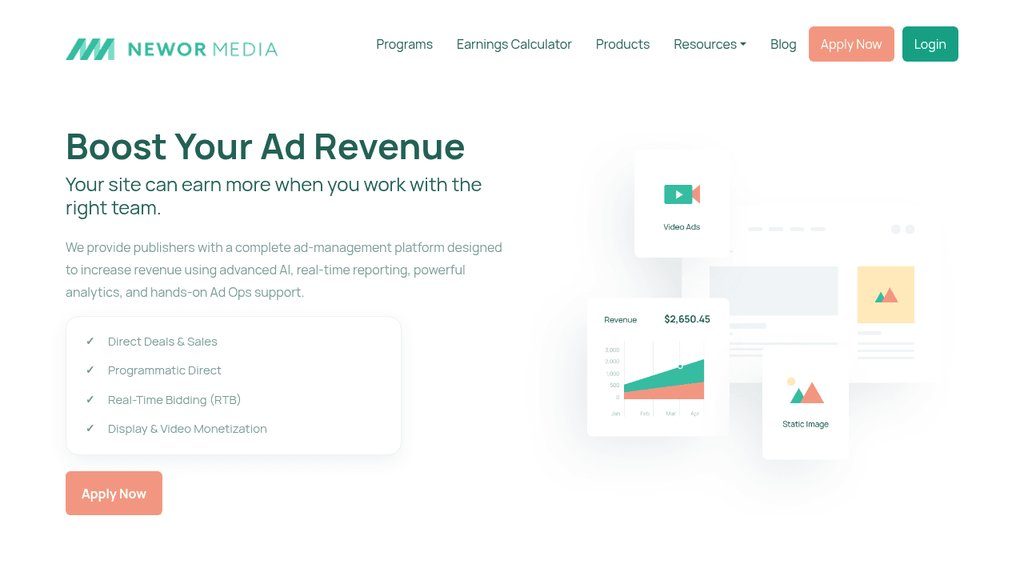
Newor Media is a premium network designed for medium-sized sites that find the thresholds of Raptive or Mediavine too high. It accepts publishers very early, with content in English, and provides access to premium level optimization: header bidding and buyer competition. Its revenue sharing is presented as comparable to that of large agencies. It is an ideal gateway to advanced monetization, without waiting to have very large traffic. Across a large sample of publishers, the average RPM observed is around $10.
Minimum traffic: around 30,000 unique visitors per month. Remuneration: around 75% for publisher, average RPM around $10.
Setupad is a European platform specializing in header bidding. It brings many demand sources into competition to maximize your CPMs, while avoiding you having to build your own technical stack. This is a good option for publishers who want advanced auction mechanisms without excessive complexity, with international demand. Setupad does not publish its precise sharing grid and is instead aimed at sites that already have several tens of thousands of page views per month. A technical and flexible choice, particularly appreciated in Europe.
Minimum traffic: several tens of thousands of page views per month. Remuneration: share of revenue via header bidding, non-public grid.
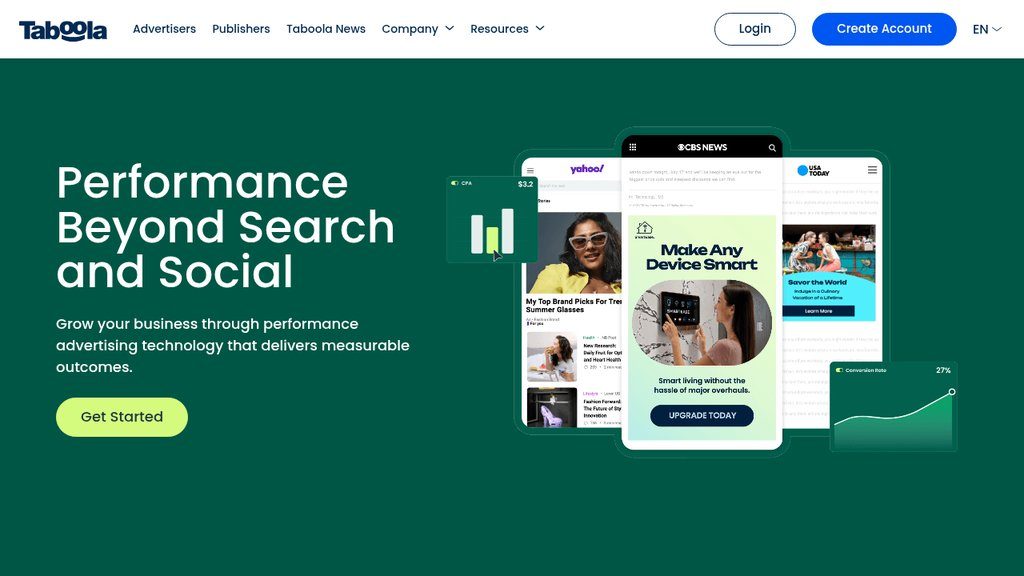
Taboola is the world leader in native advertising, these blocks of recommended content that you come across at the bottom of articles (“You might also like”). The model is per click: you are paid each time a reader clicks on a sponsored recommendation. It is an excellent complement to display to monetize your end-of-page areas, without encroaching on your classic advertisements. Highlight: Taboola bought its competitor Outbrain, making it the ultra-dominant native player. To watch out for quality: certain sponsored content may send a “clickbait” image, to be filtered according to your editorial line.
Minimum traffic: oriented to sites with significant traffic. Remuneration: CPC (pay per click) model.
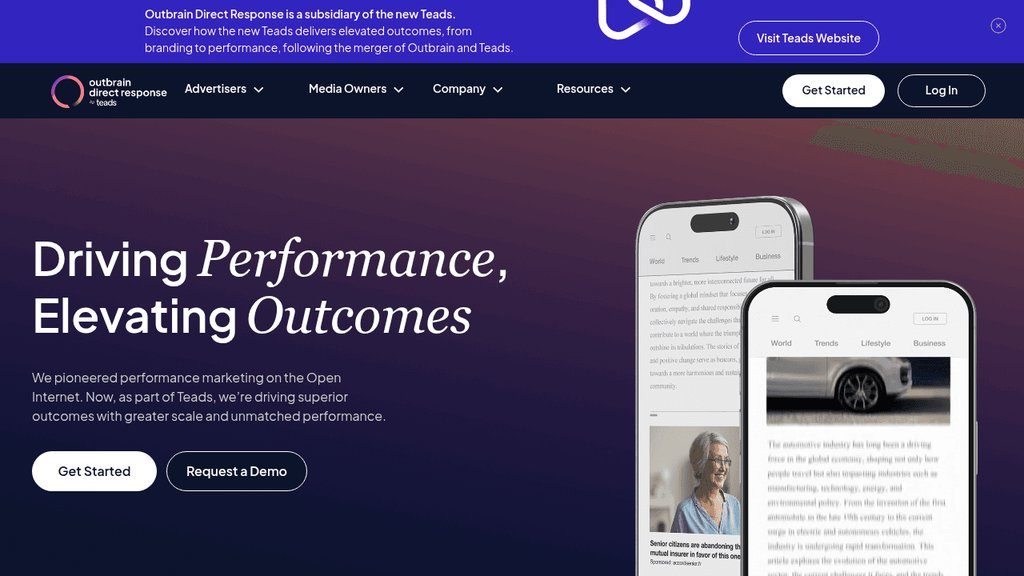
Outbrain is the other big name in native advertising, now part of Taboola after their merger. The principle is identical: blocks of sponsored recommendations inserted into your pages, paid per click. Outbrain historically relies on more discreet placements and a rather premium selection of editors. This is an interesting additional source of income if your traffic is significant, provided you keep an eye on the relevance of the content displayed to preserve your readers’ experience. Between Taboola and Outbrain, the best thing is to test which one integrates most naturally with your site.
Minimum traffic: oriented to sites with significant traffic. Remuneration: CPC (pay per click) model.
How to choose your advertising agency?
All these agencies fill your advertising spaces. However, the right choice depends above all on your situation. Here are the criteria that really matter.
Your traffic volume
This is the first filter. Below a few tens of thousands of visitors per month, AdSense is often your only option, and that’s great to start with. From 25,000 to 30,000 page views, premium agencies like Raptive or Newor Media become accessible and increase your income. The most demanding, like Ezoic or The Moneytizer, target sites with high traffic.
The origin of your audience
A point often overlooked. Advertisers pay much more to reach a North American or British audience. Some premium agencies also require a majority of traffic from these markets. If your audience is mainly French-speaking, check that the network correctly values this traffic, and look at a solution like The Moneytizer.
Revenue share and transparency
The share you keep varies widely, from 68% at AdSense to 90% at Mediavine for the largest publishers. But a high percentage doesn’t tell the whole story. Also look at any costs, the clarity of the grid and especially the RPM actually observed, which counts much more than the displayed rate.
Your readers’ experience
More ads means more revenue in the short term, but at the cost of a degraded experience and the risk of driving away your readers. The best management companies find balance. Be wary of ad densities imposed too high and always test the impact on your loading time.
Conclusion
There is no universal advertising network: the right choice depends on your traffic, your audience and your ambitions. My advice: start with Google AdSense to lay the foundations and understand the mechanics, then migrate to a premium solution like Ezoic, Mediavine Or Raptive as soon as your traffic allows it. Add a layer of native advertising with Taboola to diversify your revenue.
Above all, don’t stay frozen. The advertising market evolves quickly, thresholds and sharing grids change regularly. Test, measure your real RPM and don’t hesitate to change management when your site reaches a milestone. This is often where your biggest revenue increases are hidden.