
The job of administrative and financial director has changed profoundly in just a few years. Where it was previously a question of producing monthly reports and guaranteeing accounting compliance, the CFO is now expected to work on a much more strategic level: the allocation of capital, the optimization of working capital requirements, the operational performance of the company.
This development is accompanied by a simple but radical requirement: making decisions faster, based on more reliable data. And this is precisely where the expense management software come into play. By centralizing the flow of purchases, invoices and commitments, they offer the CFO an instant reading of the financial health of the company.
But how, in concrete terms, do these tools modify daily strategic arbitration? This is what we will detail in this article.
The end of blind management for financial departments
For a long time, financial departments operated according to a rhythm imposed by the accounting calendar: monthly closings, restatements, consolidation, then production of dashboards. Between the expense incurred and the usable data, several weeks could pass.
This latency had a very real cost: difficulty detecting budgetary deviations in time, approximate cash flow forecasts, supplier negotiations carried out without complete visibility on the volumes committed. Today, the Source-to-Pay platforms specialized in expense management are radically changing the situation: each purchase request, each order, each invoice is captured in real time and consolidated in a single view. To understand the functional scope covered by this type of solution — supplier management, invoice processing, budget management — you can consult a detailed presentation here.
This informational continuity, from purchase order to payment, removes the blind spots that have weighed on financial management for decades.
From accounting data to decision-making data
Expense management software does more than just facilitate administrative processing. It transforms raw data into usable strategic information. The CFO no longer needs to wait for a report to know where the commitments of a department, a project or a supplier are: the information is continuously available, and broken down according to the relevant areas of analysis.
The break with historical tools
Traditional ERPs remain essential for general accounting, but their logic is retrospective: they record what has happened. Modern expense management solutions are designed for prospective management. They aggregate commitments before they even become invoices, and give the DAF a head start on future flows.
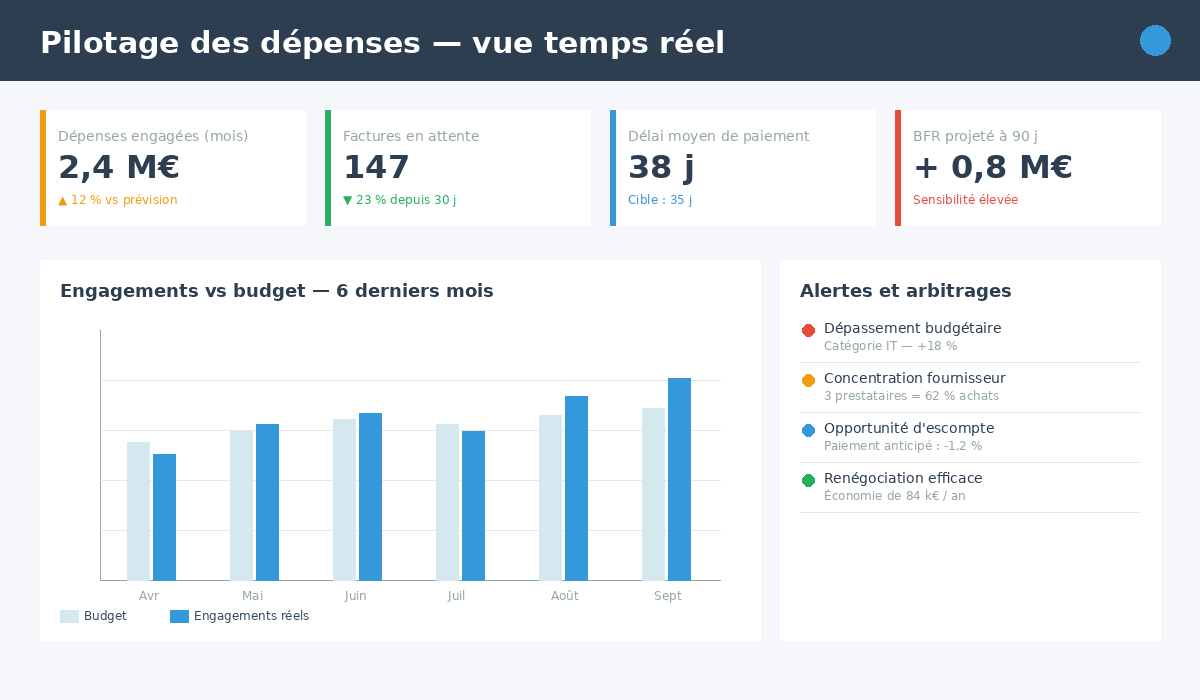
Typical dashboard of expense management software: consolidated KPIs, budget monitoring and real-time alerts.
Instant access to data: a new strategic lever
The most visible contribution of expense management software can be summed up in three words: time, granularity, reliability. Three dimensions which transform the very nature of the decisions taken by the DAF.
Real-time visibility on commitments
Knowing the exact state of expenses incurred at the moment T, by category, by cost center or by supplier, allows you to act before an overrun materializes. Rather than noticing a discrepancy at the end of the month, the CFO can alert, adjust, or even block a commitment before it is validated. Control is preventive rather than corrective.
More reliable financial forecasts
The aggregation of massive and structured data allows modern solutions to offer refined forecasting models. Seasonality of expenses, purchasing behavior of teams, supplier payment deadlines: these variables, previously buried in disparate Excel files, now provide much more reliable cash flow projections. The DAF no longer plays guessing games in the management committee.
Faster and better documented arbitrations
When a management committee asks the CFO to quantify the impact of a 10% reduction in software spending, the response no longer requires a week of work. It is built in a few hours, from consolidated and auditable data. This reactivity changes the place of the CFO in decision-making bodies: he is no longer the one who slows down, but the one who sheds light.
| 💡 Good to know: according to several sector studies (Deloitte, PwC), financial departments having digitalized their purchasing processes spend on average 30 to 40% more time on high value-added activities — analysis, advice, foresight — to the detriment of transactional tasks. |
Concrete cases: how the DAF arbitrates differently
The impact of expense management software is not only measured in time savings. It profoundly modifies the nature of the strategic decisions that the DAF is able to propose.
Optimization of working capital requirements
With a real-time view of commitments and payments, the CFO can actively manage the WCR. Selectively extend certain supplier deadlines, accelerate customer recovery where possible, choose value-added advance payments – for example when a discount largely covers the cost of capital: all micro-tactical decisions which, aggregated, free up cash without resorting to additional debt.
Renegotiation of supplier contracts
Accurate mapping of spend by supplier reveals hidden concentrations. The same service provider can be referenced in several forms in different subsidiaries or departments, masking the actual volume negotiated. Consolidation makes this volume visible and gives the CFO immediate negotiating leverage — or, conversely, highlights excessive dependence that will need to be diversified.
Detection of drifts and anomalies
Anomalies — duplicate invoices, price deviations from the framework contract, repeated overruns on a budget item — are automatically reported by the integrated analysis engines. The CFO is moving from a posture of a posteriori verification to a posture of prevention. On large volumes of invoices, this gain alone can represent several tens of thousands of euros per year.
Comparison table: before / after digitalization
| Dimension | Before the tool | With dedicated software |
|---|---|---|
| Data access delay | Monthly, after closing | Real time |
| Granularity | Aggregated | By commitment, supplier, project |
| Reliability of forecasts | Variable, Excel dependent | High, based on consolidated history |
| Gap detection | A posteriori | Continuous, with automatic alerts |
| Time spent on reporting | 30 to 50% of team time | 10 to 15% |
Beyond control: a transformed strategic role
Today's CFO is no longer just the guardian of financial compliance. He becomes a strategic partner of general management, capable of informing investment choices, purchasing policies or organizational decisions.
Facilitated dialogue with the professions
By making data accessible to all stakeholders – purchasing, accounting, management control, operational – expense management software creates a common language. No more sterile debates on the reliability of the figure in meetings: everyone works on the same basis, updated continuously. The discussion can then focus on substance rather than form.
Increased contribution to business strategy
When the CFO has a comprehensive and instantaneous view of financial flows, it can provide the executive committee with prospective analyses: impact of an acquisition on consolidated cash flow, sensitivity of WCR to a variation in payment terms, cost reduction scenarios by category. These analyzes were once rare and expensive to produce; they become routine.
Towards a more attractive finance function
The digitalization of purchasing and invoice processes also changes the profile of the teams. Repetitive tasks — entry, reconciliation, follow-up — are automated, freeing employees for analysis and business partnering missions. A significant asset for attracting and retaining talent, in a context of marked shortage of experienced financial profiles.
How to integrate expense management software into your information system?
Adopting an expense management platform is not just a technological choice. It involves rethinking certain internal processes, mapping existing flows and aligning the departments concerned.
Define a clear perimeter
A successful deployment begins with prioritization: should we first cover indirect purchases, supplier invoices, or expense reports? Most projects that fail suffer from initial over-ambition. Better to aim for a small scope, prove the value in six months, then gradually expand.
Connect the tool to the ERP
Expense management software does not replaceERPhe completes it. The quality of the integration between the two determines the reliability of the data. Check in advance the compatibility of available connectors with your existing system — SAP, Oracle, Sage, Cegid, etc. — is therefore an essential step in the specifications.
Supporting change
User buy-in remains the key success factor. Training of purchasing and finance teams, support for operational staff who fill out purchase requests, internal communication on expected benefits: these human dimensions are as determining as the technical choices. A perfect but poorly adopted tool produces no value.
Conclusion: data at the service of strategy
The transition from monthly financial management to real-time management is no longer a technological option: it becomes a condition of strategic performance. CFOs who have taken the plunge notice a profound change in posture — less time devoted to ex post control, more capacity to guide the company's decisions.
Choosing the right expense management software means above all choosing a technological partner capable of supporting this transformation over time. This project impacts processes, teams, IS: it deserves to be structured as a real transformation process, not as a simple license purchase.