
One person calls in sick. Everything stops.
Not because the team doesn’t know what to post. Not because the content isn’t ready. Because one person (you, a senior manager, or the client’s marketing director) is the only node in the approval chain, and the chain only moves when they move.
We’ve seen this stop social media agencies cold. Campaigns missed during conference week. Content queues sitting untouched over long weekends. Clients asking why nothing went out while their competitor ran three announcements.
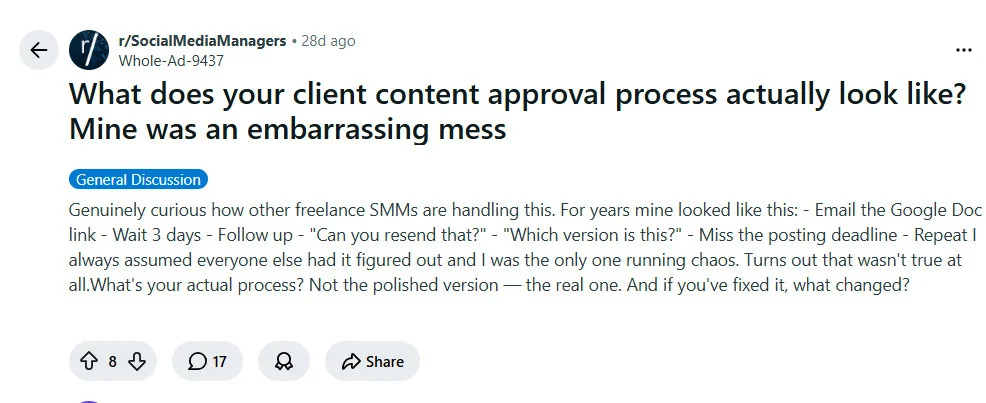
As one social media manager on r/SocialMediaManagers put it:
It’s not a people problem. It’s a design problem. And it’s one every agency runs into, usually when there’s no time to fix it quietly.
When “Quality Control” Becomes the Bottleneck
Single-approver setups don’t start as a bad idea. They start as obvious ones.
The owner approves everything because they know the clients best. The team grows, but the approval habit stays, because it’s worked so far. By the time the agency is managing eight clients, the entire social media workflow still runs through one inbox, and nobody built a backup for it.
On the client side, the same thing. One marketing director owns every approval. Nobody ever asks: what happens when they’re unreachable?
One user on r/freelance described exactly what that waiting looks like:
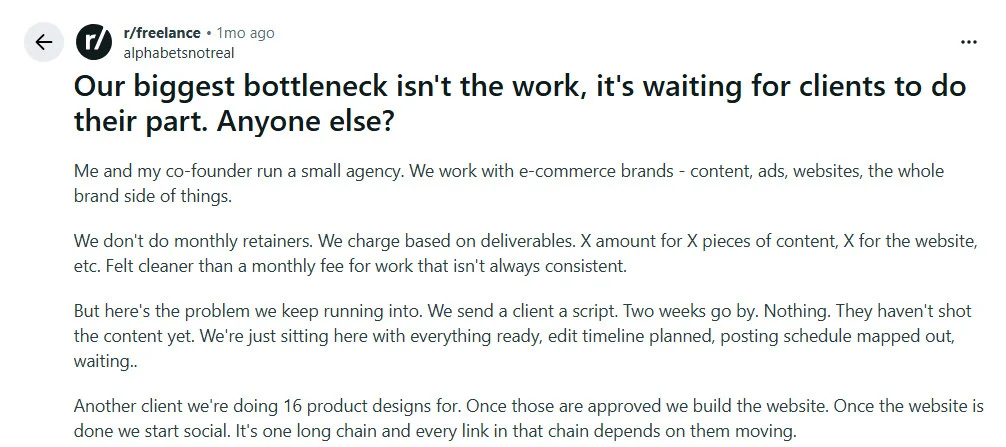
Think about what’s actually frozen here. Not just one script. The edit waiting on it. The schedule built around it. The posts that were supposed to go out. One person goes quiet, and everything downstream stops with them.
92% of marketers say approval delays are the main reason they miss deadlines (Gleanster & Kapost). 47% of B2B marketers call workflow and approval management a significant operational bottleneck (CMI, 2025).
Both numbers trace back to the same root: when approval depends on one person, it fails the moment that person isn’t available.
The fix isn’t a faster follow-up. It’s removing the single point entirely.
What Changes When You Build Approval Differently
The agencies that don’t have content blackouts aren’t better at chasing approvals. They’ve stopped building around one person.
Three things separate those agencies from the ones still stuck:
They’ve named a backup. Not in their head: in writing, in their client agreement, in their tool. Every approval role has a designated backup with the same access and the same context. When the primary is unreachable, the backup doesn’t have to ask for a login.
Their coverage policy is two sentences, not a verbal assumption. Who approves when the primary is out. How long before the backup steps in. 65% of marketers lose more than a day per week chasing feedback (Ziflow, 2023), mostly because nobody knows who’s on point when the usual person disappears.
Their tool matches the policy. We built SocialPilot and its features around this solution. The goal was to make sure no single person is the only way content moves forward.
Posts from Content Schedulers land in a pending review queue. Any Manager or Admin on the account can clear it, with no single person as a hard requirement. Posts stay on schedule in the social media content calendar regardless.
For client approvals, the client gets a shareable approval link. No SocialPilot login needed. Their backup contact uses the same link. When neither responds in time, the Auto-Approve toggle publishes on schedule anyway. This client approval walkthrough shows the full flow inside SocialPilot in under two minutes.
Here’s what that shift looks like against a standard setup:
| Old Setup | With a Backup System |
| One person receives all approval requests | Multiple approvers configured in the tool in advance |
| Team messages the approver and waits | Backup can clear the queue with no handover needed |
| Client’s single contact goes dark, content stops | Client’s backup uses the same shareable approval link |
| Posting gap spotted by the client, not the team | Auto-Approve prevents gaps when no one responds in time |
Is Your Approval Setup One Absence Away From Breaking?
The gap between agencies that lose content and agencies that don’t usually comes down to five things. Check where you stand.
| Question | Yes / No |
| Is there a named backup approver for every client account? | |
| Does your client contract specify who approves when the primary contact is unavailable? | |
| Does your backup approver already have the right tool access? | |
| Is there a defined window before content auto-publishes or escalates? | |
| If you were unreachable for 48 hours, would content still go out on schedule? |
More than two “no” answers means your next content blackout is already scheduled. You just don’t know the date yet.
The Question Worth Asking Before the Next Absence
If your answer to “what happens when the approver is out” is still “we’ll figure it out”: that’s the problem.
You’ve built a content operation where one person’s unavailability is everyone else’s emergency. That’s not sustainable at five clients. It’s untenable at fifteen.
The agencies we work with that have stopped having this conversation made the same call: they named a backup, wrote the policy, configured the tool. None of it took more than an afternoon.
So, the question isn’t whether you have time to name a backup and write a two-sentence policy. It’s what happens to the clients you have while you keep running without one.