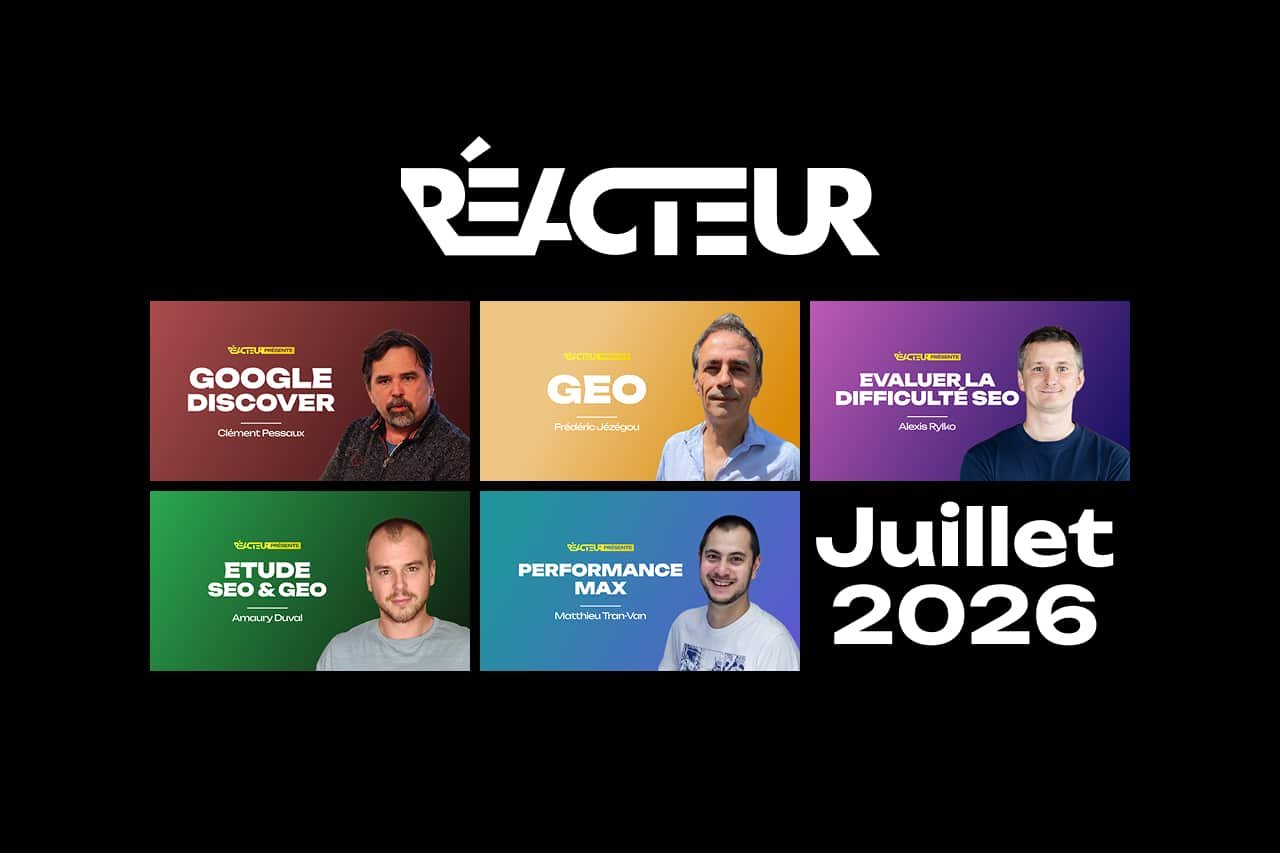
On the program for this edition Reactor from July 2026:
We warmly thank our 5 authors for their responsiveness and especially the quality of the articles published: Matthieu, Amaury, Frédéric, Clément and Alexis!
As a bonus : as usual, this new edition also welcomes our eve of July 2026 and a presentation tools that caught our attention these last few weeks!
And, if this is not yet the case, subscribe !
Performance Max is not smart. He is starving.
By Matthew Tran-VanGoogle Ads expert, ex-Googler, founder of MTV Consulting
HAS To discover in this article:
- A deliberately underperforming Shopping Standard campaign can explode the ROAS of an adjacent Max Performance: the field case that started it all, with the figures to back it up.
- The “Feeder Strategy”: how a low CPC campaign, which never converts, can replenish the audience signal pool that PMax needs to make a good decision.
- Why does this mechanism only work cross-channel, and violently reverses as soon as we try to replicate it intra-channel?
- The three absolute conditions for the strategy to work, and the real obstacle: convincing a CFO or a client to maintain 30 days of degraded ROAS without cutting the budget.
- What this mechanic reveals about the real nature of Google Ads algorithms, and why Google has no interest in saying it so clearly.
💜 What we liked:
An article that goes against ten years of good SEA practices without ever falling into gratuitous provocation. Matthieu Tran-Van documents his demonstration on four different accounts, supporting figures and correlations, and does not hide the limits of his own reasoning (persistence of the effect over time, applicability to very large accounts, generalization effect). We will also appreciate the governance part, often absent from this type of article: how to contractualize the evaluation framework before the launch so that the system survives its first unfavorable reporting. Concrete, a clear doctrine, and a real questioning of what it means to “manage” a Google Ads account in 2026.
👉 Discover the article Matthieu Tran-Van: Performance Max is not smart. He is starving.
A single page for Google, ChatGPT and Claude: the study on 6 engines and the method to cover everything
By Amaury Duvalfounder of SERPmantics
To discover in this article:
- A field study of 600 analyzes (100 queries × 6 engines) which quantifies precisely what Google, Bing, ChatGPT, Claude, Gemini and Perplexity expect in structure, semantics and sources.
- The dividing line that separates two “worlds”: classic engines on one side, a homogeneous block of LLMs on the other, with what that concretely changes for your content strategy.
- A three-step method for making a single page appeal to several engines at the same time, illustrated by a real case where the same content goes from 46% to 77% score on ChatGPT without ever degrading its Google score.
- The proof, with supporting figures, that being well ranked on Google absolutely does not guarantee being cited by a generative AI, and why that changes the situation.
- The five levers from academic research at Princeton to increase the visibility of content in generative responses, up to +40%.
💜 What we liked: A study which does not simply state that “LLMs are different from Google”, but which methodically calculates it, query by query, engine by engine. Amaury Duval documents his approach with rare transparency (methodology, sample size, limits of the exercise assumed at the end of the article) and above all proposes a method that can be implemented immediately: diagnosis of intention, pillar/support architecture, score iteration by engine. The part on automation via MCP is a real plus for anyone managing a large volume of pages. Concrete, figures, and a clear response to a very shared anxiety in the profession: no, it does not have to triple its content to exist everywhere.
👉 Discover the Matthieu Amaury Duval article: A single page for Google, ChatGPT and Claude: the study on 6 engines and the method to cover everything
Well ranked on Google, invisible in AI
By Frédéric JézégouSEO & GEO Consultant
To discover in this article:
- Why the 0.3% of traffic sent by AI hides the essential: the ratio of pages crawled per visit returned, which gives the true measure of what LLMs have already memorized of your content.
- A precise map of who uses which engine: Claude and Le Chat on Brave, Perplexity on its own crawler, ChatGPT on an in-house index supplemented by scraped Google, each with its own classification rules.
- The three families of robots that are now crawling your site, and why blocking the wrong category can make you invisible without you knowing it.
- Two invisible technical obstacles in robots.txt that block entire sites: JavaScript rendering and certain firewall rules activated with a click.
- A concrete and little-disseminated GEO tip to enter the Brave index, the one that directly feeds Claude and Le Chat de Mistral.
💜 What we liked:
An article of rare density, which is not content with a theoretical discourse on GEO but documents each assertion with sourced figures (crawl/referral ratios, market shares, Mehta court decision, SerpApi episode). Frédéric Jézegou dismantles several preconceived ideas, notably on Cloudflare Bot Fight Mode or on the real usefulness of llms.txt. The part on AI agents and the Web Bot Auth protocol opens a perspective that few SEO articles still address, just like the final reminder: beyond indexes and robots, it is the brand strength which remains the asset that no one can take back in the event of a change in algorithm.
👉 Discover the article by Frédéric Jézégou: Well ranked on Google, invisible in AI
Google Discover: before betting everything on GEO, there is a channel that already exists
By Clement PessauxDiscover & SEO Consultant, founder of The BlackRoom
To discover in this article:
- Why Discover today represents 60 to 80% of major media traffic, and why a drop in classic SEO traffic linked to AI Overviews would ultimately only affect them very marginally.
- What makes Discover fundamentally different from classic SEO: no keywords, no search intent, flow logic that is closer to TikTok than Google Search.
- Why e-commerce and high authority sites are missing out on an accessible lever, and how an editorial article in no way affects their identification as a commercial site by Google.
- The parallel with social networks, and why Discover remains, unlike TikTok or Instagram, a much more accessible area for those who have already mastered the basics of SEO.
- A list of concrete actions to check before investing further in GEO, a channel which, unlike Discover, still generates almost no measurable traffic in France.
💜 What we liked:
An article that goes against the dominant narrative without denying the reality of GEO, relying on figures that put things into perspective (60 to 80% Discover traffic for the media, compared to 2 to 3% real impact of AI Overviews on their overall traffic). Clément Pessaux recalls that Discover is the most human branch of SEO, the one which starts from the audience rather than the algorithm, and in the process dismantles a very widespread false belief among e-retailers about the risk of “losing one’s commercial status” by publishing editorial content. A salutary reminder that a concrete and measurable opportunity today is sometimes better than a bet on a channel that is still largely theoretical.
👉 Discover Clément Pessaux’s article: Google Discover: before betting everything on GEO, there is a channel that already exists
SEO difficulty of a keyword: all the methods and what they are really worth [Partie 1]
By Alexis Rylko, SEO consultant and technical director at iProspect
To discover in this article:
- Why competition and CPC Google Ads, the most used method, are also the most misleading: false positives, false negatives and the particular case of “gray” themes where advertising is prohibited.
- The weak spots method, with the tools that allow it to be automated (SEObserver, LowFruits, ClearSERP) and the precise criteria that ensure that a result is truly “within reach”.
- How to spot an under-optimized SERP from titles and snippets, with a concrete example on a product query where only one result out of ten really matches the search intent.
- The method of active thematic clusters, illustrated by several real cases, including a historic player in e-commerce who took 15 months before appearing on keywords outside its usual authority territory.
- The striking distance method, to identify relevant keywords from your own Search Console data.
💜 What we liked:
An article which methodically dismantles a very widespread confusion in SEO, that which consists of confusing Google Ads indicators and real organic difficulty. Alexis Rylko bases each method on numerical examples and real cases rather than on theory, with several concrete illustrations of the thematic authority nestled opposite much more general and powerful sites. A pragmatic and actionable approach, which already provides grounds for reworking your reading of the SERPs. The rest (with other methods) is coming next month.
👉 Discover Alexis Rylko’s article : SEO difficulty of a keyword: all the methods and what they are really worth [Partie 1]
Like every month, this new edition of Reacteur is accompanied by a section dedicated to the latest tools to test And the articles that caught our attention on the web !
Join our 20,000 subscribers and receive all our articles in your inbox every week!
The data transmitted through this form is intended only for Abondance. They will under no circumstances be transferred to third parties. You can unsubscribe at any time by clicking on the unsubscribe links in each of our emails. For more information, you can view the full our policy for processing your personal data.