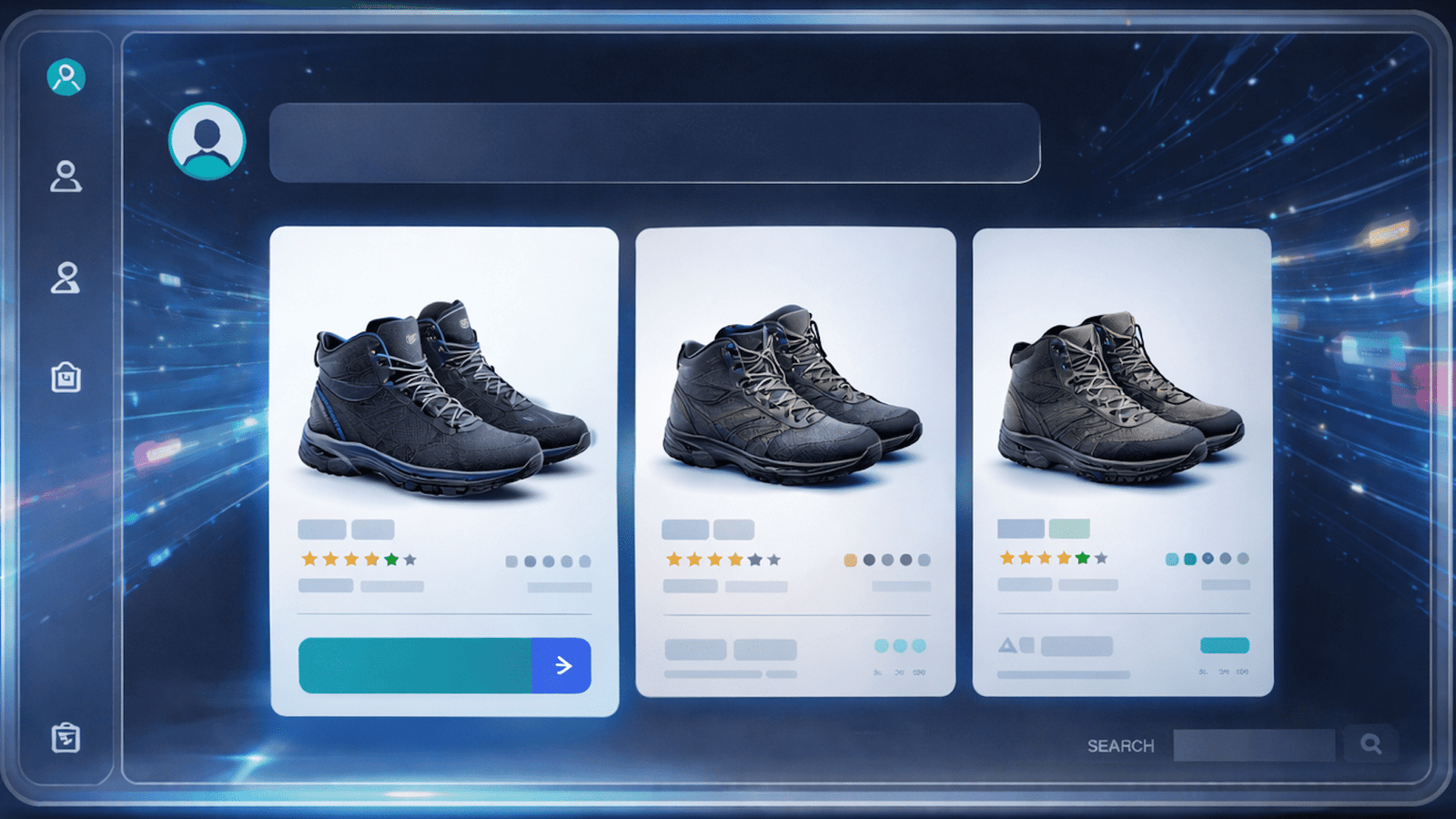
As Google rolls out AI Overviews, AI Mode in Search, and the Gemini ecosystem, we face a growing challenge: what happens when users get answers — and soon complete purchases — without leaving Google’s interfaces?
Enter Google’s Universal Commerce Protocol (UCP), now in beta.
UCP is designed to help brands to sell to consumers without leaving the Gemini or LLM experience. Consumers can check out within the LLM, add rewards points, and fully execute the transaction. Here’s an example flow:

How Google’s Universal Commerce Protocol works
At its core, UCP standardizes how consumer AI interfaces communicate with merchant checkout systems. When a user tells Gemini, “Find me a highly rated, waterproof hiking boot in size 10 under $200 and buy it,” UCP is the invisible bridge that allows the AI to securely fetch inventory, process the payment, and confirm the order.
While Google’s developer documentation leans into technical jargon like “Model Context Protocol (MCP)” and “Agent2Agent (A2A) interoperability,” the implications are remarkably straightforward:
- It uses your existing feeds: UCP plugs directly into your existing Google Merchant Center (GMC) shopping feeds. The inventory data you’re already managing for your campaigns is the same data that will power these AI transactions.
- You keep the data: Unlike selling on some third-party marketplaces, where you lose the customer relationship, UCP ensures you remain the merchant of record. You process the transaction, you own the first-party customer data, and you control the post-purchase experience.
- Frictionless checkout: By enabling checkouts directly within Google’s AI ecosystem, UCP can reduce cart abandonment and increase conversion rates among high-intent shoppers.
Dig deeper: How Google’s Universal Commerce Protocol changes ecommerce SEO
Your customers search everywhere. Make sure your brand shows up.
The SEO toolkit you know, plus the AI visibility data you need.
Start Free Trial
Get started with

Best practices for Google’s UCP
Like many LLM optimization recommendations, these steps come down to the fundamentals of managing your shopping feed and Merchant Center account.
Google outlined a few best practices. If you follow these four steps, you’ll be well-positioned for success.
1. Master your feed data hygiene
In an agentic commerce environment, your product feed is your primary sales tool. To ensure the AI accurately matches your products to highly specific user queries, you need to enrich your feed with granular details.
- Write product titles that are 30 or more characters long.
- Expand product descriptions to 500 or more characters.
- Include Global Trade Item Numbers (GTINs), where relevant, to ensure accurate product matching.
- Include three or more additional images alongside your primary product photo to engage visual shoppers.
- Use lifestyle images, not just standard product shots on white backgrounds.
- Ensure your image quality meets the standard of 1,500×1,500 pixels.
- Categorize your inventory by product type and share key product highlights.
- Prepare specific feed attributes required for UCP, such as returns, support information, and policy information.
- Support Google’s Native Checkout when possible (checkout logic integrated directly into the AI interface). Google also offers another option called Embedded Checkout (an iframe-based solution for highly bespoke branding). This will work, but is suboptimal at this time.
Dig deeper: Google publishes Universal Commerce Protocol help page
2. Highlight convenience and trust signals
To set your brand apart when AI is helping consumers make immediate, confident purchasing decisions, you must pass trust and convenience signals directly through your feed. The data shows that these elements directly impact the bottom line:
- Indicate clearly if your brand offers free shipping.
- Share your shipping speed (next day, two-day, etc.).
- Display your return policy.
- Submit sale prices when available. Regardless, ensure the feed represents the most accurate pricing details.
- Include product ratings.
Get the newsletter search marketers rely on.
3. Upgrade your technical infrastructure and SEO
The shift to UCP requires foundational updates to how your backend systems interact with Google. You must work hand in hand with their development and SEO teams to prepare for these AI search experiences.
- Migrate from the Content API to the Merchant API to enable real-time inventory updates and programmatic access to data and insights.
- Upgrade your tag in Data Manager and implement Conversion with Cart Data to effectively use first-party data in your campaigns.
- Prioritize content-rich pages for indexing and crawling, and ensure structured data is always supported by visible content.
- Create your Business Profile and claim your Brand Profile to highlight your business information and brand voice on Google platforms.
- Have your development team explore and prototype with UCP open source on GitHub to map APIs for checkout, session creation, and order management.
4. Additional features and tools beyond UCP to consider
Google is actively rolling out pilot programs designed specifically for the agentic era. Be proactive in adopting these new solutions rather than waiting for wide release:
- Prepare for the “Business Agent,” a virtual sales associate that acts like a brand representative to answer product questions right on Google.
- Consider the “Direct Offers Pilot,” a new way for advertisers to present exclusive discounts directly in AI Mode.
- Inquire about the “Conversational Attributes Pilot,” which introduces dozens of new Merchant Center attributes designed to enhance discovery in the conversational commerce era.
Dig deeper: Are we ready for the agentic web?
The future of search will happen within LLMs
The launch of Google’s Universal Commerce Protocol signals a significant shift. The SERP is becoming a transactional engine that increasingly operates within large language models.
UCP presents a meaningful opportunity. By removing friction between discovery and purchase, conversion rates could increase.
However, taking advantage of this requires stepping outside the Google Ads interface and working directly in your feed data and technical integrations, much like with Google Shopping. While this isn’t new, it’s becoming more important.
Ultimately, this comes down to the quality of your product data.
Contributing authors are invited to create content for Search Engine Land and are chosen for their expertise and contribution to the search community. Our contributors work under the oversight of the editorial staff and contributions are checked for quality and relevance to our readers. Search Engine Land is owned by Semrush. Contributor was not asked to make any direct or indirect mentions of Semrush. The opinions they express are their own.
