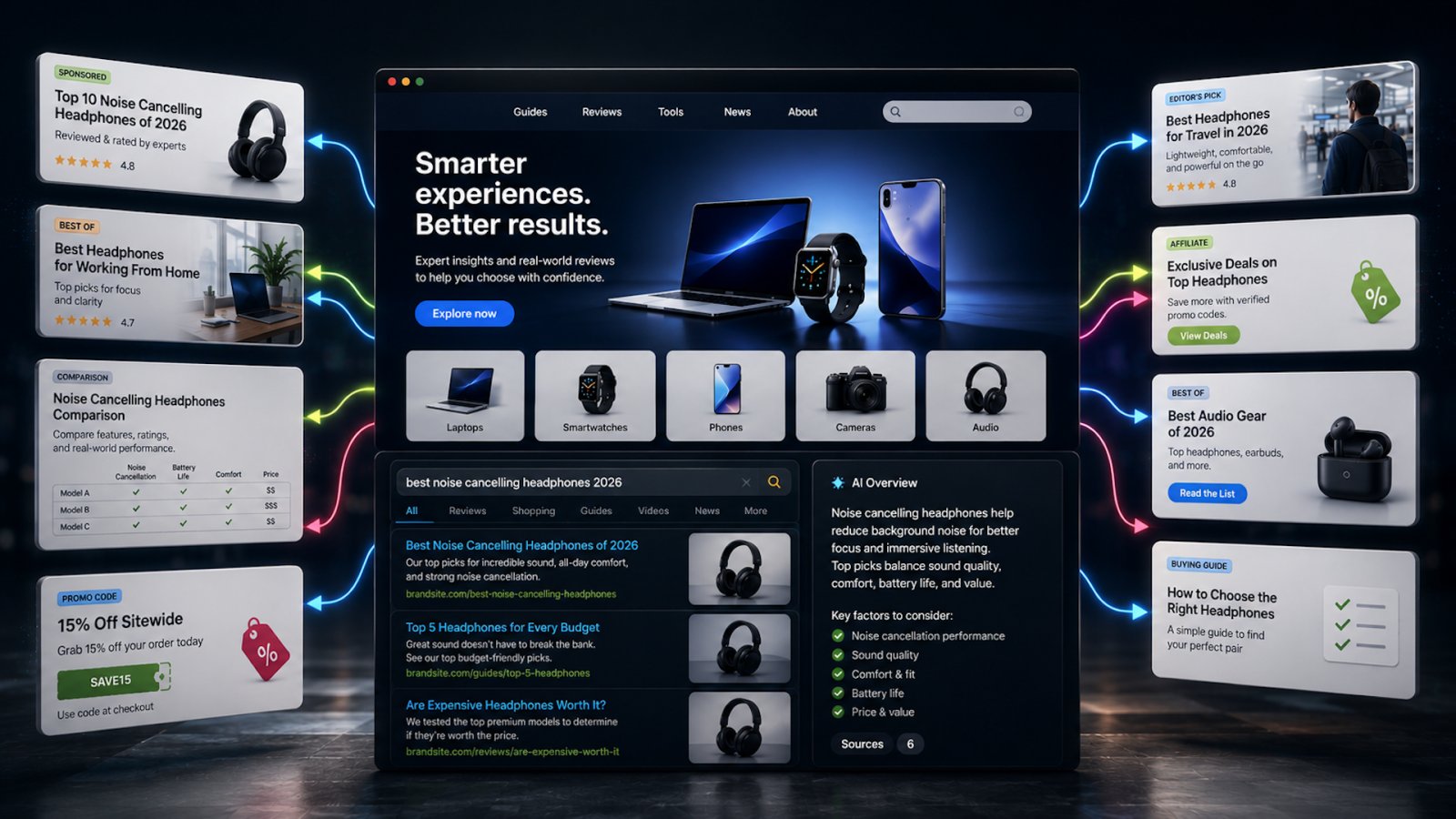
In most companies, SEO teams and affiliates — third parties that advertise your products or services for a commission — often operate in silos. The SEO team usually manages rankings, content, and organic traffic, while the affiliate team manages partner relationships, negotiates placements, and tracks commissions. But rarely do the two sit in the same room to coordinate their impact on the business.
Cross-functionality is key for a growing business. Working with other departments helps me better understand what success looks like to other teams in the company, and it pulls me out of my SEO bubble so I can see the wider business goals. I also learn about new initiatives and how to leverage them for SEO growth.
Coordination between the SEO and affiliate teams is especially important. So let’s talk about brand protection, LLM visibility, tooling, and more, and why a tighter collaboration between these two will improve efficiency, save money, and boost your business.
Protect your brand and search terms
When working with affiliates, it’s important to protect your brand and rank for search terms that are rightfully yours and not to let an affiliate control them. With my clients, whatever has an impact on organic performance is my or the SEO team’s responsibility.
For example, here are some high-intent conversion terms that use discount codes as part of a marketing strategy:
- [brand] + discount code
- [brand] + promo code
- Plus dozens of other variants
You don’t want to let terms like these slip away. When affiliates rank for your terms, they can send back your own branded traffic and sales and charge you a commission for it.
This can be a disaster, resulting in hefty amounts of affiliate commissions, and it can easily be avoided.
Dig deeper: The best affiliate networks by need and use case
Your customers search everywhere. Make sure your brand shows up.
The SEO toolkit you know, plus the AI visibility data you need.
Start Free Trial
Get started with

How to reclaim your rankings
Brands can lose branded conversions to their own affiliates as well. Take Trainline, a train ticket buying platform, as an example.
At the time of writing, the term “trainline promo code” has 17,000 monthly searches in the UK. Trainline has a dedicated page for the promo, but it’s not properly optimized to rank for the term. As a result, the site ranks on and off and loses branded traffic and conversions to its own affiliates.
In this case, the solution is simple: a targeted tweak in the meta title, H1, and body copy will better reflect the relevant terms.
By reclaiming those rankings, we
- Increased organic revenue for the organic channel.
- Reduced affiliate spending.
- Increased profitability for the entire business.
Another example: One of the brands I manage lost significant Share of Voice for a high-intent branded discount codes page to affiliates. Our response was a strategic content update. One day after it went live, the page shot from 14% to 31% Share of Voice.
These are successes for the business as a whole, not just SEO. And that’s what SEO should be about — insights that lead to business growth.
Get the newsletter search marketers rely on.
How SEO and affiliate teams can work together to compound returns
Traditionally, affiliates produce content that favors reputational signals: “Best of” articles, comparison articles, category roundups, and more.
LLMs give significant weight to reputational signals. For example, being mentioned across multiple “Best of” articles in your specific niche signals to LLMs that you are good at what you do. And if a lot of authoritative sources in your niche mention you as one of the go-to brands, that reputational signal will compound.
It’s important to educate your affiliate team so your brand will be included in these types of articles. This has two benefits:
- It will give your affiliate visibility, leading to direct traffic and conversions from affiliate placements.
- It will give you LLM visibility, boosting reputational signals that feed into how AI models perceive and recommend your brand.
On a technical note, affiliate tracking URLs — the parameterized versions of your pages that affiliate platforms generate — need to be handled correctly to avoid indexing issues. This is a great example of an issue that lives on the boundary between SEO and affiliate teams.
The solution is to no-index these, which Google sees as a directive and respects. (A common approach is to add a canonical tag pointing to the clean, non-parameterized version of the page, but I have seen canonicals ignored, resulting in affiliate tracking URLs flooding the index.)
To monitor this, I use SEOTesting, which sends automated alerts whenever new URLs get indexed and start receiving impressions. If an affiliate tracking URL slips through, I can catch it fast and act before it becomes a bigger indexing problem.
Dig deeper: What incrementality really means in affiliate marketing
Collaborate with affiliates today
SEO and affiliate teams often operate in silos, but each has a direct impact on the other. Affiliates can outrank you and cost you money. But they can also help you build LLM visibility, and those equipped with SEO data can make better decisions for the whole business.
The closer these two teams work together, the better the outcomes are for everyone, and most importantly, the business.
Contributing authors are invited to create content for Search Engine Land and are chosen for their expertise and contribution to the search community. Our contributors work under the oversight of the editorial staff and contributions are checked for quality and relevance to our readers. Search Engine Land is owned by Semrush. Contributor was not asked to make any direct or indirect mentions of Semrush. The opinions they express are their own.