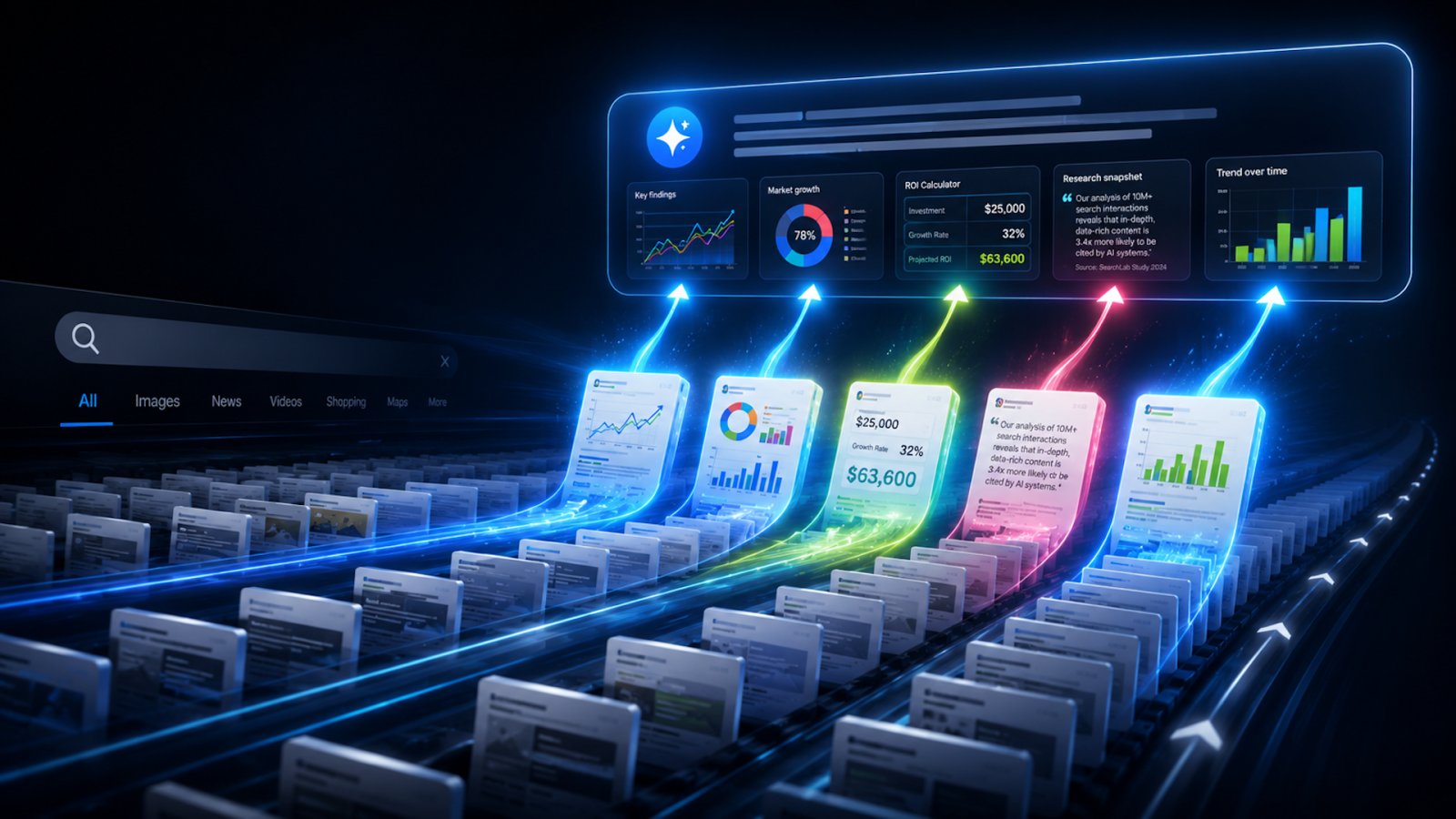
Some marketers argue GEO replaces SEO. Others claim strong SEO is enough for AI visibility.
To test both assumptions, we analyzed LLM referral traffic and organic traffic across 10 websites and 150,000 indexed pages. The results showed that AI search favors different content patterns than traditional organic search.
3 key findings from the dataset
1. Traditional SEO content strategies aren’t best for GEO
Blog content theme predicted LLM traffic more reliably than almost any other variable. Educational “comprehensive” guides consistently underperformed compared to shorter posts built around unique data.
Trends and analysis posts attracted LLM citations 78% of the time. Data-based year-in-review posts sat at 61%. Posts with unique data consistently dominated the LLM citation pool.
Meanwhile, educational how-to content sat at just 12%. This includes the SEO workhorse content that fills most calendars: guides, how-to posts, and top-of-funnel FAQs.
If you produce authoritative, data-rich, measurement-oriented content, you are disproportionately likely to be in the LLM citation pool. If you produce generic educational content, odds are that you won’t be.
2. Organic success doesn’t guarantee LLM traffic
The top 10 organic pages in this study captured 55% of organic sessions. Those same pages captured only 29% of LLM sessions.
Put another way: Your best-performing organic content and your best-performing LLM content are likely not the same content. Among the top 100 organic pages, 49 had zero LLM traffic whatsoever!
LLM traffic is correlated with organic performance, but it is not simply organic performance re-labeled.
3. Service product pages punch above their weight class for LLM traffic
By raw session count, articles and blog posts still generated the most LLM referrals. But when viewing LLM sessions per 1,000 organic sessions (a fairer measure of relative performance), service and product pages outperformed everything:
| Page type | LLM sessions per 1,000 organic |
| Service/product | 29.4 |
| Article/content | 23.4 |
| FAQ/support | 14.0 |
| Tool/demo | 9.8 |
| Homepage | 5.6 |
Your customers search everywhere. Make sure your brand shows up.
The SEO toolkit you know, plus the AI visibility data you need.
Start Free Trial
Get started with

The methodology behind the case study
This case study analyzed GA4 data from 10 websites, covering a combined 150,000 indexed pages across a one-month window in March 2026.
- The 10 domains deliberately span a range of industries, including healthcare, cybersecurity, technology, retail, education, economic development, and other B2B and B2C service verticals. The sampled domains were also selected for their relative consistency across key SEO metrics: strong Core Web Vitals, concerted content marketing efforts, and a consistent history of organic performance.
- LLM-referral traffic was isolated using GA4 channel groupings and referrer path segmentation, capturing sessions originating from ChatGPT, Claude, Perplexity, Copilot, and other major conversational AI platforms. Organic sessions reflected traditional search engine visits, primarily from Google.
- Blog content was further categorized by topic theme to compare LLM citation rates across content types. Engagement time comparisons used per-page averages as reported by GA4.
There’s one additional methodological note worth flagging, as it’s a frequent point of confusion: LLM bot crawls (GPTBot, ClaudeBot, etc.) aren’t recorded by GA4; they make server-level HTTP requests before client-side JavaScript fires. The organic session counts in this study reflect human visitors only.
What LLM traffic patterns reveal
LLM referral traffic behaves differently than organic traffic
At first glance, average engagement time per session between organic and LLM traffic appears nearly identical: 46.9 seconds for organic versus 47.1 for LLM. But that average hides an interesting statistical artifact.
On 71% of LLM-receiving pages, LLM sessions were notably shorter than organic. On 27% of pages, LLM sessions were dramatically longer, often three to 10x the organic average.
The split makes more sense when viewed by page type:
| Page type | Organic avg. time | LLM avg. time |
| Tool/demo | 101 seconds | 146 seconds |
| Homepage | 36 seconds | 82 seconds |
| Service/product | 69 seconds | 63 seconds |
| Article/content | 56 seconds | 40 seconds |
LLM users appear more engaged on tools, homepages, and service/product pages — but less engaged on articles.
One possible explanation is that LLM users arrive at articles to verify or extract a specific piece of information before leaving, while tools and service pages give them something more actionable to evaluate.
Interactive tools are an underappreciated LLM traffic category
Among all page-type categories, interactive tools showed the highest per-page LLM citation rates in the study. Nearly all interactive tools were gathering at least some LLM sessions.
LLMs actively recommend specific tools by name when users ask about assessments, screeners, or evaluations. Any site with a functional, named tool (e.g., a calculator, screener, or quiz) should expect LLMs to route relevant queries directly to it.
A new category worth watching: LLM-only traffic
Interestingly, 14% of all LLM-receiving pages in this study had zero organic clicks during the study window.
It’s tempting to interpret this as evidence of some new discovery mechanism unique to LLMs. A more likely explanation is that these pages either rank poorly in organic search or lose clicks because AI Overviews answer the query directly in the SERP. AI Overview citations consistently underperform blue links on click-through rate, even compared to results near the bottom of the SERP.
Get the newsletter search marketers rely on.
GEO tactics supported by the data
Based on these findings, here’s what the evidence indicates for effective GEO.
Prioritize content that answers questions LLMs can’t answer themselves
Generic educational content likely underperforms in LLM citations because LLMs are perfectly capable of producing it themselves.
Original data, proprietary research, and owned insights are the strongest differentiators for LLM citation. If you have a data asset, make it the centerpiece of your content.
Even better, if budget allows, allocate resources to generating studies and identifying new, verifiable data.
Use answer capsules on every page you want cited
In prior research across 15 domains and nearly 2 million sessions, answer capsules were the single strongest structural predictor of ChatGPT citations. An answer capsule is a concise, direct response to the core question of the page. It is placed early, written in clean prose, free of internal links, and gives the LLM a clean, extractable unit to quote.
LLMs pattern-match for the easiest, most direct answers. Give them what they want! The pages in this study that punched well above their organic weight class on LLM traffic tended to answer a specific question with specific data rather than explore a topic broadly.
Build (or surface) a named interactive tool
If your site has a calculator, screener, assessment, or configurator, it is one of your best GEO assets and potentially more valuable per page than your entire blog archive.
Make sure it:
- Has a clear, searchable name grounded in keyword research.
- Answers a specific question when someone arrives cold.
- Provides a useful service.
Track organic and LLM-performing pages separately and treat the difference seriously
Of the top 100 organic pages in this study, 49 pages had zero LLM traffic. That doesn’t mean those pages are failing. It just means LLM citation and organic visibility aren’t a 1:1 correlation.
A page that ranks No. 1 in the organic results for “best practices for X” may never get LLM traffic if nobody is asking an LLM about best practices for X. Content mapping for GEO means asking a different question than content mapping for SEO: Not, “What do people search for?” but, “What do people ask an AI?”
If you have pages that already receive LLM sessions with no organic clicks, don’t dismiss them as noise. In this study, the engagement quality on those pages was among the highest recorded. Those users were specifically directed to you by an AI, and they showed up ready to engage.
See the complete picture of your search visibility.
Track, optimize, and win in Google and AI search from one platform.
Start Free Trial
Get started with
GEO and SEO: Same strategies, different tactics
The overall picture derived from this data isn’t that GEO is replacing SEO, but that GEO is rewarding a slightly different set of on-page tactics. Additionally, the gap between the two may be widening as zero-click search accelerates.
The sites that performed best with LLM traffic built content that answers precise questions with original information, while keeping the page useful as a destination, not just a click. That has always been a good strategy. The difference now is that two separate systems are evaluating your content according to two separate sets of criteria, and optimizing for one no longer guarantees performance in the other.
Contributing authors are invited to create content for Search Engine Land and are chosen for their expertise and contribution to the search community. Our contributors work under the oversight of the editorial staff and contributions are checked for quality and relevance to our readers. Search Engine Land is owned by Semrush. Contributor was not asked to make any direct or indirect mentions of Semrush. The opinions they express are their own.