
Social media today isn’t a side hustle you hand off to an intern. Building a high-performing social media management team is now a strategic priority for both agencies and businesses alike. And there are numbers to back this claim.
About 73.2% of the world’s population uses the internet, of which 93.8 % use social media. Millions of people turn to social media platforms every single day to research new brands and products.
That’s billions of potential customers forming opinions about your brand every single day, and they expect consistent, quality interactions.
Yet, most businesses still run their social presence with a single overworked marketer juggling content creation, community engagement, analytics, social media advertising, and crisis response — all before lunch. That approach doesn’t scale, and it certainly doesn’t compete.
In this guide, we break down the essential social media team roles, structures, workflows, and AI-powered strategies you need to build an effective social media team that actually drives business growth.
Key Takeaways
- Social media is a team sport, and building a dedicated social media management team with clear roles can help brands, not just “show up,” but actually grow on social media.
- A high-performing team needs specialized roles like manager, content creator, strategist, analyst, community manager, and paid specialist.
- For proper governance and cross-departmental coordination, make sure to structure these roles according to your company’s size, goals, and budget.
- Using the right social media management tools can help your team multiply its impact. Consider automating mundane tasks like content creation, scheduling, collaboration, approvals, and analytics, so your team can get more done in less time.
The social media landscape is changing faster than ever. Every day, we encounter new and complex algorithms and changing content formats. On top of this, the behavior of your target audience and the advertising ecosystem also keeps changing. Managing all of this requires a range of skills that really exist in a single person.
Research also shows that the average user now regularly engages with 7 social media platforms each month. Each of those platforms runs its own algorithm, favors its own content formats, attracts a distinct audience, and changes its rules constantly.
Managing so many social media platforms at the same time requires a collection of specialized disciplines, all operating across platforms that have their own rules. So, expecting one person to master all of this, across every platform, every day, isn’t ambitious – it’s a setup for mediocre results and eventual burnout.
When businesses work with the right social media teams, they can develop real social strategies, test different content formats, build genuine community relationships, run smart paid campaigns, and ensure their social presence delivers the expected ROI.
So, if you are a business looking to see measurable results from social media, then you must invest seriously in building the right social media management teams. But how exactly can you go about this process?
Let’s find out
Building the right social media marketing teams is where most companies get stuck. They know they need help, but they are not sure which roles to hire for.
In the sections below, we will break down some important social media team roles that companies should be hiring for.
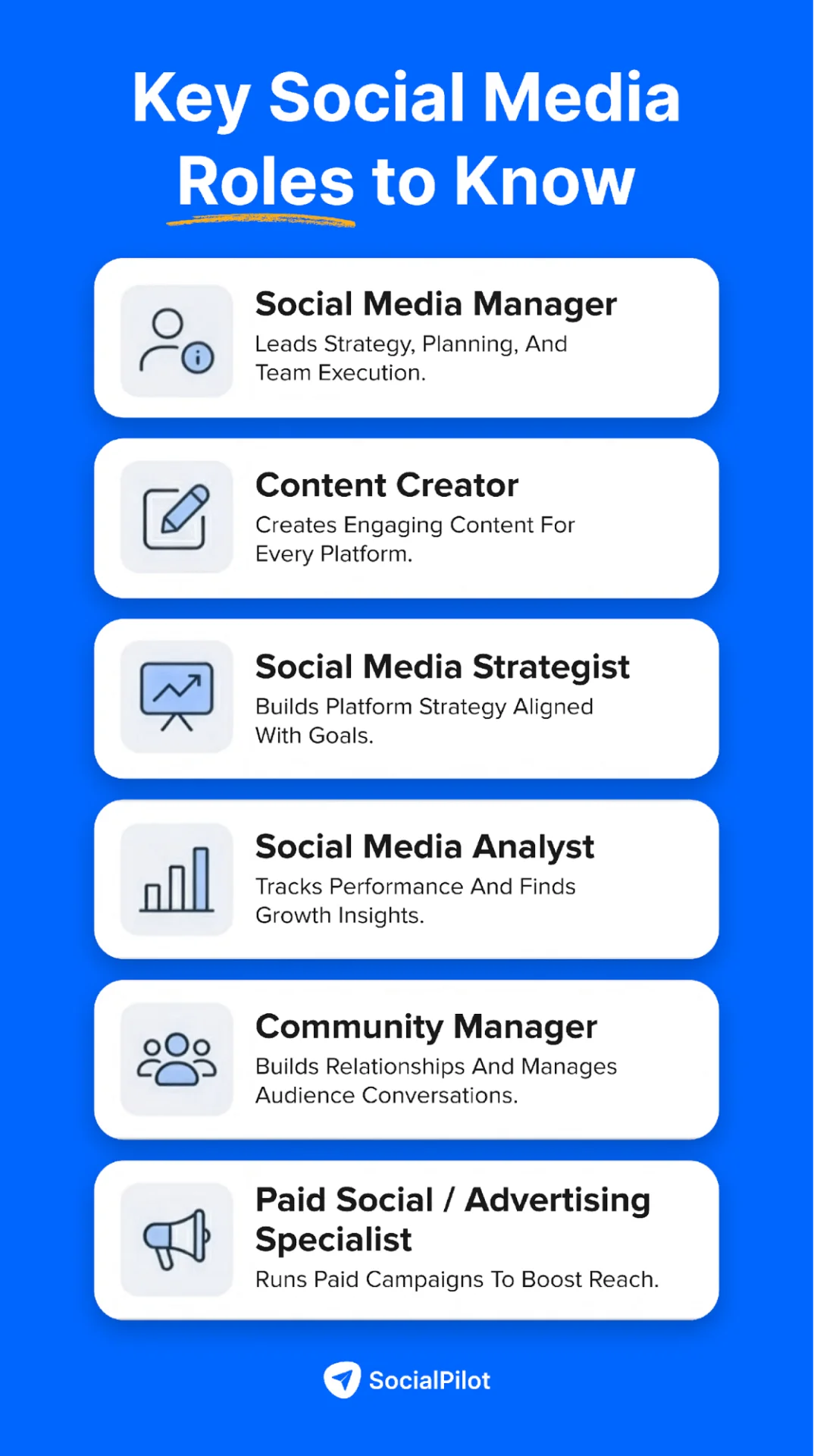
A social media manager is like the lead vocalist in a band. They are the marketing leaders who keep the entire operations team moving and ensure that content goes out on time and the brand sounds consistent. They help companies achieve their bigger social media marketing goals.
A good social media manager sits at the intersection of creativity and operations. They translate business objectives into a social media plan, coordinate across internal teams (and often across departments), and serve as the go-to person when business leaders want performance reports.
Key Responsibilities:
- Owning and maintaining a social media content strategy across all social platforms
- Coordinating workflows between content creators, designers, and other team members
- Managing the team’s social media tool stack – setting up role-based permissions, configuring approval workflows, and maintaining the publishing queue.
- Ensuring brand voice and messaging stay consistent across every channel
- Monitoring latest trends and identifying opportunities
- Managing the publishing schedule and making real-time adjustments when needed
- Social media performance analysis and communicating results to stakeholders
- Serving as the primary point of contact between the social team and other departments
Key Skills
- Organization and project management – Juggling multiple platforms, deadlines, and team members requires someone who thrives on structure.
- Communication – Both written (brand voice, captions, briefs) and verbal (team coordination, stakeholder updates)
- Platform fluency – Deep understanding of how each platform’s algorithm, content formats, and audience behavior
- Adaptability – Social media moves fast, and the best managers can pivot quickly without losing sight of the bigger strategy.
- Leadership – Even in small teams, this role sets the tone and pace for everyone else
Content Creator
These are the people who actually implement the content strategy and make the stuff that your target audience sees – be it the blogs, reels, carousels, tweets, posts, or Stories.
Content creators are not just copywriters; they are also part-time videographers, graphic designers, and trend spotters who can create content across different platforms.
Key Responsibilities
- Writing copies, captions, scripts, and hooks tailored to each platform’s tone and format
- Producing short-form video content for Reels, TikToks, YouTube Shorts, and Stories
- Designing statics, like graphics, carousels, infographics, and quote cards
- Ensuring that your content aligns with the overall strategy and calendar
- Staying on top of content trends, emerging formats, and platform updates
- Repurposing and adapting content across different social media channels
- Maintaining a consistent brand aesthetic and voice
Key Skills
- Copywriting and storytelling – The ability to communicate clearly and compellingly in a few words (or a few seconds of video)
- Video production – Comfortable shooting, editing, and producing short-form video
- Design sense – Proficient with design tools and have a strong eye for visual branding
- Platform intuition – Knows what “native” content looks like on each platform, and doesn’t create one-size-fits-all posts
- Speed and creativity under pressure – Trends move fast, and the best content creators should be able to produce quality work quickly.
If your content creator is making the posts, the strategist conducts market research and plans them. This person is the big picture thinker on your team, and they are more focused on defining the direction.
- Which social media platforms deserve your attention?
- What kind of content resonates with your audience?
- How does social media support the company’s larger business goals?
- What should you stop doing?
- What should you double down on?
These are some of the many questions that social media strategists think about. They bring more discipline and intentionality to your social presence, ensuring that every campaign, content pillar, and platform you choose delivers the desired outcomes.
Key Responsibilities
- Developing social media marketing strategies that align with the business objectives
- Conducting audience research to understand what they like and where they spend most of their time.
- Setting KPIs and success metrics for the company’s social media
- Running competitive analysis to identify gaps and opportunities in the market
- Planning social media campaigns and ensuring smooth cross-channel coordination
- Regularly reviewing and adjusting strategy based on performance data and platform changes.
Key Skills:
- Strategic thinking – To see how the everyday social content contributes to the bigger picture and fits into the social media marketing mix
- Audience understanding – Go beyond surface-level demographics to truly understand what motivates the target audience.
- Data literacy – Interpret analytics and translate numbers to see how it’s working.
- Cross-functional collaboration – Works with different teams for a smoother workflow.
How do companies know that their social media strategies are actually working? This is where the role of a social media analyst comes into play. They dig deep into social media analytics to decipher the performance data, spot patterns, run tests, and turn numbers into insights so that better social media decisions can be made.
They tell you exactly what is working- the content formats that drive engagement, the times when your target audience is most active, the social media campaigns that actually move the needle, and the efforts that deliver results.
Key Responsibilities
- Tracking key performance indicators for all platforms – engagement rates, reach, follower growth, click-throughs, conversions, etc.
- Translating data into recommendations for content creators and social media managers.
- Building dashboards and recurring reports to give the team a clear picture of performance
- Running A/B tests to find what works best
- Monitoring competitor performance and industry benchmarks for context.
- Identify the ongoing social media trends that are resonating with people.
Key Skills
- Analytical thinking – They should be drawn to patterns and be good at evidence-based reasoning.
- Tool proficiency – Comfortable using analytics platforms and building reports in Excel, Google Sheets, etc.
- Communication – Able to break down data into valuable insights for people who aren’t so data-focused
- Attention to detail – Because small data discrepancies can lead to big strategic mistakes
The community manager is the human face of your brand on social media. While content creators focus on what goes out, the community manager focuses on what comes back – the comments, the DMs, the mentions, the reviews, and the conversations happening about your brand.
Their role is to manage the brand’s online reputation and build customer loyalty. They make you followers feel heard, valued, and connected, turning them into loyal fans and brand advocates.
Community managers also deal with complaints, trolls, sensitive topics, and occasional crises, which is why this role is very much emotionally demanding and needs composure.
Key Responsibilities
- Monitoring and responding to the comments, direct messages, and brand mentions across all platforms.
- Building relationships with the most engaged social media followers and super fans
- Moderating online communities like Facebook groups, Reddit threads, or any other place where the audience is.
- Escalating sensitive issues and potential crises to the right internal teams before they spiral
- Gathering feedback from the community and sharing it with internal teams and leadership
- Sparking conversations and meaningful interactions about the brand on social media.
Key Skills
- Empathy and emotional intelligence – To understand the tone, context, and emotion behind the message
- Written communication – So they can match the brand voice while also sounding like a real person.
- Conflict resolution – To de-escalate tense matters and handle frustrated customers
- Speed and responsiveness – They should be quick but never careless.
- Genuine interest in people – They should actually care about the community and people.
Amidst the growing noise on social media, posting only organic content may not cut it anymore. Algorithms today favor paid content, which is why most companies depend on paid ads.

An ad specialist is the person who determines your ad budget and ensures your ads reach your target audiences. Ad specialists build full-funnel campaigns — increased brand awareness at the top, consideration in the middle, conversion at the bottom — with precise audience targeting, creative testing, and budget allocation across social platforms like Facebook, Instagram, TikTok, LinkedIn, and more.
Key Responsibilities
- To plan, build, and manage paid campaigns right from audience setup to budget allocation.
- Define custom audiences, lookalikes, interest-based segments, and re-targeting pools.
- To run regular A/B tests on ad creatives, copy, formats, placements, and landing pages
- Monitor campaign performances in real time and make optimizations.
- Track and report on key paid metrics like ROAS (return on ad spend), cost per acquisition, conversion rates, and cost per click
- Collaborate with the content team and strategist to ensure that paid and organic efforts complement each other
- Manage ad budgets responsibly and forecast spend needs.
Key Skills
- Platform expertise – Deep, hands-on knowledge of ad managers across all social platforms
- Analytical mindset – To constantly test, measure, and iterate based on performance data.
- Budget management – Ability to manage significant ad spend and take allocation decisions that maximize ROI
- Creative judgment – An understanding of what makes someone stop mid-scroll, and design ads accordingly
- Full-funnel thinking – Ability to see beyond clicks and impressions to understand how paid social fits into the entire customer journey from awareness to purchase
Emerging Roles to Watch Out For
Beyond these core social media team roles, several new positions are gaining traction as the industry evolves. You may not need these people right away, but an understanding of their work profile can help you stay ahead of the curve.

1. SOSEO (Social Search Optimization) Strategist
The youth of today use social media as a search engine, so instead of Googling “best coffee shops in Austin” or “how to style wide-leg jeans,” Gen Z and Millennials are searching for these things directly on TikTok, Instagram, and YouTube.
They trust the social media results because they come with real visuals, real reviews, and real people, and not just keyword-optimized web pages.
This shift has created an entirely new discipline called Social Search Engine Optimization, and here are some things that an SOSEO strategist does:
- Develop a social media SEO strategy that complements your broader content and SEO efforts.
- Make sure your content is discoverable through social search.
- Optimize the captions with searchable keywords, add descriptive on-screen text in videos, add relevant alt text, and structure content so that it surfaces when someone searches for a similar query.
- Analyze search trends across platforms to identify what your audience is actively looking for
2. Social Customer Care Lead
Customer service on social media has become non-negotiable as more and more customers reach out to brands through DMs, comments, and mentions. They expect their queries to be seen, acknowledged, and replied to.
A social customer care lead reviews customer complaints on social media and ensures they are resolved at the earliest. Here’s what they do:
- Design and document customer care workflows on social media – determining who handles what and how to respond to different issues on social platforms.
- Handle sensitive or high-visibility customer interactions in a public forum.
- Coordinate with the social team and customer support to ensure fast, accurate resolutions.
- Keeps a track of response time, resolution rate, and customer satisfaction on social media
3. AI Workflow Specialist
Today, almost all businesses have started embedding AI tools in social media workflows. From drafting content to generating images and scheduling posts, AI is being used everywhere. But still, most teams are using AI in a scattered, ad hoc way.
Hiring an AI workflow specialist can bring structure to this everyday process. They evaluate different AI tools to understand which tools add the most value, build standardized workflows, and create prompt libraries to help brands maintain a consistent voice across different social platforms. They also establish quality checks on every piece of content generated using AI.
Their day-to-day workflow includes:
- Evaluating, testing, and implementing AI tools for ideation, creation, scheduling, and reporting.
- Building prompt libraries and templates for consistent brand voice and content guidelines.
- Creating quality assurance processes for AI-generated content
- Establishing clear policies for the use of AI in the team
- Train team members for effective AI tool usage so that adoption becomes easy.
Now that we know what roles to hire for, let us also understand how to structure those roles so that your social media team can operate as a well-coordinated unit.
There are 4 common models for social media team structures. Let’s walk through them one by one.
1. Functional Model (Organized by Specialization)
As the name suggests, the functional model groups team members based on what they do best, like one person handles the content, another runs the campaign, and someone else manages the community.
The social media manager oversees the entire team, and below him is a social media specialist handling every department. Each person has their own lane, and they come together when it’s time to plan campaigns, do brainstorming, or conduct cross-functional reviews.
This model works best for mid-size to large teams, where every member needs a defined focus area. But also, when everybody works on their own defined speciality, it’s easy to lose sight of how the pieces fit together. To address this issue, businesses must ensure strong communication rhythms, weekly syncs, collaborative sessions, and shared dashboards.
2. Network-Based Model (Organized by Platform)
Here, businesses create separate teams to manage their social media channels. For instance, one person handles TikTok, another handles Instagram, and someone else handles LinkedIn. The platform lead of each channel is responsible for everything on that channel – right from strategy building to content posting to reporting.
Then there is a head of social media or a social media director, who sits above the platform, leading to maintain brand consistency and coordinate cross-channel campaigns.
This model works best for brands that have a strong, active presence across multiple platforms. But just like a functional model, this one also has an obvious risk. When each person is heads-down on their own channel, messaging can drift. Also, conducting cross-platform campaigns can become harder.
3. Audience-Engagement Model (Organized by Goals)
This one flips the script entirely. Instead of organizing by skill or platform, you organize your team around stages of the customer journey.
So there is one team that reaches out to new audiences and focuses on brand visibility, then another team that focuses on engagement, nurturing relationships, sparking conversations, and building community. Lastly, there is also a team that focuses on customer care and handles support requests, helping businesses turn frustrated customers into satisfied ones.
Each sub-team here works across platforms rather than being siloed into one channel.
This model is especially effective for companies where social plays a significant role in customer support. This includes e-commerce brands, SaaS companies, or any business where customers regularly turn to social channels with questions and complaints.
This model also makes cross-departmental collaboration more natural. The social media marketing goals are directly tied to business outcomes, which makes reporting cleaner and ROI conversations easier.
However, the biggest challenge here is platform fragmentation. Since every team works across all platforms, it may become difficult to prevent people from stepping on each other’s toes. Also, coordination is the key here; without it, things can get messy really fast.
4. Center of Excellence (CoE) Model
In a CoE model, you still have a dedicated social media team handling day-to-day execution. But on top of that, you create a cross-departmental council made up of representatives from teams that have a stake in social media — PR, HR, customer support, product, sales, legal, and executive leadership.
This council meets regularly to share insights, align on messaging, coordinate initiatives, and ensure the social media strategy reflects what’s happening across the organization, not just the marketing department.
It works best for large organizations where multiple departments are impacted by social media. So, the whole point of a CoE is seamless collaboration. Also, because these teams have members from different departments, it’s important to set clear boundaries so that the social media teams can still retain their operational autonomy.
The “ideal” social media team doesn’t look the same for everyone. A five-person startup would have a different team than a global enterprise with multiple offices.
The following sections will discuss what a social media management team typically looks like at each stage of growth, and how to know when it’s time to level up.
Startups and Solopreneurs (1–5 People)
When you’re just getting started, your social media “team” is probably one person who handles everything from website updates to blog content to email marketing and your social media handle.
And honestly? At this stage, it’s fine to have only one generalist in your team.
They handle a full spectrum of content across different platforms and pull you the performance reports from time to time. These people should be capable of running the show solo.
Their work would typically include managing content on the company’s website and across two to three social media platforms. At this stage, they would also need social media management tools to write AI-assisted copies, create graphics, and schedule social media posts.
Small and Mid-Size Businesses (5 – 25 People)
This is where things start to get exciting, and you can finally go beyond a generalist model. A typical social media team for a small business includes:
- A social media manager
- A content creator
- A community manager
Depending on your priorities, you may also hire a paid social media specialist, especially if you often run ads on social media.
Some businesses at this stage also bring freelancers or part-time contractors to fill gaps, like a videographer for monthly shoots, or a graphic designer for campaign assets, etc.
Enterprises and Large Organizations (More than 25 People)
At enterprise scale, you would need social media teams that are fully specialized. Every core function must have a dedicated owner, and the team must work more like a small agency embedded within the company.
At this stage, the social media team requires its own leadership, workflows, tools, and reporting structure. Here are some roles that enterprises hire for:
- A Head of Social / VP of Social Media
- A social media strategist
- A social media manager
- Multiple content creators
- A community manager or a team of community managers
- A social media analyst
- A paid social media specialist
Some enterprises also hire an SOSEO strategist, a social customer care lead, an AI workflow specialist, or an influencer marketing manager, depending on their social media operations.
Agency Teams Managing Multiple Clients
If you are an agency managing social media for multiple clients across different industries, then you would not just need a robust team, but also systems and structures to handle that scale of work.
The margin for error here is slim. Miss a post for one client, and you’ve damaged trust. Confuse one client’s brand voice with another’s, and you’ve got a real problem.
Agencies usually hire dedicated client teams, which include a specific group of people — usually a social media manager, a content creator, and sometimes a paid specialist or community manager — to a single client.
That team learns the client’s brand inside and out, builds a direct relationship with stakeholders, and can move quickly because they don’t have to context-switch between different brands all day.
Some agencies also have shared (or pod-based) teams. These teams take a different approach. They include specialists like content creators, designers, analysts, and paid media experts, who work across multiple clients, managed by account leads who maintain client relationships and ensure that all social media accounts get the attention they need.
However, one downside of shared teams is context-switching. Moving between five different brand voices in a single day is mentally taxing, and the quality can sometimes slip if workloads aren’t managed carefully.
Besides the right team members, agencies must also invest in the right social media tools that support multi-client workspaces, role-based permissions, approval workflows, and white-label reporting.
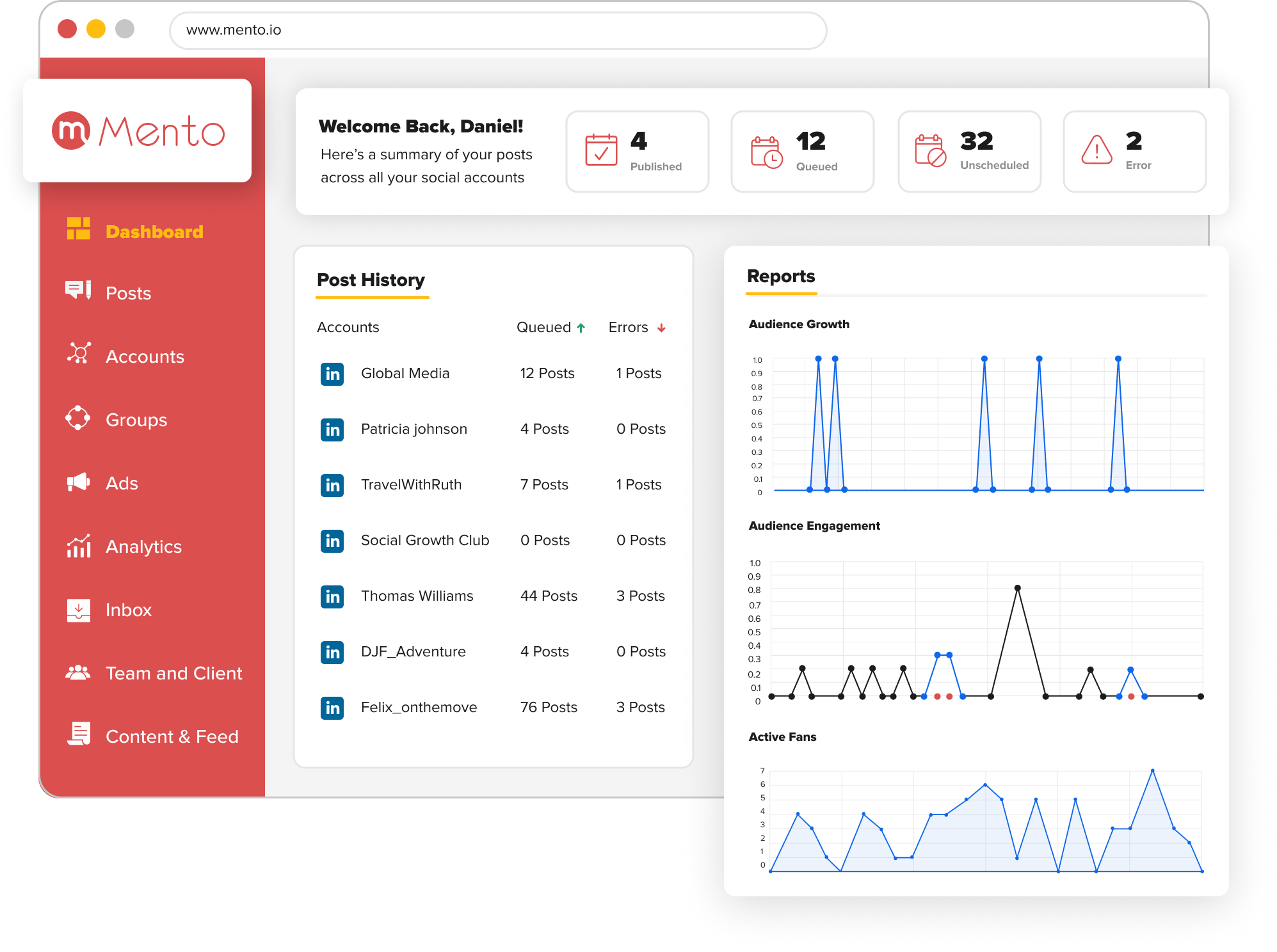
If you’re an agency juggling multiple clients, SocialPilot is a social media management tool that can support your workflow. It lets you manage social media for all your clients using a single centralized dashboard. You can create separate workspaces, content calendars, and approval flows for each account.
But what really sets SocialPilot apart is it’s white-label solution for agencies. This feature lets you generate detailed, fully branded performance reports with your agency’s logo, colors, and identity.
It’s a small touch that makes a big difference in how polished and professional your agency appears at every client touchpoint.
Try SocialPilot Today!
Even the most talented social media teams can fall short without the right tools to help them. But given that there are hundreds of tools out there, how do you even select the right ones?
Let’s talk about some essential tool categories and recommendations to help you ace your social media game.
Scheduling and Publishing Tools
Scheduling tools let your team plan, queue, and auto-publish content across multiple platforms from one place.
Here’s what to look for in scheduling tools
- Multi-platform support for all the major social media channels.
- Visual content calendar to oversee what’s going out.
- Bulk scheduling to manage high content volumes.
- Suggestions for the best time to post on social media.
- Mobile access to manage social media as and when needed
Analytics and Reporting Platforms
Social media analytics tools give your team visibility into what’s performing, what’s falling flat, and where to focus next. Look for tools that offer:
- Social media analytics to identify best-performing posts.
- Cross-platform reporting that pulls data from all your channels.
- Customizable reports tailored to different audiences.
- Competitive benchmarking to understand competitors and their social media strategies.
Content Creation and Design Tools
Your content team can have incredible ideas, but if they don’t have the right social media content creation tools to bring those ideas to life quickly and at a high quality, output suffers.
Here is what to look for in content creation tools:
- AI-assisted content generation to generate caption drafts, suggest headline variations, hashtags, etc.
- Template libraries with pre-built templates for social post sizes, Stories, carousels, etc
- Brand kit management to store your brand colors, fonts, logos, and style guidelines for content consistency across all platforms.
- Collaboration features like shared asset libraries, version history, and the ability to comment on designs.
Collaboration and Approval Workflow Tools
No matter the size of your business, you would need an approval process for your social media that helps you review the content before it goes live. Here are a few things that you should look for in social media collaboration tools:
- Multi-level approval workflows to set up clear review chains (creator → manager → client or stakeholder)
- Visual previews to see exactly how the post will look when published – with the image, the caption, the hashtags, everything in context.
- Feedback mechanism to suggest edits in the draft and speed up the process.
- Role-based permissions for content creation, editing, approval, and publishing.
Instead of juggling separate tools for scheduling, analytics, content creation, and approvals, SocialPilot brings nearly all of these capabilities into a single platform.
It covers multi-platform scheduling with a visual content calendar, bulk scheduling for high-volume accounts, optimal timing suggestions, in-depth analytics with customizable reports, AI-powered content generation through AI Pilot, multi-level approval workflows, and role-based team permissions — all from one dashboard.
For teams tired of switching between five different tools just to get a single post from idea to published, it’s a much cleaner way to work.
Try SocialPilot Today!
Building a social media team isn’t just about getting the right people in the room. Even companies that hire well can stumble if they fall into a few common structural traps.
Here are some common mistakes that companies make when hiring a social media team.
Even the flip side to this is equally problematic. Hiring social media specialists too early will waste your budget and create awkward role gaps.
How to avoid it: Start with generalists. As specific functions (paid media, analytics, community) start bottlenecking the team, that’s your signal to bring in specialists. Let your actual needs guide hiring, not a theoretical org chart.
2. Neglecting Analytics and Data-Driven Decision-Making
How to avoid it: Assign analytics ownership from day one, even if it’s a shared responsibility on a small team. Define your KPIs early, report on them consistently, and use performance data to improve your social media performance.
3. Ignoring the Need for Clear Processes and Documentation When everything lives in one person’s head, your team’s success is entirely dependent on that person being available. But still, most small teams don’t follow a clear documentation process.
How to avoid it: Document your core social media workflows – content creation, review, approval, scheduling, publishing, and reporting. Create brand voice guides, platform-specific playbooks, and escalation procedures that your entire team can follow.
4. Underinvesting in Tools and Training Your team cannot deliver top-tier results with free tools and a zero professional development budget.
How to avoid it: Keep aside some budget for a proper social media management platform. Also, allocate a budget for your team’s training and development — like certifications, courses, and conferences — to help them stay current and sharp.
5. Running Your Team’s Workflow Across Disconnected Tools
When your team is toggling between a scheduling tool, a separate analytics platform, a design app, Slack threads for approvals, and spreadsheets for reporting, you’re creating unnecessary friction and room for error.
How to avoid it: Use one centralized platform that handles scheduling, approvals, analytics, and client communication in a single workflow.
Building the Team and Prepping it for Success
Building a successful social media strategy and a strong presence on social platforms definitely starts with the right social media teams.
But even the best teams can only do so much when they’re buried in manual workflows, jumping between disconnected tools, and spending more time on logistics than on the creative and strategic work that actually drives results.
That’s where using the right social media management and scheduling tools can make all the difference. SocialPilot brings your team’s entire social media workflow into one place.
For agencies, it provides features like separate client workspaces, white-label reports, client approval links, and role-based permissions, while in-house teams and SMBs can benefit from its features like scheduling, AI content assistant, content calendar, and analytics suite.
Use SocialPilot to help your team work faster, stay aligned, and focus on what they do best.
Try SocialPilot today to see how smooth your social media operations can actually get.