
Have you ever scrolled through your social media feed and wondered, “Is any of this actually working?”
Yeah, us, too.
In this age of content overload, creating and posting great stuff is no longer enough.
You must learn about your target audience, collect the right social media data, and analyze it to understand what goes behind your digital presence. This helps you unlock powerful and actionable insights to fine-tune your social media strategies and get real results.
In this guide, we will walk you through the complete process of doing social media analysis, the types of analytics you need to consider, and the right tools to measure these metrics.
So, without any further ado, let’s get started!
Social media analytics is the process of collecting, analyzing, and interpreting data from various social media channels to understand how your audience perceives and interacts with your content.
This involves tracking and evaluating social media metrics such as likes, shares, comments, and mentions to understand how each content piece is performing on a macro level and how your audience responds to it.
But what all is covered in social media analytics?
The main areas include performance metrics, audience demographics, competitor insights, paid social media performance, and brand sentiment. Deciphering all this social media data helps marketers and businesses understand how their social media campaigns perform and impact their business goals.
This leads us to an important question:
We live in a data-driven culture where data analysis (or social media analytics) and decision-making are integrated into every aspect of the organization. From marketing and sales to operations and finance, data is used to identify opportunities, measure performance, and boost company growth.
This data-driven culture can greatly help savvy marketers with the following:
- Deciphering Audience Sentiments: Analyzing interactions, from comments to mentions, helps discern whether content resonates with your audience or needs adjustments.
- Strategic Content Creation: The insights collected can help you pinpoint which type of interactive content, videos, blogs, or infographics garners the most attention. This data-driven approach ensures that content strategies are tailored for maximum engagement.
- Competitor Analysis: A top-down social media analysis can reveal who you’re competing with, identify market opportunities, and use it to hone your own strategies.
- Improved decision-making: When data and insights from social media are used for decision-making, there is a reduced likelihood of bias and subjectivity.
- Increased efficiency: When data is at the core of operations, processes, and procedures can be streamlined to eliminate redundancy and maximize efficiency. This can lead to cost savings and increased productivity.
- More Effectiveness: The analytics also help you understand the effectiveness of your online customer service, from response times to the success of your chatbot interactions.
- Better results for businesses: Businesses adopting the data-first approach can better understand their audience and tailor their services or products to match their needs.
- Setting Social Media Goals: Finally, by using social media data analytics, you can update your strategy.
Basically, social media analysis gives you a holistic view of which parts of your strategy are working in your favor and which need to be changed.
But what all is covered in social media analytics, or what metrics should you be tracking?
Let’s find out.
Well, there are several types of social media metrics, but we have defined them into 6 major categories that offer a granular look at what data you can look at.
Here are these:
Performance Metrics
These are some obvious metrics that help you understand how your social media content is performing. Also known as descriptive metrics, it includes:
- Reach
- Impressions
- Interaction
- Interaction rate
- Profile link taps
- Follow online activity
- Engagement rate
- Open rate
- Comments
- Shares
- Views
- View trends
- Hashtag performance
- Website clicks
Every business, no matter what industry they are in, should be tracking their performance metrics. You can easily view all these metrics inside the SocialPilot dashboard:
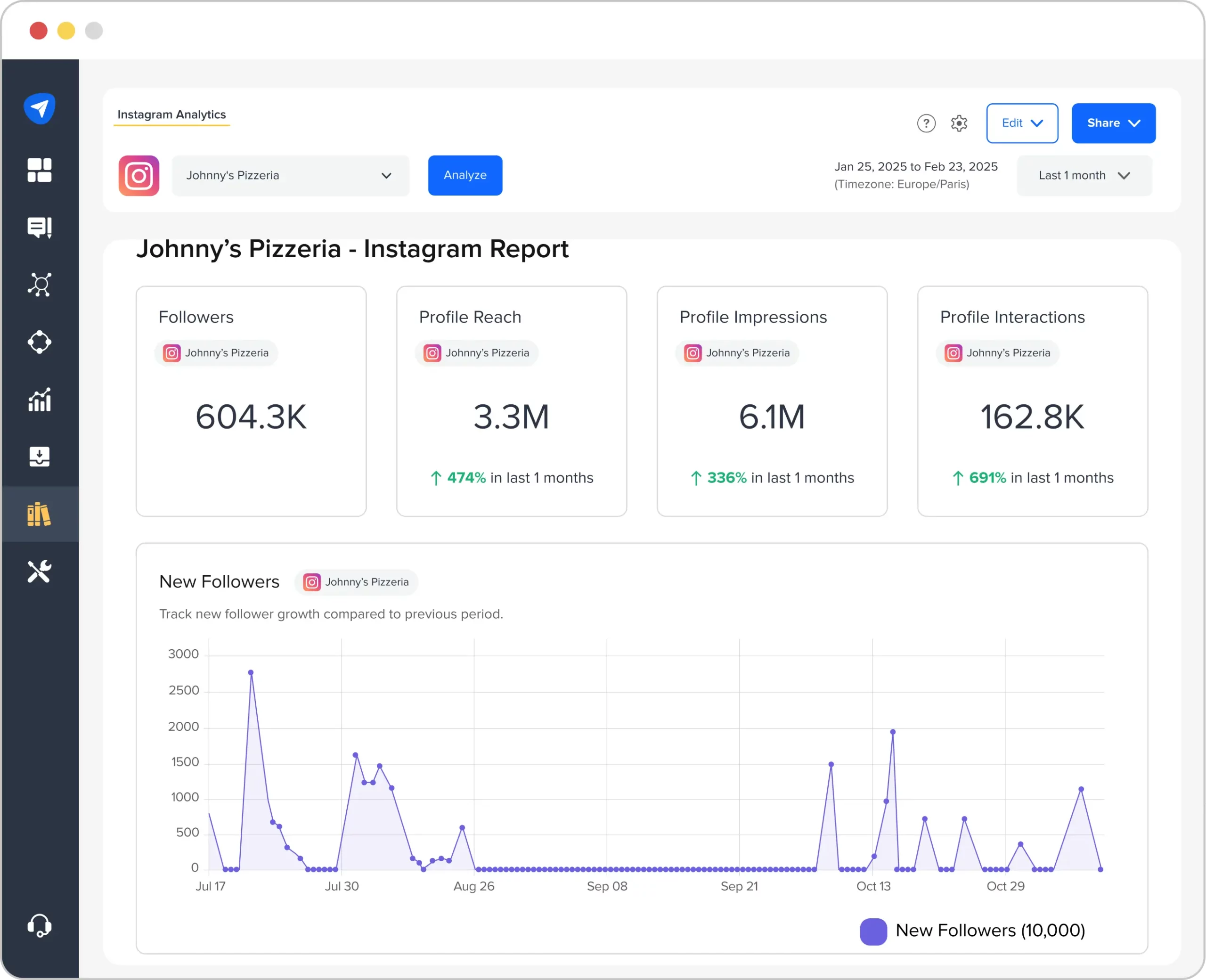
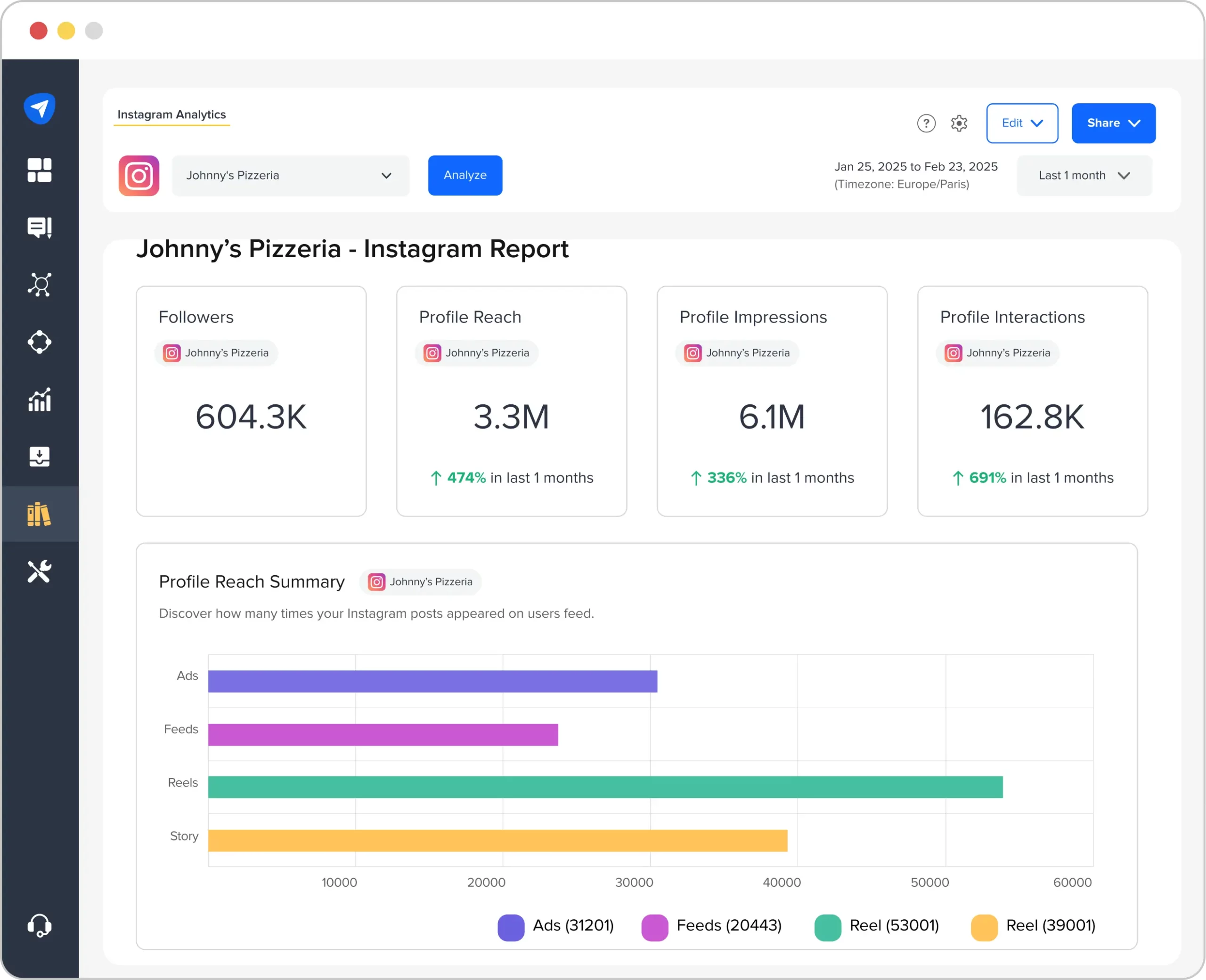
You can get detailed insights into different types of posts. Quickly identify the most viewed content.
Audience Analytics
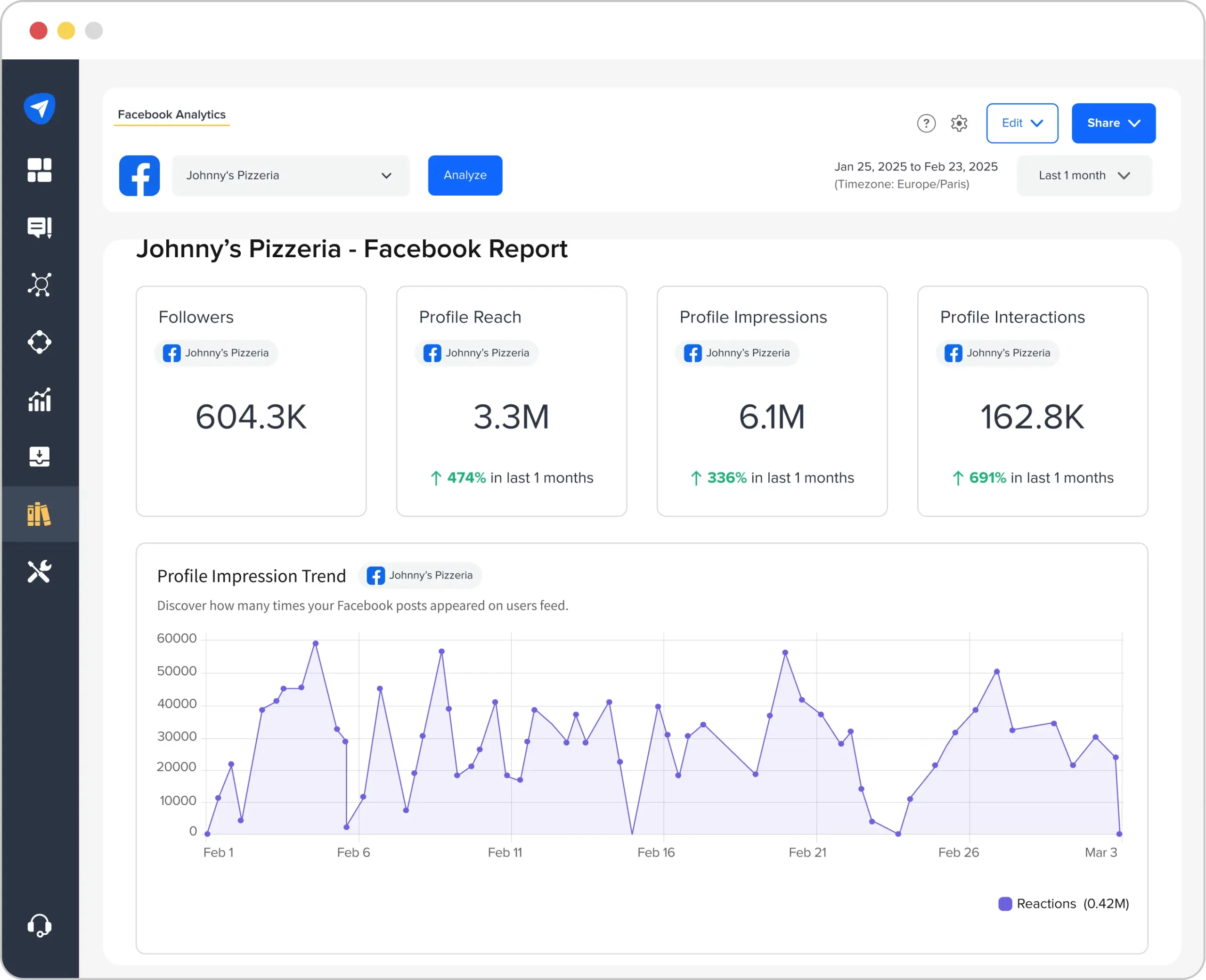
The next metric is audience analytics, which helps you understand who your followers are and their demographics, such as age, gender, location, and interests.
It also helps you learn about their interaction trends and online behavior, so you can tailor your content to their preferences and behaviors, ensuring that your social media content strategy reaches the right target audience.
Read this 6-step guide to learn more about how to do social media audience analysis.
Branding Analysis
Also known as brand sentiment, this key metric dives into conversations and mentions about your brand to help you understand how people perceive it on the internet. This allows you to track areas for improvement, detect negative sentiment to avoid any PR crisis before it happens, and build a strong brand reputation.
Competitor Analytics
Keeping an eye on the competition and what they are doing is crucial for any business strategy. Competitor analysis breaks down what kind of content your competitors are posting, their target audience demographics, what is working for them, and how their overall social media strategy and performance stack against you.
SocialPilot also helps you create competitor reports to help you compare your own performance data against that of your competitors
This exposes their share of voice, helps you establish benchmarks, and finds potential gaps in their strategies that you can exploit to stay ahead of them. You can also use our selected competitor analysis tools to speed up the process.
If you invest in paid social media campaigns on social media platforms, this is one critical area you should not overlook. Here, you can track the social media ROI by measuring metrics such as:
- Cost Per Click (CPC)
- Click-Through Rate (CTR)
- Cost Per Acquisition (CPA)
- Total Ad Spend
- Return on Investment (ROI)
- Return on Ad Spend (ROAS)
The goal is to increase ad spend efficiency, maximize social media ROI, and optimize targeting for better results.
Influencer Analytics
This type of analytics helps you assess the effectiveness of your influencer marketing campaigns. You can track the reach and engagement generated by influencer posts, measure the ROI and conversion rates, and identify the most impactful influencers for your brand.
Now that you finally know what the types of social media analytics are, it is time to learn how to track them.
Tracking metrics is one thing, but businesses must also know how to use social media analytics for content planning and improved productivity.
We have broken down the entire process of tracking and using social media analytics into six simple steps.
Step 1: Set SMART Goals and Align Teams Around Them
Any social media strategy starts with a proper plan of action. You create a marketing strategy based on your business goals, but it is not possible without a map of your goals and how you will track them.
The first step is to define SMART goals. SMART is an acronym that stands for Specific, Measurable, Achievable, Relevant, and Time-bound. This framework helps you clarify your social media marketing goals more deeply and increase your chances of success.
For your reference, here are some common goals that businesses use:
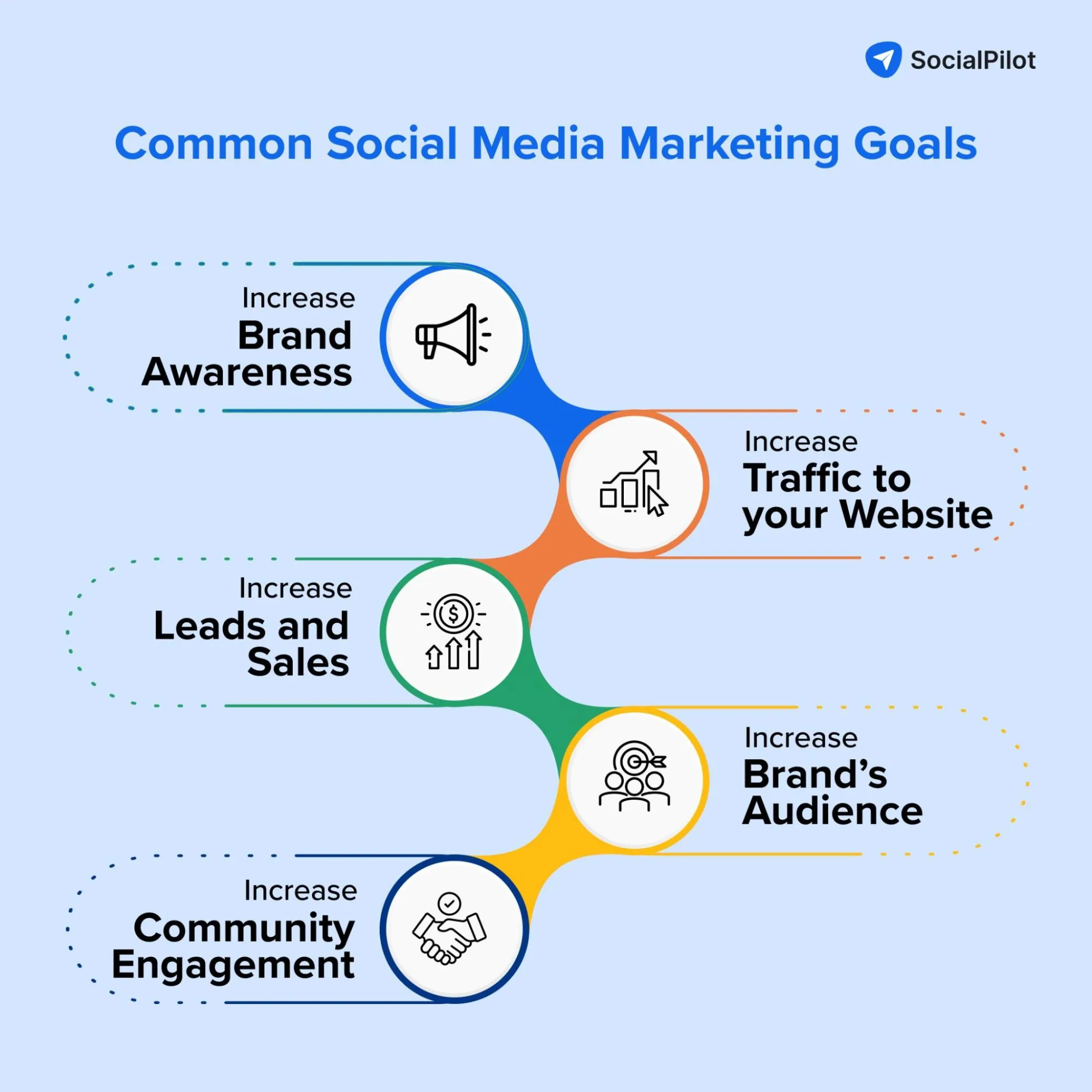
Instead of saying, “Increase website traffic from Instagram,” you can say, “Increase website traffic from Instagram by 25% within the next 3 months.”
After setting up your goals, you need to identify what metrics you need to measure.
At this stage, leadership plays a critical role. Establishing a data-first culture requires leaders to embrace data-driven decision-making, communicate its importance to the team, and ensure that social media goals clearly align with broader business objectives.
A shared vision ensures everyone is working towards the same goals and objectives and understands how their work contributes to the overall success.
Step 2: Identify Your Key Metrics and Build Processes Around Them
When we talk about social channels, there are a lot of metrics that might distract you from the broader picture. You need to establish benchmarks and decide which social analytics to use.
Here are some key metrics you should always consider:
- Brand Awareness: Reach, impressions, follower growth, brand mentions
- Engagement Rate: Likes, comments, shares, re-shares, click-through rates (CTRs)
- Website Traffic: Website clicks, referral traffic
- Lead Generation: Lead form submissions and sign-ups
- Sales: Conversions, revenue generated through social media
Besides the above metrics, businesses must also perform sentiment analysis by categorizing the brand mentions into positive, negative, and neutral buckets. Tracking the raw volume of tagged and untagged conversations about your brand reflects your brand health and familiarity.
At the same time, if you want to track platform-specific signals, then here are some platform metrics for different social channels:
- Instagram: Saves, profile visits, story replies, and reach.
- Facebook: Post engagement, link clicks, and shares.
- LinkedIn: Reactions, comments, link clicks, and follower growth.
- X (Twitter): Impressions, engagement metrics, reposts, and link clicks.
- YouTube: Watch time, audience retention, and subscribers gained.
- TikTok: Video watch time, completion rate, shares, and saves.
Once the relevant social analytics have been identified, it’s important to establish regular data review and reporting processes. You can use a Social Media Audit Template to compile your data and analyze your social strategy.
Most social media platforms offer built-in, native analytics tools for tracking the performance of your social media profiles. However, for deeper insights, you must have social media analytics tools in your arsenal.
Before opting for any tool, it’s important to ask the right questions, like
- What goals you’re tracking
- Which platforms do you need to monitor
- What reports are required
- Whether the tool offers customizable dashboards and paid campaign tracking.
Access to data is meaningless if employees lack the skills to analyze and interpret it. Organizations must assess their current tools, evaluate new technologies to fill gaps, involve team members in tool selection, and continuously monitor effectiveness.
Step 4: Track, Analyze, and Adapt Through Continuous Learning
The magic happens in this stage. Regularly monitor your selected metrics and analyze them in relation to your SMART goals. Here are some methodologies you can consider:
- Look for Trends: Identify patterns in your social media data over time. Are there any specific content types that consistently generate higher engagement? Are there any posting times that outperform others?
- Benchmarking: Compare your performance against industry averages or your competitors. This can help you identify areas for improvement.
- A/B Testing: Try different approaches to see what resonates best with your audience. For example, try variations in content format, posting times, or even ad copy.
Provide training and resources to help your team members interpret and analyze data, so that everyone is aligned. Training programs should cover data analysis for different social media networks, visualization, and data storytelling.
Encouraging experimentation and risk-taking allows teams to test new ideas without fear of failure and to improve performance continuously.
Step 5: Start Making Adjustments to Your Strategy
You are officially done with the social media monitoring and data collection – but what now?
It’s time to update your social media strategy and start driving growth. Based on your analysis, adapt your social media strategy to maximize results.
Here are some actions you should start taking:
- Double Down on Winning Content: If a particular type of content consistently performs well, start creating more of it!
- Optimize Posting Schedule: Use a social media scheduler to post at times when your audience is most active.
- Refine Your Targeting: Tailor your content and brand messaging to specific audience segments based on demographics and their interests.
- Experiment with Paid Social: If you are a social media marketer looking to reach a wider audience, consider investing in paid advertising.
- Refine Your Influencer Strategy: If you run influencer marketing campaigns, partner with influencers who resonate with your target audience and deliver measurable results.
Remember, social media analytics is an ongoing process. By consistently tracking, analyzing, and adapting your strategy, you can transform your social media presence into a powerful tool.
Encourage team members to ask questions and provide insights based on the data to drive better decision-making across the organization.
Step 6: Create a Data-First Culture To Make Analytics Work
A data-first culture ensures that social media analytics doesn’t stop at reporting. When leadership sets the tone, teams share a clear vision, and analytics are embedded into workflows, data becomes actionable.
Instead of reacting to numbers, organizations start making confident, informed decisions that turn social media analytics into a long-term growth driver rather than a one-time exercise.
Common Challenges for Not Adopting a Data-First Culture
Despite the growing importance of data-driven decision-making, only 24% of executives in the NewVantage Partners survey reported having achieved a data-driven culture.
Here are some common scenarios that prevent organizations from adopting a data-driven culture:
- Resistance to change: People may be comfortable with the status quo and hesitant to change established processes and workflows.
- Lack of data literacy: Not everyone is comfortable with analytics and their interpretation. Employees may need training to work with data and draw insights.
- Difficulty in finding and interpreting data: With so many analytics, finding the right data sets to answer specific questions can be complex and time-consuming.
- Insufficient resources: Adopting a data-first culture requires technology, training, and infrastructure investment, which some organizations are not willing to make.
- Ineffective communication: You must communicate the value of a data-driven culture to all stakeholders. If people don’t understand its benefits, they may resist it.
- Lack of buy-in from leadership: Without buy-in from senior leadership, it can be difficult to implement significant changes across an organization.
- Security and privacy concerns: When working with data, it is important to ensure that it is protected and handled in a way that meets regulatory requirements and maintains customer privacy.
5 Best Analytics Tools That Support a Data-Driven Culture
Social media analytics tools are the compass that guides brands to success. Here are some such social media reporting software that provide invaluable insights, shape strategies, and drive engagement:
SocialPilot stands out as a comprehensive solution for social media analytics. It offers a plethora of features that make tracking and managing your brand’s image a breeze:
- Content Performance Analysis: Effortlessly track the performance of your content across all social platforms from its all-in-one dashboard. Customize the dashboard with the metrics that matter to you the most.
- Audience Insights: Dive deep into audience demographic metrics such as age, gender, location, interaction, online activity, and more, as well as the organic and paid likes, to understand trends and growth patterns.
- Optimal Posting Times: SocialPilot’s analytics identify the best times to post on social media, so you can reach the maximum audience. By analyzing activity patterns, brands can maximize their content’s visibility and engagement potential.
- Advanced Reporting: You can generate advanced social media reports for yourself and your clients. You can either auto-schedule them, directly download them as PDFs, email them, or share them via live links.

Get a 14-day free trial
2. Meltwater
Meltwater is a global company specializing in media intelligence and social listening. They provide software solutions and services to help businesses monitor their online presence, track media coverage, and gain insights from social media and other online sources.

Meltwater collects data from various online channels, including social media platforms, news websites, blogs, and forums. Their social media analytics capabilities allow businesses to understand their brand’s reputation and industry trends.
3. Hootsuite
Hootsuite is a social media calendar and planner with analytics capabilities. You can measure and analyze performance across different social media platforms in one streamlined place.

Reports inform the best times to post based on when your audience is the most active and identify top-performing posts. Pre-built templates make reports customizable and easy to digest.
4. Brandwatch
Brandwatch is a consumer intelligence and social listening tool that comes with advanced analytics capabilities. It helps brands uncover social insights through social listening, sentiment analysis, and competitor benchmarking, which can inform content strategy and audience understanding.
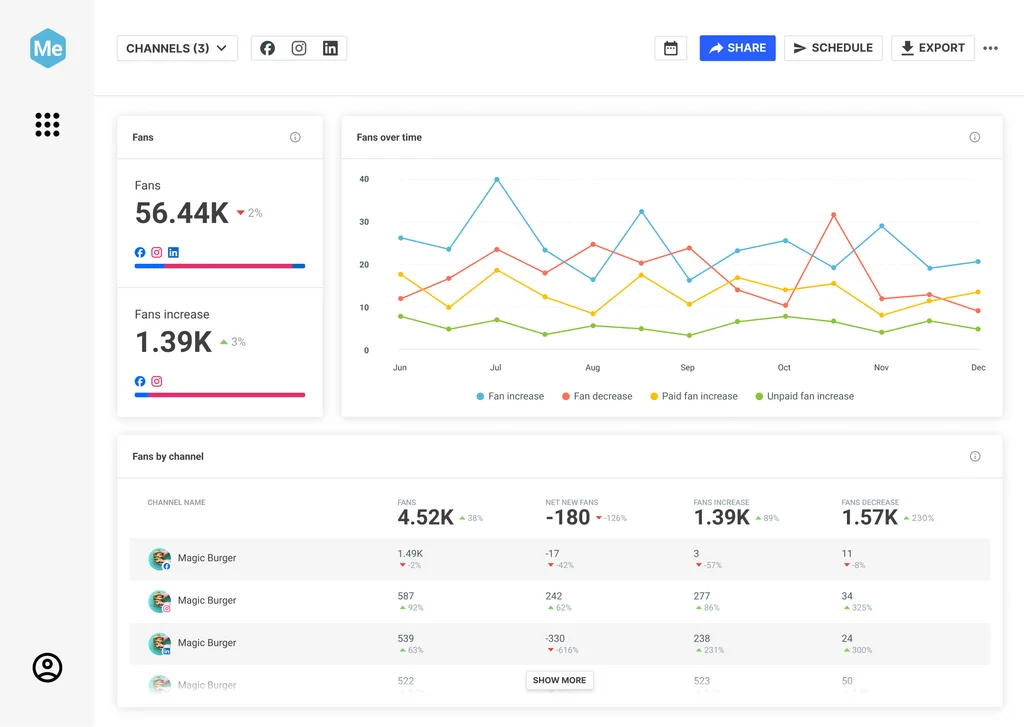
Audience profile cards can help you better understand the audiences engaging with your social content, and customizable dashboards allow you to view key data in one place.
Birdeye Social is an advanced social media reporting and analytics tool that empowers multi-location businesses to measure and optimize performance across different networks and locations.

With it, you can gain regional insights across major social media platforms, uncovering local preferences to tailor strategies. It also helps you monitor follower trends across platforms and locations, refining audience acquisition and retention strategies proactively.
Make Social Media Analytics a Part of Everyday Decisions
The whole purpose of tracking social media analytics is to turn them into actionable insights that you can act upon. Analytics help you set clear marketing goals, make informed decisions, and even improve the ROI for yourself and your clients.
Every comment, click, and share that you track will help you refine your social media strategy and strengthen your online presence. So, the sooner you start tracking these analytics, the sooner you’ll know what’s working and where you need to improve.
With the right analytics tool like SocialPilot, you can skip the guesswork and focus on strategies that actually move the needle. Explore SocialPilot’s pricing to find a plan that fits your needs and start making your data work harder for you.