“It was free, and it was visual. No one was using Instagram as a designer to promote their business – but I saw other businesses using it and thought there had to be something there.”
That was Shea McGee in 2014, posting from a spare bedroom before Studio McGee had a single full-time employee, before the Netflix show, and before the 4-million-follower audience she built entirely without paid marketing.
Her story gets told often. What gets left out is the context is that nearly 80% of interior designers are now active on social media, yet only 17% rate it as very effective for their business, according to a Forbes study from 2018. The gap between being on social media and actually benefiting from it is wide, and for most designers, it comes down to being on the wrong platform for their goal or posting without a system that survives a busy project month.
This guide covers every platform worth your time as an independent interior designer or small studio, shows you how real design businesses are using each one, and gives you a clear framework for deciding where to put your effort.
Social media’s real job in a design business is to validate a decision your potential client has already started making, not to create that decision from scratch. Most clients find designers through Google or a referral first, then check their social profiles to decide whether to reach out. Your feed is a credibility signal, not a discovery engine.
A comment from r/smallbusiness captures it plainly:
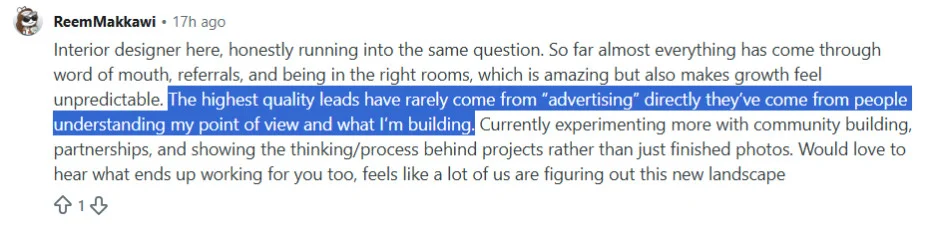
These threads tell us that most often, people don’t use social media to find a designer. They use Google or ask someone they know.
That framing changes what success looks like. You are not trying to go viral. You are trying to make sure that when a warm referral looks you up, what they find confirms you are the right choice.
Most designers fall short of that for one of three reasons:
- Wrong platform for your goal. Posting portfolio work on a platform where your clients are not in a hiring mindset produces engagement from other designers, not inquiries from clients.
- Portfolio dumping instead of trust building. Beautiful room photos with no personality or process behind them do not answer the question every potential client is really asking: what is it like to work with you?
- No publishing system. Posting when you have a free hour, then going quiet for three weeks during an install, signals inconsistency to anyone who checks your profile before reaching out.
Before we move any further, let us first talk about different platforms that work well for interior designers and also understand what each of these platforms actually does.
Six platforms come up consistently in recommendations for design businesses. Each serves a different function, reaches a different audience, and fits a different point in how clients make hiring decisions.
1. Instagram
Instagram is where clients come to vet you, not find you. By the time someone lands on your profile, they have usually already heard your name from a friend, a contractor, or a Google search. What they are doing on Instagram is confirming you are worth calling.
This Reddit thread talks about the experience of an interior designer who built a massive follower base but still couldn’t fetch clients from Instagram.

What this tells us is that your Instagram profile acts as a credibility asset and not a lead generation channel. The way you build that credibility is through consistency, personality, and showing the thinking behind your work alongside the finished results.
In 2025 and 2026, Instagram also functions increasingly like a search engine. The platform reads captions, on-screen text in Reels, and alt text as keyword signals. Writing captions with phrases like “transitional living room design Chicago” or “small bedroom refresh neutral palette” helps your content surface to users who are actively searching rather than passively scrolling.
Five content types that build genuine trust for designers on Instagram:
1. Process Documentation Posts – photos and short clips from material selections, site visits, and work-in-progress rooms. These are the easiest to produce because you are already at the project; you just need to pull out your phone. They also show potential clients that you have a real process, not just good taste.
Studio McGee regularly shares in-progress project moments that show the work before the reveal.

2. Client Transformation Reveals – before-and-after posts showing the full scope of what changed. This format gets high engagement and makes clear the difference between hiring a professional and attempting a renovation without one.
Amber Lewis of Amber Interiors uses full project reveals to show the complete transformation from empty room to finished space.

3. Design Decision Explainers – short posts or Reels explaining why you chose a specific material, layout, or fixture over the alternatives. “Why I specified this stone tile instead of three others we considered” demonstrates expertise in a way that a finished room photo cannot.
Emily Henderson walks through specific design decisions in Reels format, explaining the reasoning behind choices like rug placement and scale.
4. Material and Palette Spotlights – close-up shots of tile samples, fabric swatches, or paint selections from a current project. These are fast to produce and consistently get saved by users in the planning phase of a renovation.
Leanne Ford shares close-up paint and finish comparisons that help followers understand how material choices actually look in context.

5. Behind-the-Brand Moments – your face, your opinions on design trends, a showroom sourcing day, or a quick walk through a trade show. Clients hire the person as much as they hire the portfolio, and this content type is where they decide whether they like you.
Jeremiah Brent shares personal behind-the-scenes moments that give followers a view into the person behind the projects.
Posting cadence: 4 to 5 feed posts per week, with daily Stories when possible. The algorithm rewards consistency over volume, Reels surface your content to non-followers, and Stories keep your warm audience engaged between feed posts.
For more insights, read this guide on how often to post on Instagram to improve your reach.
2. Pinterest
Pinterest is not a social network. It is a visual search engine, and that distinction matters enormously for how you think about it as a design business.
When someone opens Instagram, they are browsing without a specific goal. When someone opens Pinterest, they are usually planning something concrete: a kitchen renovation, a bedroom refresh, a whole-home redesign. They type in “modern farmhouse kitchen ideas” or “warm minimalist bedroom with wood tones”, and they are searching for exactly the kind of work you produce. That intent-driven behavior is why Pinterest converts differently from every other platform.
The shelf life difference is equally significant. A pin you post today can drive traffic to your website 12, 18, or even 24 months from now. An Instagram post stops getting meaningful reach within 48 hours. For a studio that cannot post every day, Pinterest’s compounding nature is a structural advantage.
Pinterest has over 631 million monthly active users, and home and interior design is consistently one of the platform’s top search categories. 70% of users are female, which closely aligns with the primary demographic that makes residential design hiring decisions.
The right strategy is SEO-first: treat your pin titles, use rich pins and descriptions the way you would in a blog’s metadata. Keywords like “open-plan kitchen renovation ideas,” “Scandinavian bedroom design with wood accents,” or “coastal living room neutral palette” are how your work gets found by the right people at the right stage of their planning process.
Organize your boards by room type and aesthetic style rather than chronologically. A homeowner searching for bathroom renovation ideas should be able to land directly on a board full of your bathroom work without scrolling through your entire portfolio history.
Posting cadence: 5 to 10 pins per day, spread throughout the day using a Pinterest scheduler. Pinterest’s algorithm rewards consistent volume – more pins create more surface area for discovery across search. Batching your pins in a single weekly session and scheduling them to publish over the following days is the practical way to maintain this cadence without logging in daily.
Amber Lewis of Amber Interiors (pinterest.com/amberinteriors) uses Pinterest as a long-tail discovery engine for her California-cool aesthetic. Her boards are organized by room type, consistently keyworded, and serve homeowners who are years away from starting a project, building awareness of her studio long before they are ready to make a hiring decision.

The board structure and keyword approach Amber Lewis uses is replicable regardless of your studio’s size or aesthetic. If you want to build it from scratch, this Pinterest marketing strategy guide walks through exactly how to do it.
The repurposing shortcut: Most Instagram content translates directly to Pinterest with a keyword-rich title and description added. Same image, different platforms, different discovery paths, and months of additional reach from content you already created.
3. TikTok
TikTok is the only platform in this guide where your follower count does not predict your reach. Every video gets shown to a test audience of users who do not follow you, and if they watch it through or engage with it, the TikTok algorithm distribute it further. A designer with 200 followers can reach 200,000 people on a single video when the content connects. That cold-reach mechanic exists on no other platform in the same form.
The most common objection from established designers is that TikTok skews too young for their client base. The data does not support that for design content. The hashtag #interiordesign has billions of views on TikTok, with significant engagement from the 35 to 55 demographic that makes substantial home investment decisions.
Caroline Turner (@carolineturnerinteriors), a Chicago-based designer who trained under Kelly Wearstler and Nate Berkus, now books clients on the Upper East Side, in Naples, Florida, and in Park City, Utah – all of whom found her on TikTok.

She told Business of Home that TikTok clients arrive already knowing her material preferences and point of view, which compresses the project sales process considerably. The platform has become her primary client pipeline, replacing cold referrals.
Content formats that perform well for interior designers on TikTok:
1. Before-and-after reveals in 30 to 60 second time-lapse format. Arrofi Ramadhan (@arrofiramadhan) has built a 2M+ following almost entirely on transformation videos that compress full room makeovers into under a minute.
2. Design decision videos that walk through why you chose one option over several alternatives. Anthony Immediato (@anthonyimmediato) shares videos that explain the reasoning behind specific material and layout choices, giving followers insight into how professionals think through decisions.
3. Process walk-throughs from an empty room to a finished install, compressed into under a minute. Julie Jones (@juliejonesdesigns) documents full project progressions from planning through install, showing 640K+ followers exactly how a space comes together.
4. Educational content like “three things to clarify before your first design consultation” or “the lighting decision that changes every room.” Erin of Nifty Nest (@niftynest) consistently produces practical design education for homeowners, covering trends, tips, and decisions in a format that performs well with an audience actively planning a renovation.
Posting cadence: 3 to 5 videos per week. Short-form content (30 to 60 seconds) consistently outperforms longer videos for cold discovery, though longer formats work well for an established audience that already follows you.
Ideally, designers should add TikTok to their list once they have started posting consistently on at least one other platform. TikTok has a genuine learning curve; the algorithm needs several weeks of content before it understands what you create and starts distributing it effectively. Starting there before you have a stable foundation elsewhere adds complexity without a base to build from.
4. Houzz
Houzz is the most underused platform in interior design marketing, and it has the highest buyer intent of any channel in this guide.
Instagram users scroll for inspiration with no immediate hiring intention. Houzz users are actively searching for a professional to work with. Houzz has over 40 million monthly unique users, and the platform reports that 90% of them are homeowners actively considering significant home improvements. That intent-driven audience is fundamentally different from a social media browsing audience.
The review mechanic is what makes Houzz particularly powerful. Houzz Pro’s own data shows that professionals with at least three reviews are 15 times more likely to be contacted by a homeowner than those without any. That single figure explains why a well-maintained Houzz profile with five strong reviews can consistently outperform a highly active Instagram account for generating actual project inquiries.
What are the requirements to build a strong Houzz profile:
- Complete professional information: specialty, service area, minimum project budget, and any professional credentials (ASID, NCIDQ, state licensing)
- 15 to 20 portfolio photos minimum, organized by project type rather than upload date
- A consistent review collection process after each completed project
- Response to every inquiry within 24 hours, since Houzz displays the response rate on your profile, and prospective clients pay attention to it
Jennifer Kizzee, featured in Houzz Pro’s business growth series, built a steady stream of qualified renovation leads by treating her Houzz profile as a professional listing rather than a social feed. After uploading 20+ completed projects and building a systematic review collection habit, Houzz became a reliable source of inbound inquiries from homeowners already in active decision mode – a conversion quality that passive social media browsing rarely produces.

Note: Houzz does not support native post embeds like Instagram or TikTok. A screenshot of a complete, well-reviewed Houzz profile illustrates what an optimized listing looks like in practice.
Houzz works best for residential designers with three or more completed projects to show, particularly those targeting renovation and remodel clients who are searching by specialty and location rather than browsing by aesthetics.
5. LinkedIn
LinkedIn connects you with professionals who refer work to you, like architects, contractors, property developers, real estate agents, and commercial property managers. For designers working in commercial interiors, it is the primary channel. For residential designers focused on high-end clients, it functions as a professional credibility layer that matters to clients who research thoroughly before reaching out.
The content register on LinkedIn is different from every other platform here. Posts should read like professional case studies, not design portfolios. What performs well:
- The project context – what the space was, who it was for, what constraints you were working within
- The design challenge – what problem you were solving, not just what it looks like finished
- The outcome – measurable or observable results where possible
- The rationale behind key decisions – why you chose one approach over another
Aesthetics-first imagery without the professional context behind it does not land the same way it does on Instagram.
Posting cadence: 2 to 3 times per week, with longer posts (500 to 800 words) consistently outperforming short captions. The platform rewards quality and professional depth over volume.
IA Interior Architects uses LinkedIn as their primary visibility channel, posting project case studies, sustainability metrics, and workplace design commentary aimed at the corporate clients, developers, and property managers who commission large-scale fit-outs. Their content is outcome-focused and is framed around results and rationale rather than aesthetics, which is the appropriate register for an audience that hires based on demonstrated expertise, not design inspiration.
LinkedIn works best for:
- Commercial designers targeting architects, developers, and property managers
- Studio owners actively building contractor or architect referral relationships
- Marketing coordinators at mid-size firms with a B2B growth mandate
For solo residential designers, a complete and up-to-date profile is worthwhile as a professional credibility signal, but heavy content investment rarely justifies itself unless B2B referrals are an active goal.
6. Facebook
Facebook‘s organic reach for business pages has declined substantially, and relying on organic-only posting there is a low-return use of time for most design studios in 2026. The genuine value Facebook still offers designers sits in two specific areas: hyper-local paid advertising and professional community participation.
With paid Facebook Ads, you can geo-target homeowners in your area by income bracket, estimated net worth, and behavioral signals like “recently moved” or renovation-adjacent purchase behaviors. That level of specificity for a local professional service is harder to achieve through any other platform’s ad system. If you are trying to build a local client base and have a budget for paid advertising, Facebook is the most targeted option available to you.
On the community side, Facebook Groups like the Interior Design Business Network and The Ivy Designer Network are active professional communities where designers share business insights, discuss pricing and contracts, and exchange referrals. These are worth participating in even if your business page itself is not an active priority.
Nate Berkus uses his Facebook presence to maintain consumer brand awareness, sharing design projects and product picks with followers who found him through television and press. His page functions as a cross-platform credibility layer for people who want to follow his work in multiple places.
Posting cadence: Facebook’s organic algorithm heavily deprioritizes business page content, so posting frequency matters less here. If you are running paid ads, 3 to 5 posts per week gives the algorithm enough active content to work with.
Basically, Facebook marketing should be prioritized by designers running geo-targeted paid advertising campaigns for local client acquisition and those actively participating in professional Facebook Groups. As an organic-only channel without ad spend, it is not worth a heavy investment for most small studios.
Knowing what each platform does is the first part. Deciding which ones to actually invest in is the part that saves you from spreading effort across five channels and doing none of them well.
Here is the Platform-Purpose Framework of social media for interior designers, where we map out each channel to a specific function in a design business:
| Platform | Primary Function | Best For | Buyer Intent |
| Portfolio validation and warm lead nurturing | All residential designers, studio lifestyle content | Medium – discovery to consideration | |
| Evergreen cold discovery via visual search | Reaching homeowners actively planning a project | High – project-planning mindset | |
| TikTok | Brand awareness and cold reach beyond referral network | Designers wanting to grow a new audience | Low to Medium -awareness and education |
| Houzz | High-intent professional discovery | Designers targeting active renovation clients | Very High – ready-to-hire mindset |
| B2B referral network and professional credibility | Commercial designers, studios seeking architect or contractor referrals | Medium – professional credibility check | |
| Local paid targeting and community | Local client acquisition via ads; professional peer groups | Low organically; High with paid targeting |
Where to start based on your business type and need:
Solo or small residential studio (1–3 people)
Start with Instagram and Pinterest together. Instagram validates warm leads who already know your name; Pinterest builds discovery with homeowners actively searching for what you do. They serve the same client type through complementary mechanics.
Solo designer who wants faster audience growth
Swap Pinterest for TikTok. You get a stronger cold reach, but TikTok requires more frequent content and has a steeper learning curve. Pinterest compounds quietly with less ongoing effort – choose based on how comfortable you are on camera.
Commercial designer or B2B studio
Start with LinkedIn and Houzz. Architects, developers, and property managers who refer commercial project work spend their professional time there, not on Instagram.
Marketing coordinator at a mid-size firm
Prioritize in this order: Instagram → Pinterest → Houzz → LinkedIn → TikTok → Facebook. Add the next platform only when the previous one is consistently active and genuinely maintained.
The principle that saves more time than any tactic: Pick two platforms, show up consistently for 90 days, then decide whether to expand. A strong presence on two platforms consistently outperforms a thin, sporadic presence across five.
The Content System That Keeps You Consistent During Busy Project Phases
The most common reason designers go quiet on social media has nothing to do with running out of ideas. It is that they post manually on instinct, which works when no active projects are competing for their attention, and breaks completely the moment two or three clients are in parallel phases.
An inconsistent profile does not just fail to attract new business. It actively loses warm leads that your referral network has already generated. When someone who heard your name from a contractor checks your Instagram and sees nothing posted in five weeks, many of them make a quiet judgment about your availability or business health before they ever reach out.
For a professional service, your social presence functions as a credibility signal, whether or not you are actively trying to generate inquiries through it.
The batching method for an active social media presence
One focused weekly session replaces daily reactive posting. The process has three steps:
1. Document during project work. Take photos during material selections, site visits, sourcing days, and install milestones throughout the week. These become your content bank, and they cost almost no extra time because you are already at the project when you capture them.
2. Write all captions in a single sitting. Writing 5 to 8 captions at once using SocialPilot’s caption generator. This is significantly faster than writing one a day because you stay in the same mindset throughout rather than switching back and forth between project work and content creation.
Instagram Caption Generator
Generate scroll-halting Instagram captions with our AI-powered Instagram Caption Generator.
Here is the Generated Result
Create More for Free!
Get 500 Credits to Generate AI Content!
Since you’re an AI fanatic, we are offering you 500 Free Credits to generate awesome content
on
the AI Assistant of SocialPilot.
3. Schedule everything to publish automatically. Set your posts to go out at the right times throughout the week, then close the tab and do not think about social media again until the following session.
The total time investment is 60 to 90 minutes per week, which replaces 10 to 15 minutes of daily stress-posting that produces less consistent results and requires ongoing mental context-switching.
Realistic weekly time per platform
| Platform | Weekly Time Investment | What It Covers |
| 60 to 90 minutes | Batching 4 to 5 posts plus responding to DMs and comments | |
| 30 to 45 minutes | Scheduling 35 to 50 pins via a scheduling tool | |
| TikTok | 60 to 90 minutes | Filming and editing 3 to 4 short videos |
| Houzz | 15 minutes | Responding to inquiries, adding portfolio photos as projects complete |
| 30 minutes | 2 to 3 posts plus engaging with relevant professional content |
The scheduling layer that prevents last minute hassle
Manually logging into Instagram, Pinterest, and TikTok separately to post takes 20 to 30 minutes on its own, before you have written a single caption or selected a single image. A scheduling tool like SocialPilot replaces that fragmented daily habit with a planned calendar built once per week.
Our social media content calendar lets you schedule posts across Instagram, Pinterest, TikTok, and Facebook from a single dashboard, so a 90-minute weekly session keeps every active platform running consistently, including through the project weeks when you have no spare mental bandwidth for social media.

Build a Platform Stack That Works While You Work
Social media does not replace the referral network that most established design practices run on. What it does is validate the leads that the network produces, and through platforms like Pinterest and TikTok, occasionally surface new ones through discovery that would never have reached you otherwise.
Pick two platforms that match your market and your client type. Build a simple documentation habit around your project work. Use a scheduler to keep your profiles consistently active through every install week and client deadline. When someone hears your name and looks you up, what they find should confirm the decision they were already leaning toward.
To see how much time a scheduling tool can save across your active platforms, start a free 14-day SocialPilot trial and build your first full week of posts in a single session, no credit card required.