
Jamie runs a seven-person social media agency. Eight clients, mostly retail and e-commerce. On a Tuesday afternoon, she’s on a call with her longest-standing client – $1,800 a month, has been for two years – and the client says, “I just feel like we’re not getting enough value.”
Jamie posted 20 times last month. Replied to every comment. Sent the monthly report on time. And she’s still sitting there wondering how to defend her invoice.
If that sounds familiar, you already know the problem with fixed retainers.
The frustration is real, and it’s only getting worse as platforms become more challenging and tracking results gets trickier. There is a model that can change this: the performance-based retainer for social media agencies. This approach combines a steady base fee with a bonus that depends on hitting agreed KPIs. When results improve, you benefit. Your client also gets built-in accountability through the contract.
This guide will show you exactly how to build a performance-based retainer, covering the formula, how to qualify clients, how to pitch the idea, set KPIs, price your services, write the contract, and set up reporting so it works for 5 to 15 clients.
What Is a Performance-Based Retainer? (And How It’s Different from What Most Agencies Offer)
A performance-based retainer is a hybrid agency pricing model in which your fee has two components: a fixed base that covers guaranteed monthly deliverables, and a variable bonus that triggers only when agreed results exceed a set baseline.
This model is not the same as commission-only pricing, where your income depends completely on results you can’t always control. It’s also not like a fixed retainer, where your invoice stays the same no matter what happens. The performance retainer sits in the middle: you have a minimum to protect your margin, and a bonus to reward good results.
The Basic Formul
Once the model is in place, the math works like this:
Total Fee = Base + [(KPI Result − Baseline) × Agreed Rate]
Here’s how that formula looks with real numbers:
| Component | Amount |
| Base Fee | $2,500/month |
| Baseline (attributed social revenue) | $15,000 |
| Actual Result (attributed social revenue) | $20,000 |
| Revenue Above Baseline | $5,000 |
| Bonus Rate | 20% |
| Bonus Triggered | $1,000 |
| Total Invoice | $3,500 |
This example assumes you have a 30-day attribution window tracked with UTM parameters. Without this tracking in place, the calculation won’t work. That’s why we’ll talk about qualifying clients before you pitch this model.
What This Solves That Fixed Retainers Don’t
Under a fixed retainer, you get paid the same amount whether results are exceptional or flat. The client has no way to tell the difference, and you have no financial upside for outperforming.
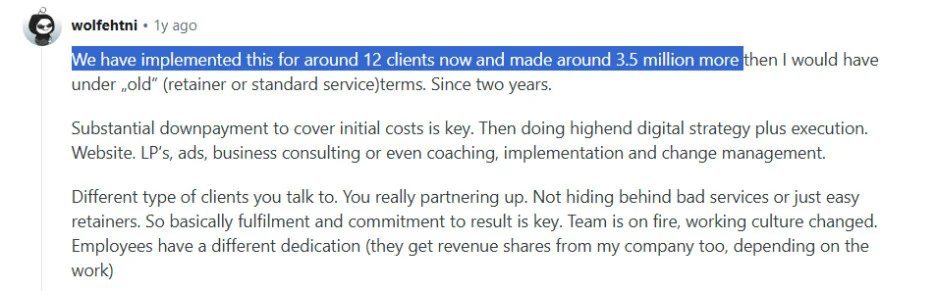
Under a performance retainer, the upside is tied directly to the work moving the needle. Multiple agencies have said they made much more money with performance retainers than with their other retainer clients. [Source: Reddit]
Your clients will stop asking, “what am I paying for?” because now there’s a clear number tied to your work. The conversation moves from defending your time to showing your results.
The One Condition That Makes This Model Work
You need a baseline. Without one, there’s no reference point for the bonus, no agreement on what “better” means, and no way to prove you earned the uplift.
Set the baseline during the first one or two months before any performance clauses start. Look for data like engagement rate, DM inquiries, link clicks, and attributed revenue. After you have 60 to 90 days of solid data, you can activate the performance part of the agreement.
Why Fixed Retainers Create Friction (And Why It’s Getting Worse)
Fixed retainers commoditize your work. The client sees a line item on an invoice, not a result. There’s no mechanism in the contract to show them what moved.
You’ve probably heard some version of this, coming from a retainer client [Source: Reddit]
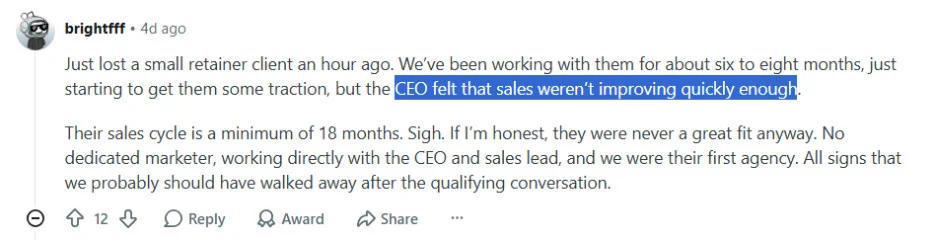
When clients on a retainer ask you to “do more,” it’s usually not about getting more content. They want proof that their money is making a difference. Fixed pricing can’t answer that, so you end up in a cycle: more posts, same fee, and the same conversation every quarter.
How Platform Algorithm Changes Made This Worse
The problem isn’t just about client expectations. Social media platforms have also made it harder to justify fixed pricing.
Over the last two years, organic reach has declined across every major social platform.
- Instagram engagement dropped approximately 24% year-over-year in 2025, according to the Rival IQ benchmark report.
- Facebook organic reach has been in a long-term decline since 2021, as the Facebook algorithm increasingly favors paid content and Reels over standard Page posts.
- LinkedIn shifted its feed algorithm in 2023 and again in 2024 to reduce the reach of broadly networked posts in favor of content within niche communities.
- TikTok’s algorithm remains the strongest for organic discovery, but even there, consistency and trend-timing have become harder to predict and guarantee within a fixed scope.
All these are platform-wide shifts that are outside an agency’s control.
With fixed pricing, you take on all the risk. If the client’s reach drops and engagement falls, your invoice stays the same, and you end up having another “what are we paying for?” call the next week.
Why the “Just Show ROI” Advice Doesn’t Fix It
Telling small agency owners to “just prove ROI” misses the real issue. Social media is at the top of the funnel, and tracking results is genuinely difficult.
Most small retail clients don’t have clean UTM tracking, a properly configured GA4 account, or CRM attribution that connects social activity to closed revenue. Showing ROI without that infrastructure doesn’t end the argument; it just starts a different one about which numbers to trust.
The performance retainer model avoids this problem by agreeing on how you’ll measure results before any work starts, not after the client is already frustrated.
You define the KPIs upfront, lock in the measurement source in the contract, and report against those same numbers every single month.
That’s where the right tool matters. SocialPilot’s social media analytics pulls engagement, reach, and post performance data from Instagram, Facebook, LinkedIn, TikTok, and X into one dashboard – so the numbers you report are consistent, and platform-verified.
When the measurement layer is clean from the start, the “which numbers do we trust?” conversation never happens.
What Performance Pricing Actually Solves and What It Does Not
A well-structured performance retainer fixes two specific problems.
The first is the accountability perception problem. The client sees that the agency has direct financial skin in the game. You’re not just billing for hours; you’re billing for outcomes. That changes how clients engage with you, how seriously they take your recommendations, and how quickly they move on approvals.
The second is scope creep. Because the bonus is tied to agreed KPIs, the work boundaries become explicit. The client knows what you’re accountable for and what falls outside the agreement. That gives both sides a reference point when new requests come in.
What it does not fix: Proving that your social media work is directly responsible for sales. That’s an attribution problem – and it’s a separate challenge entirely. To solve it, you need tracking links (UTMs) set up, an agreed method for measuring results, and a clear rule for how long after seeing a post a purchase still counts as social-driven.
The performance retainer gives you the structure. The tracking setup is what makes your bonus claims impossible to dispute.
Don’t present this model as a magic fix for proving ROI. Instead, explain that it’s a solid way to solve the accountability problem. That’s its real value.
How to Qualify Clients Before You Pitch Performance Pricing to Them
Not every client is a good fit for performance pricing. Before you pitch this model, look for these three signals to understand if your client is really ready:
Consistent baseline data – Before you can tie your fee to results, you need to know what “normal” looks like for that client. That means at least three months of social activity on the platforms you’ll manage – enough data to establish a realistic starting point.
A clear conversion path – Performance pricing only works when there’s something concrete to measure at the end of the funnel. That could be a purchase on their online store, a booking through their scheduling system, a lead form submission, or even a trackable click to a specific landing page.
If a client’s goal is “build brand awareness” with no defined action they want people to take, there’s no KPI to tie your bonus to.
Operational trust – If a client takes a week to approve content, keeps changing creative direction mid-month, or regularly pulls posts down after they go live, your results will suffer for reasons that have nothing to do with your work.
You need a client who reviews and approves content within 48 hours, trusts the agreed strategy enough to stick with it, and doesn’t introduce last-minute changes that disrupt the posting plan.
This Reddit thread on how to pick performance-based retainers is an insightful read for agencies.
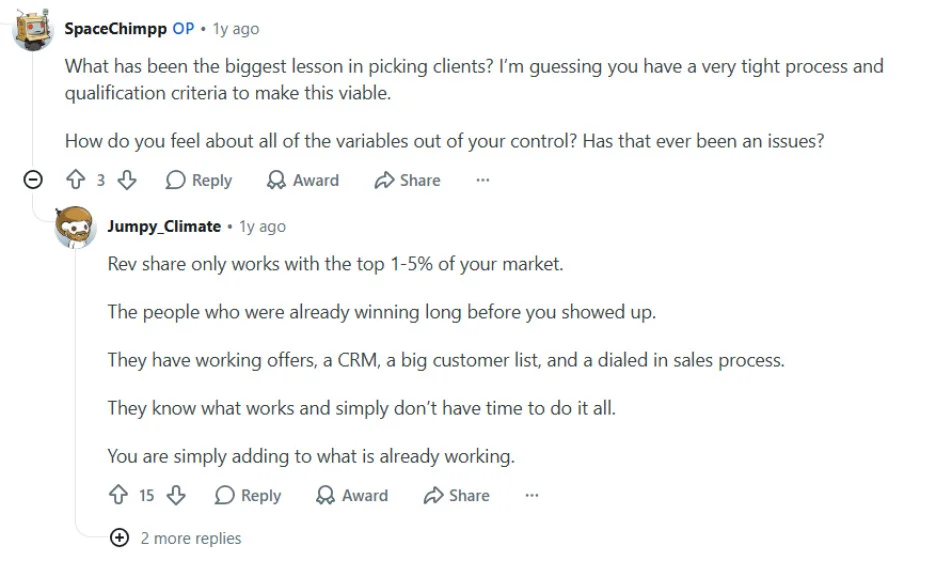
Your clients need to meet all three criteria above. If even one is missing, the model is likely to fail.
The Red Flags That Make Performance Pricing a Trap
Watch for these before signing anything:
- The client regularly pivots creative direction after content goes live.
- No tracking infrastructure – no UTMs, no GA4, no CRM
- A business category where social is a brand play, not direct-response (local restaurants, service businesses with no online booking, brick-and-mortar retail with no e-commerce component)
If a client doesn’t have a conversion path, there’s nothing to measure performance against. Keep them on fixed pricing and revisit in 6 months.
The Retainer Health Audit (Run This Before Pitching)
Before you approach any client about switching models, do a quick self-audit:
- List each current client.
- Note their conversion path (or lack of one)
- Note whether you have 90 days of baseline data.
If a client doesn’t have both a conversion path and baseline data, keep them on fixed pricing. Don’t try to force the performance model.
How to Introduce Performance Pricing Without Losing the Deal
The biggest mistake agencies make when pitching this model is saying, “I’ll only get paid if things work out.” This makes it sound like you’re taking on all the risk, which can make clients uneasy instead of confident.
Frame it as shared skin in the game instead.
A line that works: “I want to tie part of my fee to what we actually move, so you’re only paying more when the numbers go up.”
Make it clear that the base fee still covers all your deliverables. Posting schedules, community management, and reporting are all included. The bonus is just an extra layer on top of the work you already do.
The Three Objections You’ll Hear (and What to Say)
| Objection | Your Response |
| “What if social doesn’t move sales?” | “That’s why we set a baseline first and only trigger the bonus above it. If we don’t beat what you’re already doing, you pay the same base.” |
| “What if you just inflate vanity metrics?” | “The KPIs we agree on are the ones you already track – we’ll write them into the contract before we start, so there’s no ambiguity.” |
| “Can I just pay you a commission instead?” | “Commission-only removes the operational floor that lets me staff your account properly. Base plus bonus protects both of us – you only pay the bonus when results actually go up.” |
When to Walk Away
Two situations should be automatic dealbreakers.
If a client insists on commission-only with no base fee, decline. The base fee covers your hours, your team, and your tools while the work is happening. Without it, you’re funding their social media until results show up.
If a client won’t agree to a baseline period before bonuses activate, also decline. You can’t set a fair bonus threshold without knowing what normal looks like first.
These are not just points to negotiate. They are the basic requirements that make the model work. Without them, you take on all the risk with nothing to protect you.
How to Structure KPIs You Can Actually Defend
The KPIs you agree to are the ones you’ll be held to – so choosing them carefully matters more than most agencies realize. The mistake most people make is agreeing to whatever the client asks for upfront, without thinking through what they can actually control.
A workable KPI framework splits metrics into three tiers: what you own entirely, what you share with the client, and what you should never accept. Here’s how each one works.
Tier 1 – Agency-Owned KPIs (These Trigger the Bonus)
These are KPIs you control directly:
- Content output,
- Posting frequency,
- Response time,
- Engagement rate (likes + comments + shares ÷ reach or followers).
These KPIs aren’t affected by the client’s ad budget, website, or pricing choices. That’s why they work well as bonus triggers.
2025 platform benchmarks to calibrate your targets against:
| Platform | Benchmark Engagement Rate (2025) |
| 0.45–0.6% | |
| 3–3.5% | |
| TikTok | 2.5% |
| 0.06–0.2% |
KPIs that fall here include:
- Link clicks,
- DM inquiries, and
- Attributed website traffic
They’re useful indicators, but the client’s landing page quality, ad spend, and product offer all affect them.
If you include these as bonus triggers, add a clause: “KPI targets are subject to review if client-side variables change by more than 20% in any 30-day period.” This protects you when a client pauses ads or changes their homepage, leading to a drop in traffic.
Tier 3 – KPIs to Decline (Never Accept These)
This includes:
- Revenue,
- Direct sales, and
- Cost per acquisition
Too many variables sit outside organic social: product pricing, seasonal demand, competitor promotions, and inventory constraints.
If a client wants revenue-based KPIs, suggest a separate performance fee for paid social or ad spend management. Don’t include this in organic social management, since the factors are very different.
The Algorithm Change Exclusion (Non-Negotiable)
Include this in every contract: any major platform update that demonstrably affects organic reach triggers a 60-day baseline reset.
What qualifies as “major”: a documented reach drop of 15% or more across your client portfolio on that platform. Keep a dated record of when you flagged the change – that’s your protection when a client questions why engagement dropped in a specific month.
Tracking KPIs across 10+ clients manually is where this model breaks down fast. SocialPilot’s analytics pulls cross-platform data into a single dashboard, helping you track performance across clients without exporting CSVs from 5 different platforms each month.
Watch the video below to learn more about tracking ROI using social media KPI’s
How to Price Your Performance Retainer: Base Fee, Bonus Split, and Real Numbers
Most agencies just guess when it comes to pricing. They choose a number that seems fair, add a bit extra for potential upside, and hope it works out. Often, it doesn’t.
Pricing a performance retainer has three moving parts: the base fee, the bonus split, and the margin floor. Get all three right, and the model protects you. Get one wrong, and you can hit every KPI and still lose money.
What the Market Actually Charges
The average social media agency retainer sits at $2,107 per month, according to HeyOrca’s 2024 pricing report. The full range is $2,000 to $8,000, depending on scope, platform count, and deliverable volume.
When you move to a performance model, the base fee is usually 60 to 80 percent of what you’d charge for a fixed retainer. The other 20 to 40 percent is the performance bonus.
How to Split the Base and the Bonus
Two common models:
| Model | Base Fee | Max Bonus | Total if KPIs Hit |
| Conservative (70/30) | $2,100 | $900 | $3,000 |
| Balanced (60/40) | $1,800 | $1,200 | $3,000 |
The 30 to 40 percent bonus potential also motivates the client. When their bonus depends on quick approvals, clear briefs, and giving you access to tracking tools, they have a financial reason to work with you. Fixed pricing doesn’t create this kind of teamwork.
The 25% Rule (Your Non-Negotiable Floor)
Average agency net margin is 13%, according to Promethean Research benchmarks. That’s thin. It means your base fee cannot just cover direct costs; it needs to include a margin.
The rule: your base fee must cover operating costs plus a minimum 25% margin.
The calculation:
(Base Fee − Direct Hours Cost − Tool Costs) ÷ Base Fee ≥ 25%
If your margin isn’t at least 25 percent, increase the base fee. Don’t try to make up the difference with bonus earnings, since that income isn’t guaranteed.
How to Structure a Performance-Based Retainer Contract
A verbal agreement on KPIs and bonuses is not enough. The moment results are disputed – and at some point, they will be – the contract is the only thing that protects you.
A performance retainer contract needs four specific clauses. Each one closes a gap that, without it, becomes an argument.
Clause 1: The Deliverables Clause
What it is: A precise list of everything your base fee covers.
Why you need it: Without this, clients fill in the blanks themselves. Three months in, someone assumes ad management was included. Someone else thought you were writing blog posts, too. The deliverables clause makes the scope of work impossible to misread.
Write it out line by line:
- Number of posts per platform per week
- Response time for community management (for example: replies within 4 business hours)
- Reporting cadence (for example: monthly scorecard delivered by the 5th of each month)
What is explicitly NOT included – ads management, creative production, strategy calls, paid media – and whether those are available as add-ons
The more specific this clause is, the fewer “I thought that was included” conversations you’ll have.
Clause 2: The Performance Bonus Clause
What it is: The exact formula for how and when the bonus gets calculated and paid.
Why you need it: Bonus disputes usually happen because of confusion over who pulled the data, which tool was used, or what date range was counted. This clause settles all of that before you start, so there’s no confusion later.
Here’s a sample you can adapt:
“A performance bonus of [X]% of base fee is triggered when [KPI] exceeds [baseline] by [threshold] over any 30-day measurement period. Measurement source: [Instagram Insights / Google Analytics 4 – UTM-tagged sessions from social]. Reporting period: first to last calendar day of each month. Data pulled by: [agency / client – specify one].”
Clause 3: The Exclusion Clause
What it is: A list of circumstances where KPI targets are paused or reset – specifically, situations outside your control that affect results.
Why you need it: Many things can happen in a month that are outside your control. Without an exclusion clause, you could be blamed for results you couldn’t influence.
Conditions that should trigger a pause or reset:
- A platform algorithm change that causes a documented 15% or more reach drop across your client portfolio
- Client-initiated changes to creative direction mid-month
- Budget pauses or reductions are under the client’s control.
- Product changes, pricing changes, or promotional holds
- Client approval delays that push posting frequency below the contracted schedule
A straightforward trigger line to include: “Any client-side action that reduces posting frequency below 80% of contracted volume suspends the performance bonus for that billing period.”
Clause 4: The Baseline and Review Period
What it is: The rules around how the baseline is set, when it gets reviewed, and how either party exits the agreement.
Why you need it: If you don’t have a set baseline period, you’re guessing when setting bonuses. Without a review process, a baseline from January might not make sense by October if the client’s business changes. And without an exit clause, both sides can feel stuck.
Structure it like this:
- Months 1 and 2: Baseline measurement only. No bonuses triggered. This period is purely for collecting clean data.
- Quarterly review: The baseline resets if the client’s business conditions change materially – new product line, major promotional campaign, significant budget shift.
- Exit clause: Either party can exit with 30 days’ written notice. Bonuses already earned and paid are not subject to clawback.
Before the contract begins, make sure your social media workflow is set. This includes approval timelines, posting schedules, and your content calendar. The smoother your process is from the start, the less you’ll need to rely on the exclusion clause.
The Reporting Infrastructure That Makes This Model Operationally Viable
With fixed pricing, a monthly social media report was just a bonus. With performance pricing, it becomes proof for your contract.
You can only defend your bonus claim if you have data that’s timestamped and verified by the platform. If a client questions a bonus, they’ll want proof. If your data is scattered across different dashboards and spreadsheets, you’ll waste hours pulling it together or might just give up because it’s too much hassle.
So, you must build a reporting system before you sign the first performance contract.
What a Monthly Performance Scorecard Looks Like
Deliver this scorecard on the same day each month, before the invoice goes out:
| Scorecard Section | What It Shows |
| Tier 1 KPIs | Engagement rate, post frequency, response time – actual vs. target |
| Tier 2 KPIs | Link clicks, DM volume – actual vs. baseline |
| Exclusion Log | Algorithm changes, approval delays, or client-side events that month |
| Bonus Summary | Triggered / Not triggered + calculation breakdown |
The report should be clear and easy for clients to read. It shouldn’t just be a raw data export, but something they can understand in two minutes.
If you manage 5 to 15 clients on performance pricing, that’s 5 to 15 scorecards every month. Building each one manually from exported spreadsheets can eat up an entire week. SocialPilot cuts that down significantly.
Here’s what it gives you:
- Unified analytics – pull data from Instagram, Facebook, LinkedIn, TikTok, and X into one dashboard with social media analytics, updated in real time
- White-label reports – export fully branded, client-ready reports directly from the dashboard using White label social media reporting.
- Per-client views – each account is separate, so every scorecard reflects that client’s performance only
- Post performance breakdown – see which formats and posting times drove the most engagement, and pair it with best times to post data to back your recommendations
- Month-on-month trend tracking — show clients which direction results are moving, not just where they landed
Here’s a quick look at how SocialPilot’s analytics and reporting works across your client accounts.
All of this under one flat monthly fee. No per-client add-ons, no extra charges for white-label exports.
Stop Defending Your Invoice. Start Showing Your Results.
The fixed retainer model puts you in a tough spot. You do the work, but the client questions the value, and you end up spending calls defending your invoice instead of discussing real results.
The performance retainer changes this. It’s not just about how you get paid – it changes your relationship with the client. You’re not selling your time anymore. You’re selling results, backed by a contract and a scorecard.
Start with one client. Set up the structure properly: baseline period, tiered KPIs, exclusion clauses, and monthly reports. Try it for one quarter and let the results speak for themselves. Ultimately, it’s the reporting layer that makes this model operationally viable. Start a free SocialPilot trial and make the reporting side effortless across all clients.