
You have a client whose Instagram account you’ve grown from 4,000 to 22,000 followers in eight months. Engagement is up. They’re happy. And you’re sitting on a draft email proposing a bigger scope, cursor blinking, convinced the moment you send it they’ll decide you’re only in it for the money.
That hesitation is costing you more than you think. The problem isn’t the ask; it’s that most people have no system for making it.
This article gives you that system: 7 specific triggers that signal when a client is ready to hear more, a report structure that opens the conversation without pitching, and the exact language to use once it’s open.
Why Asking Clients for More Money Feels So Risky
The fear of sounding like a cash grab
The anxiety isn’t “what if they say no.” It’s “what if they decide I’m only here for the money.”
One freelancer on r/freelance described it plainly:
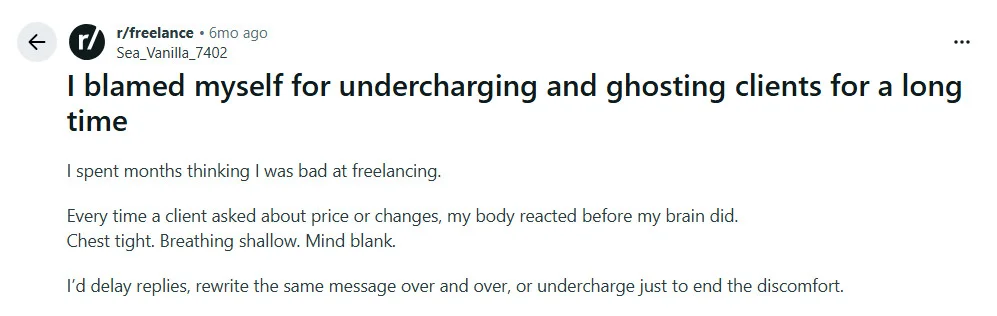
That fear is rational. Over-promising competitors have trained clients to distrust anyone who asks for more budget. When you ask without an earned reason, you sound exactly like everyone else who’s asked before you.
The solution isn’t to stop asking. It’s to ask with a reason the client can already see. When the trigger is external (a milestone, a competitor move, a platform shift), the framing changes from “I want more” to “you now need more.” That shift is everything.
Why undercharging quietly becomes a trap
Here’s what happens when you keep avoiding the conversation: costs rise, scope drifts, and your effective hourly rate silently collapses.
Not upselling isn’t the safe option. It’s a slow financial leak that compounds over months. The longer a retainer runs without a pricing review, the harder the conversation becomes, because now you’re not just asking for more. You’re trying to undo years of underpricing in a single email.
Do the math on your current retainers: actual hours, software costs, taxes, unpaid scope additions. The number is usually worse than you think.
Upsell, Scope Expansion, and Rate Renegotiation Are Not the Same Thing
Treating these three as one blurry category called “asking for more money” is the first mistake. Each move has a different trigger, a different justification, and a different conversation. Picking the wrong one is why clients push back.
| Move | What it is | Friction |
| Upsell | Adding a new service the client doesn’t have yet | Low: additive, not a critique of the current deal |
| Scope expansion | Deepening or increasing work already underway | Medium: requires showing the evidence |
| Rate renegotiation | Raising the price without changing deliverables | High: client gets nothing new |
Upselling: adding a new service
An upsell introduces something the client isn’t currently getting: paid social added to an organic retainer, short-form video alongside the existing content calendar.
The justification must be opportunity-based, not need-based on your side. “You’ve built a strong organic following on Instagram. TikTok is where the same audience spends twice as much time, and no one in your niche is there yet” is an upsell. “I need more hours to cover the work” is not.
Scope expansion: formalizing what’s already happening
Scope expansion covers more posts per week, a second platform, deeper reporting: growth inside an existing service.
The most common version of this is already happening for free. Scope creep, those “just one more thing” requests that pile up month after month, is informal scope expansion. And the longer you absorb it without formalizing, the harder the correction becomes.
One small business owner on r/smallbusiness learned this the hard way:

Track those requests as data from the start, then present the pattern as a packaged expansion. See client retention strategies for agencies for how to structure the ongoing relationship so this gets caught early.
Rate renegotiation: repricing what already exists
This is the hardest conversation because the client is paying more for exactly what they already have. It requires the strongest trigger: a renewal window, a tenure milestone, or documented under-pricing.
Disguising a rate hike as an upsell destroys trust the moment the client figures it out. Know which move you’re making before you open the conversation.
A commenter in r/smallbusiness put the positioning risk bluntly:

The 7 Triggers: When a Client Is Actually Ready to Hear More

The right time to ask is never a calendar guess. It’s signaled by something specific and observable. When you ask in response to a real trigger, the conversation stops being about what you want and starts being about what the client now needs.
1. Performance Spike Trigger
A result the client cares about just arrived: a follower threshold hit, a viral post, an engagement spike. Momentum is undeniable. Tie the ask to extending the win. “We just hit 25k. Here’s what would let us double down on what’s working.”
Pre-define which metrics count as spike triggers before they happen, so you’re not scrambling for language when the moment arrives.
2. Milestone Trigger
A campaign wrapped. A quarterly target was met. A project goal was hit. Milestones create natural pauses clients are already expecting to discuss. Use those pauses. They’re structurally built for the “what’s next” conversation.
3. Platform Gap Trigger
Your client is active on two platforms. Three competitors just moved to a third. The urgency comes from the market, not from you. The client feels the pressure. You just named it first.
4. Competitor Move Trigger
A competitor launched a new content format, hired an agency, or started running ads. This is a time-bound, blameless reason to expand scope. You’re not asking for more. You’re responding to something real that happened outside the room.
5. Algorithm Shift Trigger
A platform changed how it distributes content. Reach dropped. Short-form video now gets twice the reach that organic posts used to. Algorithm shifts create a gap between what the current retainer was built for and what the platform now rewards. That gap is an upsell opening with a built-in reason.
6. Capacity Trigger
When a client keeps adding “just one more thing,” that’s informal scope expansion happening for free. It often starts small, as this freelancer describes it on r/freelance:

Track out-of-scope requests as they come in. When the pattern is clear, bring it as data: “Here’s what’s been added over the last three months. I’d like to package this properly so we can keep doing it well.”
7. Renewal / Tenure Trigger
A contract is coming up for renewal, or a client has been with you for 12 months with consistent results. Both are legitimate windows for renegotiation or scope expansion. Rate conversations belong at renewal, not mid-contract without a reason.
The most overlooked upsell asset is the one your client already expects every month: the analytics report.
A report is not a pitch. It’s data they asked for. That’s exactly what makes it the right place to open the conversation. You’re not selling anything. You’re showing them what happened and what it means.
Most reports stop at results. They show what happened and close. That’s a missed opening every single month.
Structure the report so it ends in an opportunity
Every report should close with three sections in this order:
| Section | What it covers |
| Results delivered | What happened: growth, engagement, reach, conversions |
| What’s now possible | What these results have unlocked: the ceiling you can see, the channel that now makes sense |
| Recommended next step | One specific recommendation with a clear value link |
The “what’s now possible” section is where the trigger lives. It reads as an observation, not a pitch, because it’s grounded in data the client already trusts. A client management tool for agencies with built-in analytics and white-label reporting makes it much faster to produce this section consistently across multiple clients every month.
A commenter in r/DigitalMarketing described exactly what strong results with good reporting look like, and why it still isn’t enough on its own:

Make the ask follow from their number
Tie the ask to a result the client already values.
“We grew your organic reach by 140% this quarter. We’re hitting a ceiling because we’re only on one platform. Here’s what removing that ceiling looks like, and what it costs.”
The client is looking at their own number. The ask follows from their result, not from your revenue needs. That’s what removes the “cash grab” read entirely.
The agency-specific failure mode
Account managers often assume results sell themselves. They don’t.
The AM who produced the report is often not empowered to make the explicit ask. A strong month gets shared, the client says “great work,” and the window closes. Assign the report-driven ask as an explicit AM responsibility, and give them an actual script, not a vague instruction to “mention it.”
The Step-by-Step System for Proposing More Without Pushback
A user on r/freelance described the fix well:

Same sequence every time. That’s what makes it repeatable.
Step 1: Confirm the trigger and the value link
Never start the conversation without both. A trigger tells you when. A value link tells you why it’s worth the client’s money.
Write the value link as one sentence before doing anything else: “Because [result], the client is now positioned to [opportunity], and [new service] is what gets them there.”
If you can’t write that sentence cleanly, the trigger isn’t strong enough. Come back when it is.
Step 2: Choose the move and set a defensible number
Decide: upsell, scope expansion, or rate renegotiation. Then price it between the client’s current rate and the full market rate. Anchoring in the middle gives the client a number that feels fair, not opportunistic, and it protects the relationship regardless of the answer.
Refer to social media management costs to benchmark current rates before setting a number.
Step 3: Open with the result, qualify before you pitch
Don’t open by presenting the offer. Restate the win, then ask a question that gets the client to articulate the gap themselves.
“We hit [result] this quarter, which is a big deal. Before I share a thought on next steps, I want to ask: what does this actually change for you on the business side? Do you want to press on it, or is the priority somewhere else right now?”
Wait for the answer. If they say “press on it,” you have permission. If they name a different priority, you’ve learned something that makes the next ask more targeted.
A commenter in r/Entrepreneur recognized this sequence and had a name for it:
Step 4: Present the expansion as the logical next step
One recommendation. Not a menu.
“Given [result], the next thing standing between you and [next goal] is [specific gap]. Here’s what closing that gap looks like and what it costs. I think this is the right move, but you know your priorities better than I do — tell me if the timing is off.”
The last sentence matters. It gives them permission to say “not now” without saying no, which keeps the door open.
Step 5: Document, confirm, and set the next review
Update the scope document. Restate deliverables in writing. Book the next review date.
This is also where you update your per-client log: lifecycle stage, last trigger, conversation outcome, and next scheduled review. If you’re managing five or more accounts, this log is what keeps upsell windows from closing unnoticed.

Timing the Ask to the Client Relationship
The same trigger and the same number can land completely differently depending on where the client is in their lifecycle with you.
Onboarding: plant the expansion, don’t pitch it
In the first 30 to 60 days, your only job is to prove value. But name the bigger picture early: “As this grows, here are the next natural steps we might add.” You’re not pitching. You’re signposting. When the expansion comes up three months later, it feels pre-agreed, not sprung.
The mid-retainer window: where most upsells should happen
The 3-to-6-month mark is the highest-conversion window. Trust and results both exist. The relationship is solid enough for a real business conversation.
The optimal upsell window is approximately three months into a successful engagement, when satisfaction is high but results have not yet plateaued.
Your first strong report in this window should double as a scheduled upsell checkpoint.
Renewal and the returning client
Renewals are the natural home for rate renegotiation. The contract ending is built-in permission to revisit pricing.
The agency failure mode is rolling over old pricing out of discomfort. The client never asked for the discount. At renewal, rates are reviewed, not grandfathered. For returning clients, anchor the new price between what they used to pay and what a new client would pay. A fair number, presented clearly, rarely loses a client who valued the work.
A thread in r/Entrepreneur spells out exactly how to frame that conversation:

The Ask Was Never the Problem
Every awkward upsell conversation came from the same place: no trigger, no value link, no script. Just pressure and a vague hope the client would say yes.
The framework above is repeatable. The trigger tells you when. The value link tells you why. The five-step system gives you the language. Run it once with a real trigger and the conversation stops feeling like a request. It starts feeling like advice.
Managing the upsell conversation is one system. Managing the accounts that feed it is another.
SocialPilot is built for agencies doing both: multi-client scheduling, automated analytics, white-label PDF reports, client approval workflows, and a unified inbox, all in one place. When the trigger data is already in your dashboard and the monthly report builds itself, the “what’s now possible” section takes minutes, not an hour before the call. Explore SocialPilot’s plans and pricing to see which fits your agency.