
Have you ever driven your car without knowing your destination? Probably not. You risk wasting time, fuel… and never getting where you want. In marketing, it’s exactly the same thing. Without a clearly defined target, your campaigns risk reaching the wrong people and generating few results.
There marketing target refers to the people most likely to be interested in your products or services. Defining it allows you to focus your efforts on the right prospects, personalize your communication and optimize your marketing budget.
But how to precisely identify your target? Discover the 8 steps to building an effective marketing strategy.
1. Carry out market research
Before defining your marketing target, you must understand the market in which you operate. A market study allows you to identify consumer expectations, trends in your sector, opportunities to seize and the positioning of your competitors.
Start by gathering essential information about your market:
- the location of your target: local, national or international
- demographic data: age, profession, income level, sector of activity, etc.
- purchasing and consumption habits
- the needs and issues of your future customers
- THE market trends
- economic or regulatory developments
- the main players in your sector
All of this information will help you identify the most relevant customer segments for your business.
Complete your analysis with a SWOT matrix
There SWOT matrix (Strengths, Weaknesses, Opportunities, Threats Or Strengths, Weaknesses, Opportunities and Threats), remains an excellent tool for gaining perspective on your business and its environment.
In particular, it makes it possible to identify:
- your strengths and competitive advantages
- your weaknesses
- the opportunities offered by your market
- threats likely to impact your business
In addition, a PESTEL analysis can also help you better understand the political, economic, socio-cultural, technological, environmental and legal factors that influence your market.
Rely on your data
Today, you probably already have valuable information about your target.
Analyze for example:
- your website statistics
- queries that generate traffic from search engines
- the performance of your advertising campaigns
- data from your CRM
- requests addressed to your customer service
- reviews left by your customers
This data often makes it possible to identify the profiles that convert best, the most frequent needs or even the subjects that really interest your audience.
Save time with AI
Artificial intelligence tools can also speed up your market research.
In particular, they allow you to quickly analyze hundreds of customer reviews, summarize satisfaction surveys or even identify recurring issues expressed in your emails, your support tickets or comments published on social networks.
AI doesn’t replace your expertise, but it is a great way to surface the most important trends quickly.
Once this first step is completed, you will have a clear vision of your market and will be able to define your marketing target on solid foundations.
2. Create precise buyer personas
After collecting all this information about your market, you can create your buyer personas, i.e. profiles of your ideal customers.
The objective is to understand who your offer is aimed at and what the needs of your future customers are. To do this, ask yourself the right questions:
- What age group does your product or service target?
- What is their professional situation?
- What is their income level?
- Where do they live?
- What are their needs and goals?
- What obstacles can prevent them from buying?
Today it is also important to go beyond simple demographic criteria. Take an interest in the behaviors of your target:
- How does she search for information?
- What content does she consult before purchasing?
- What criteria influence its decision?
- On which channels is she most active?
This information will help you create more relevant marketing campaigns and adapt your communication to each customer profile.
If your business caters to multiple types of customers, create multiple personas to personalize your messages and offers.
3. Define the emotional needs of your marketing target
Beyond demographic criteria, it is essential to understand what motivates your target. What are its values? What interests him? What subjects hold his attention?
These elements will help you create a more authentic communication and to build a brand image in which your prospects recognize themselves.
For example :
- Biocoop highlights ecological values and responsible consumption
- Red Bull associates its brand with energy and surpassing oneself
- Apple conveys an image of innovation, simplicity and design
- Le Slip Français promotes Made in France and local know-how
By identifying the values that bring your business closer to your target, you will create more memorable and engaging marketing campaigns.
4. Understand pain points
To convince a prospect, you must understand why they need your product or service. What problem is he trying to solve? What goal does he want to achieve?
Pain points can generally be grouped into four categories:
- Financial : reduce costs or obtain better value for money
- Productivity : save time or automate certain tasks
- Organization : simplify a process or improve the functioning of your activity
- Accompaniement : benefit from better support, advice or an easier-to-use solution
Identifying these needs will allow you toadapt your speech commercial and show how your offer concretely meets the expectations of your target.
5. Identify your target’s purchase triggers
Understanding your target’s needs is not enough: you must also know what will push them to choose your business rather than another.
What elements can trigger your decision to purchase? A more advantageous price, time savings, a better user experience, personalized support or even a specific functionality?
Identifying these triggers will help you make the right arguments in your sales pages, advertisements and marketing content.
For example :
- Management software can convince its prospects thanks to time savings and task automation
- A premium brand can rely on the quality, expertise and experience offered
- A support service can differentiate itself thanks to its personalized follow-up
By understanding the criteria that influence the decision of your prospects, you will be able to create more relevant messages and increase your chances of conversion.
6. Know your existing customers
If you already have customers, they are your best source of information for define your marketing target.
Analyze in particular:
- your website statistics
- the data of your CRM
- the performance of your marketing campaigns
- statistics from your social networks
- satisfaction surveys
- customer reviews
All this information will help you better understand the needs, habits and expectations of your audience in order to refine your targeting.
7. Analyze the competition
Even if you’re just starting out, your competitors can provide you with valuable information.
Study their website, social media, advertising campaigns or newsletters to understand:
- who they target
- what arguments they put forward
- what content works best
- how they communicate with their prospects
Don’t forget to also analyze the reviews left by their customers. They often reveal strengths, weaknesses and expectations that you will be able to meet.
8. Identify opportunities with competitive mapping
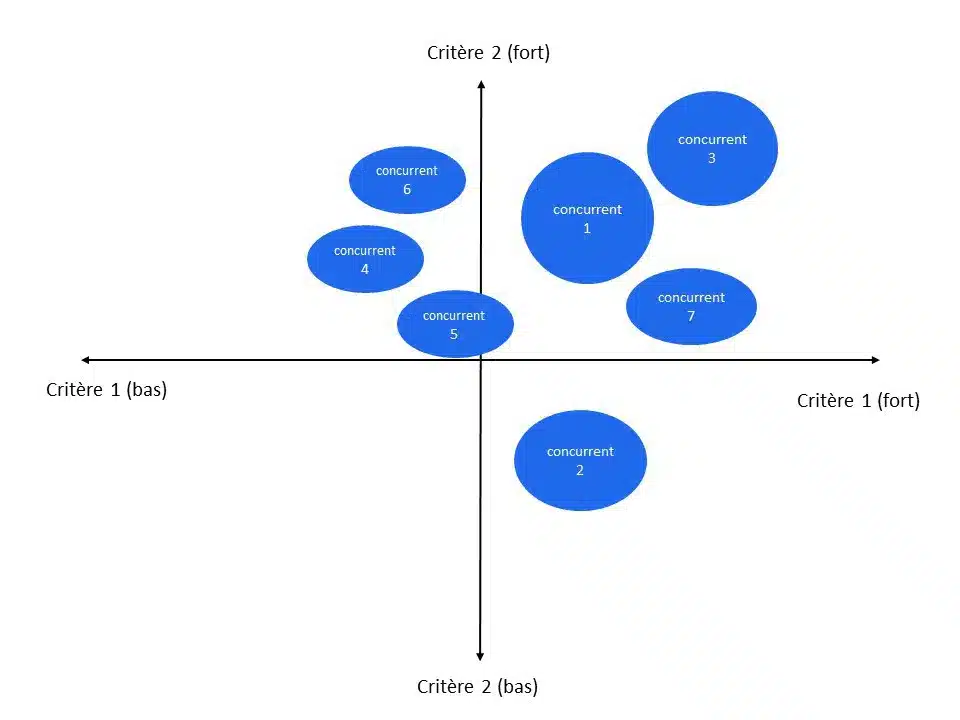
Competitive mapping allows you to visualize the positioning of the different players in your market and identify opportunities.
To achieve this, draw two axes representing the most important criteria for your customers (for example: price and quality, or expertise and ease of use).
Then position your competitors on this graph. Spaces with little or no occupancy often represent market opportunities or customer segments that are still underexploited.
This exercise will help you refine your positioning and identify a marketing target on which to focus your efforts.
A well-defined marketing target for more effective campaigns
Defining your target is the essential phase of any marketing activity and campaign. After this step, you will be able to better determine your audiences, write your message, choose your visuals and select the most appropriate content to meet your marketing and commercial objectives.
Also consider planning personalized scenarios for your different targets if you have several personas. Use a marketing automation tool to send relevant marketing communications to each target.
No time to manage the marketing of your business? Need to delegate the creation of graphics, community management or the writing of blog articles?
All the freelancers you need are on Codeur.com. Post your project for free to receive their quotes in just a few minutes.