The market for electronic invoicing was structured into two main categories of Approved Platforms (PA): those intended for final businesses and those specialized for software publishers. Understanding these differences is essential to make a choice suited to your business and avoid hidden costs or competitive risks.
In this article, focus on the specificities of the platforms for businesses and for publishers, and on the way in which IOPOLE, pure player in electronic invoicingsupports publishers in their compliance and digital transformation projects.
Electronic invoicing market segmentation
A Approved Platform is a service provider registered by the French tax administration, authorized to:
- issue, receive and transmit electronic invoices between organizations;
- ensure regulatory compliance of formats (e.g. Factur‑X, UBL, CII);
- transmit the tax and transaction data required by the reform (“e-reporting”).
Without PA, an electronic invoice is not considered compliant, and no regulatory transmission is possible.
At the same time, a Compatible Solution is software (accounting, ERP, invoicing, box…) which complies with the standards of the reform but is not registered: it must go through a PA so that invoices and information reach the administration or customers.
Concretely, a company or a publisher can use compatible software, but the effective regulatory flow is ensured by a registered PA.
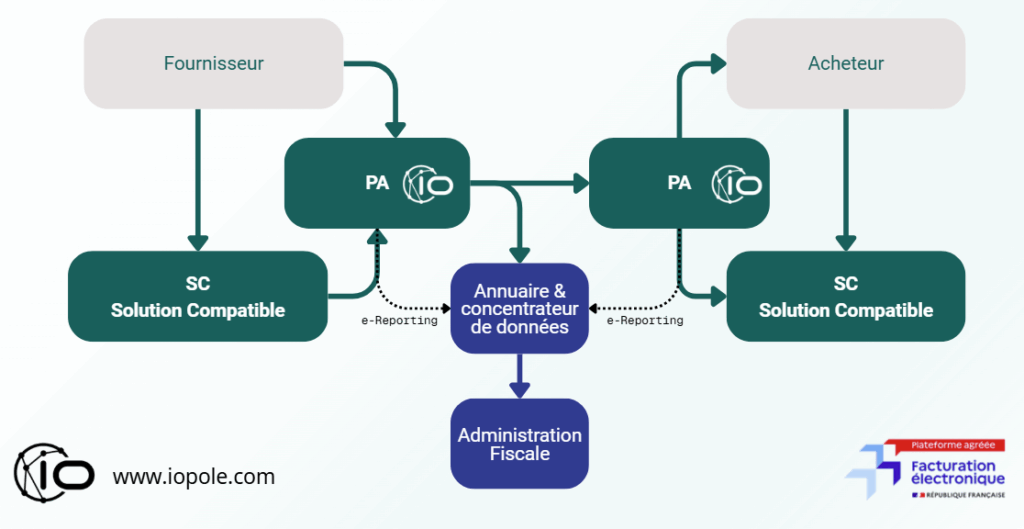
On this basis, the platforms are structured according to two logics:
PAs for end businesses
- Offered by accounting software or ERP providers.
- Objective: to offer an additional service to their customers.
- Risks: initial low cost, post-reform price increase, lock-in of the customer base.
PAs for software publishers (B2B2B)
- Designed to support publishers in bringing their customers into compliance.
- Offer modular solutions via full API, sandbox for testing and POC, regulatory monitoring.
- Allow the publisher to remain in control of its service and its customers, while outsourcing the technical infrastructure.
Approved platform for business
For whom?
Business-oriented platforms often come from historical providers of management solutions, accounting, orERP who have added a PA to their offering to provide a complete service to their customers.
How do they work?
- They allow businesses to issue and receive invoices
- They ensure basic regulatory compliance
- They generally position themselves on a broad audience without strong business customization
What they don't do or do wrong
- They do not always master all complex business use cases (construction with retentions and subcontracting, ESN with project invoicing, communication agencies, etc.)
- They are often sold as a complementary service to software, which sometimes creates dependence on the supplier (customer lock-in) rather than a strategic choice
- Many offer an initial low-cost offer (or even free) which, once the reform is fully applied, risks being increased without transparency (post-reform pricing)
For a final business, it is often preferable to opt for:
- specialized business software already labeled Solution Compatible in which the PA is integrated as a proxy (example: Summeo, Obat, Bill-Up, etc.)
- directly a robust PA adapted to its sector (example: AxonautYooz…)
In the case of a Compatible Solution well integrated into the business software, the company does not need to contract separately with a PA: transmission is managed via the agreement between the compatible software and the PA.
Example : a company using compatible software such as Summeo or Obat does not have to subscribe directly to the Iopole Approved Platform. Its invoicing business tool takes care of the routing. However, you will have to go through an onboarding process in 2 clicks which allows you to verify the identity and manage the registration in the directory/mandate.
Approved platform for software publisher: a strategic partner
For whom?
Specialized APs for business tools like Iopole are designed to:
- make software Solution Compatible
- integrate technically via comprehensive APIs
- support publishers on complex business use cases
- offer a stable, sustainable infrastructure aligned with regulatory developments.
This allows the publisher to offer its customers electronic invoicing services without bearing the regulatory burden.
Why the editor model is different
This is a fundamentally B2B2B model. Software publishers do not want to lose control of their offering and above all must not be dependent on a PA which could become a competitor:
- a PA that extends its business offerings (accountingmanagement, etc.) can become a direct competitor to the publishers it serves
- a platform that is too generic does not always understand the specific needs of this or that publisher and its market
- The publisher must be able to monetize the billing services it offers
These points are essential to explore for business solutions that want to become a white label PA or Compatible Solution.
Electronic invoicing project: the real needs of publishers
For a publisher who wishes to bring its software into compliance, a PA must offer:
- A complete and documented API: to integrate flows directly into the software without DIY.
- A powerful sandbox: to enable fast and reliable testing and POCs.
- Permanent regulatory monitoring: because standards evolve quickly (French standards, technical formats, international e-reporting).
- Commercial neutrality: the partner must never compete with the publisher in the same businesses (functional building blocks, business modules, etc.)
This is exactly what IOPOLE offers: a pure player platform 100% dedicated to electronic invoicing for publishers, without extension to competing business functions.
Comparison: company PA vs publisher PA
| Criteria | PA Company | PA Iopole |
|---|---|---|
| Target audience | End businesses | Business solution publishers |
| Integration | Limited (transmission) | Full API |
| Business adaptation | Generalist | Sectoral use cases |
| Competition | High | Pure Player e-invoicing |
| Scalability | AVERAGE | Compliant and scalable |
| Scalability | N / A | Sovereign Cloud, SLA 99.9% |
Contact the partners of the software publishers: Compliance with Electronic Billing