Think about the last beauty product you bought. Chances are, you first saw it on your Instagram feed, a TikTok tutorial, or a YouTube review.
According to a recent survey by Beauty Buddy, 97% of consumers have purchased a beauty product after seeing it on social media. Given that this industry is highly visual, personal, and trends-driven, social media offers an unprecedented opportunity for beauty and cosmetic brands around the world.
In fact, several multi-million-dollar beauty brands are built almost entirely through social media and community engagement.
Social media marketing for beauty brands acts as a catalyst, accelerating product discovery and bringing emerging beauty brands to millions of potential buyers worldwide.
But how can beauty brands leverage social media to its fullest potential?
That’s exactly what we are here to talk about. From picking the right platforms and creating content that actually drives engagement, this guide will help you turn your social media into a powerful marketing channel.
Key Takeaways
- 97% of consumers have bought a beauty product after seeing it on social media, making it the most powerful discovery and sales channel for beauty brands.
- Instagram remains the home base for beauty brands followed by TikTok. In 2024, 79.3% of TikTok Shop sales in the US came from beauty products. Platforms like Pinterest, YouTube and Facebook can be used to expand local reach and build community
- Content like Tutorials, before-and-after transformations, product demos, giveaways, and myth-busting educational posts, work for beauty brands. Also, listening to your audience, embracing user-generated content, and partnering with creators who genuinely love your product can help you stand out.
So why should your beauty business invest time and energy into social media? Because it does more than just “get your name out there.” Here’s what it actually brings to the table.
1. Drives Product Discovery
Social media is where people find new beauty products – not just buy them but discover them for the first time. In fact, 70% of the people discover new beauty products either on social media or through influencer recommendations.
The image below shows which platforms are used most by consumers and brands on social media, It also mentions the most preferred social platforms for different categories of consumers.
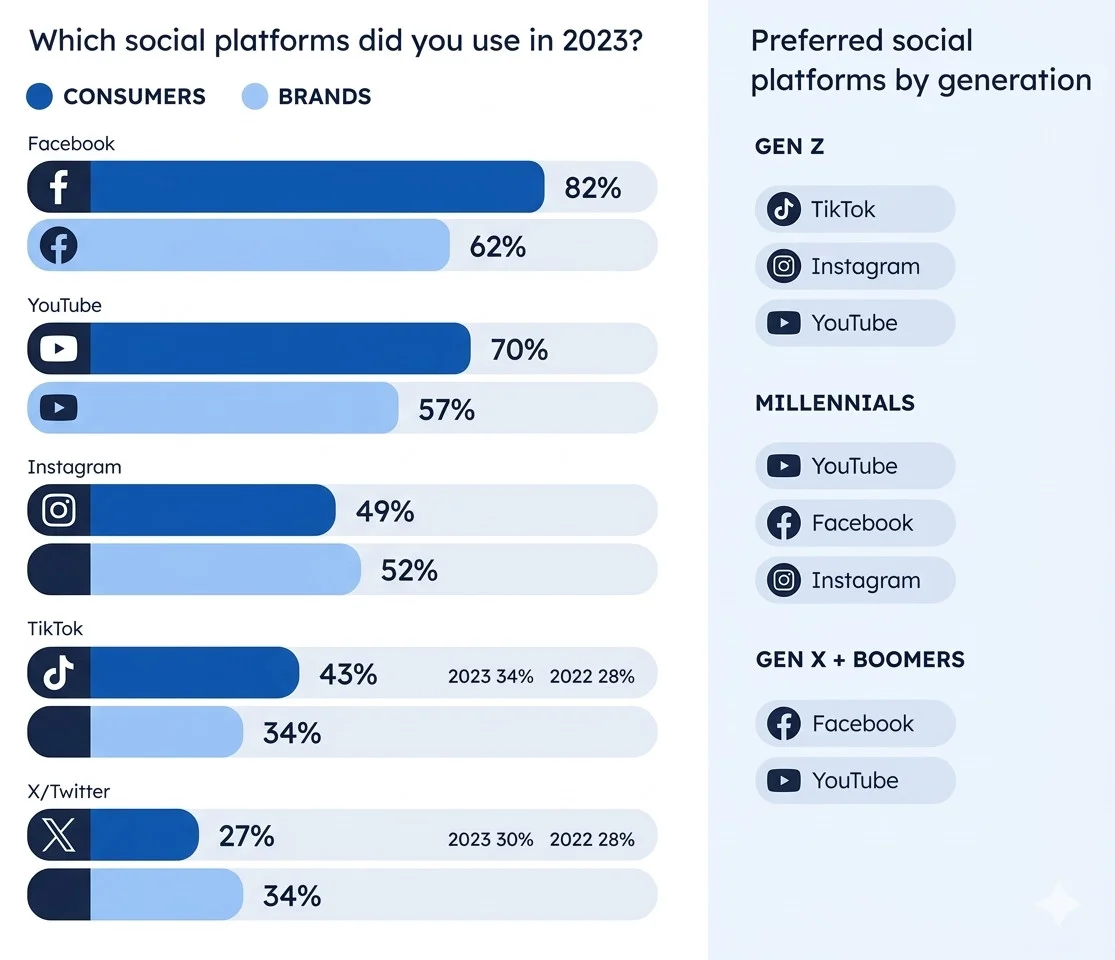
Source: HubSpot Consumer Trend Report
2. Visual-First Industry Meets Visual-First Platforms
Beauty is one of the most visual industries out there. Swatches, transformations, tutorials, packaging – it’s all meant to be seen. And social media platforms are literally designed to showcase visual content.
This is a natural advantage most industries don’t have. A foundation shade looks better in a 15-second Reel than in a product description. A haircut transformation tells a stronger story in a TikTok than in a paragraph of text.
3. Direct Access to Your Target Customers
You don’t need to guess where your audience is. They’re already on social media, actively looking for beauty content, following creators, and making purchase decisions based on what they see. Social media for beauty businesses offers a direct line to these people without a middleman, a media buyer, or a billboard.
4. It Generates Real-time Customer Insights
Every like, comment, share, save, and DM is data. And unlike traditional market research, it’s free and instant.
Social media tells you:
- What products people love – Which posts get the most saves and shares?
- What questions do they have – What are people asking in your comments and DMs?
- What content resonates – Are beauty routines outperforming product shots? Are Reels beating carousels?
- What they want next – Polls, Q&A stickers, and comment threads are basically free focus groups.
For small beauty and cosmetic brands, this kind of real-time feedback is invaluable. You don’t need to run expensive surveys. Your audience is already telling you what they want; you just have to pay attention.
5. It Amplifies Reach with Partnerships and Collaborations
One of the fastest ways to grow on social media is by tapping into someone else’s audience. And in the beauty space, collaboration opportunities are everywhere.
This doesn’t have to mean paying a celebrity influencer. For SMBs, it can look like:
- Micro-influencer partnerships – Send products to beauty influencers with 1K–50K followers who genuinely align with your brand
- Collab posts with complementary brands – A skincare brand partnering with a makeup brand for a “full routine” post
- Salon or spa takeovers – Let a stylist or esthetician take over your Stories for a day
- Customer spotlights – Feature real customers using your products
Even small-scale collaborations can put your brand in front of hundreds or thousands of new, highly relevant eyes.
6. Cost-Effective Growth for SMBs
Let’s be honest, many beauty brands don’t have a six-figure marketing budget. But fortunately, on social media, brands can post content for free and run campaigns within their predetermined budgets:
Here’s why social media for beauty businesses is a cost-effective solution:
- Organic reach on social media works pretty well, and even organic content has the likelihood to go viral.
- Brands don’t need a professional studio. A smartphone, good lighting, and a genuine voice are enough.
- Paid ads are more precise and affordable. Local brands can also target audiences in nearby areas based on their location, interests, and behavior.
Not every platform deserves your time. The key is knowing where your audience hangs out and what kind of content works there. Here’s a breakdown of the five major platforms and what each one brings to the table for beauty brands.
Instagram — The Beauty Industry’s Home Base
Beauty is a highly visual industry with consumers looking at textures, shades, tutorials, and transformations before they finally choose to buy. Instagram allows brands to post reels, stories, carousels, and short videos showcasing makeup tutorials, before-and-after transformations, skincare routines, reviews, etc.
So, Instagram practically remains the number one social platform for beauty shopping and is a great discovery tool for beauty brands.
Here’s how Instagram works for the beauty industry:
- Reels – Create short, engaging tutorials and transformations that the algorithm loves to push.
- Stories – Instagram Stories are perfect for polls (“Which shade should we launch next?”), behind-the-scenes content, and limited-time offers.
- Shopping tags – Let people buy directly from your posts. No friction, no “link in bio” runaround.
- Collab posts – Co-author a post with an influencer or partner brand and appear on both feeds instantly.
If you’re a small beauty brand just getting started on social media, you can also try Instagram influencer marketing to improve your reach on the platform.
TikTok isn’t just for dance videos anymore. In fact, it works phenomenally well for social media marketing for beauty and wellness brands. In fact, health and beauty products accounted for a staggering 79.3% of TikTok Shop sales in the United States in 2024, totaling $1.34 billion.
Over the past few years, TikTok has accelerated in social commerce within the beauty industry, and today it plays a significant role in driving real sales.
The in-app shopping data shows that over 370 million beauty products were sold globally on TikTok Shop in 2024.
Here’s what works on TikTok for beauty brands:
- “Get Ready With Me” (GRWM) videos – Casual, relatable, and wildly popular
- Before-and-after transformations – Raw and unfiltered perform best
- Trend-jacking – Jump on trending sounds and formats while they’re hot
- TikTok Shop integration – Let viewers buy products without ever leaving the app.
Explore this guide for more such TikTok content ideas.
Pinterest — The Underrated Discovery Engine
On Pinterest, people often come with an intent. They’re actively looking for ideas, products, and inspiration, and they’re ready to act on it.
Research shows that approximately 40% of Pinners have made a purchase after seeing content on Pinterest. The platform has a strong inspiration to purchase funnel, where users look for products, save ideas, and plan purchases.
But despite these numbers, Pinterest remains a massive yet underutilized platform for beauty brands.
Brands can start by creating evergreen content on Pinterest that can drive traffic for months. For instance, creating pins on “summer beauty routines” will create more traffic than creating a story on the same topic, which will disappear in 24 hours.
When someone wants a detailed, honest review about a beauty product, they often turn to YouTube. In fact, 45% of the people say that YouTube is their first choice when looking for beauty products online.
YouTube is also a go-to platform for product reviews. People often turn to their favorite beauty influencers and trust their opinions over brand ads.
So how exactly can beauty brands use YouTube? Let’s find out.
- In-depth tutorials – 10-15 minute videos showing full routines or techniques
- Product reviews and comparisons – Honest, detailed breakdowns build credibility
- Brand storytelling – Share your founder story, values, or behind-the-scenes process
- YouTube Shorts – Repurpose your Reels and TikToks here for extra reach
Below is a YouTube Short comparing liquid blush from Rare Beauty and Rhode Skin
YouTube marketing can also offer businesses a massive SEO advantage. Your YouTube video can show up in Google search results for years. That “how to contour for round faces” tutorial you posted today could still be bringing in new customers two years from now.
Facebook may not be the trendiest platform, but if you are a local beauty brand, a salon, or a wellness brand creating a Facebook marketing strategy that targets older demographics, can work wonders.
In fact, Facebook is the second-largest platform for beauty purchases after Instagram and is preferred by 59% of beauty shoppers.
So, how can beauty businesses use Facebook? Let’s find out.
- Facebook Groups – Create a private community for your loyal customers to share beauty tips, ask questions, and connect.
- Local targeting – Perfect for social media marketing for beauty salons, spas, and beauty studios looking for customers nearby.
- Events – Promote launches, workshops, or live sessions
- Appointment bookings – Integrate booking tools directly into your page
- Facebook Ads – Still one of the most precise and affordable ad platforms for targeting by location, age, and interests
But how can brands choose the social platforms that are right for them? Here are some tips:
Choosing the right platform:
To begin with brands must pick 2 to 3 platforms, depending on:
- Where does your primary audience spend most of their time?
- What content can you realistically create? Can you create long form YouTube videos or prefer photos on Instagram and Pinterest
- What is your business type? Are you a local salon, an e-Commerce beauty brand or a multinational?
Pick a few channels based on this and master those first. Then expand when you’re ready.
Content Ideas That Work for Beauty Brands
Now comes the next question – what should brands actually be posting on their social media accounts?
So, here are six content types that consistently perform well for social media marketing for beauty brands.
1. Tutorials & How-To’s
If there’s one content format that never gets old in the beauty space, it’s the tutorial. People love learning how to recreate a look, use a product properly, or simplify their beauty routine.
Bite-sized tutorials that show a product in action tend to outperform longer content. Beauty businesses can create Reels and TikTok videos on formats like:
- “3-step morning skincare routine”
- “60-second smokey eye using just two products”
- “How to apply our serum for the best results.”
Here is an Instagram reel showing the perfect holiday-coded looks, using just a few Glossier products.
The goal isn’t just to show the product, it’s to show the result. When someone watches a 30-second video and sees a visible glow-up at the end, that’s more convincing than any product description you could write.
2. Before & After Transformations
Nothing stops a scroll like a good before-and-after. It’s visual proof that your product or service actually works, and it helps build trust faster than any ad copy.
This content type is incredibly versatile and is popularly used for social media marketing for beauty salons, skincare and haircare brands, and by makeup artists.
Here are a few things to keep in mind when creating transformation videos:
- Use consistent lighting and angles so the transformation feels genuine, not manipulated.
- Add a brief caption explaining what products or services were used.
- Encourage clients to share their own before-and-after’s.
The video below shows a before-and-after transformation video by Sam Beauty
Before-and-after’s are also incredibly repostable. People love tagging friends with “we need to try this,” which gives you free organic reach.
3. User-Generated Content (UGC)
Here’s a content strategy that saves you time and builds your community by letting your customers create content on your behalf.
When a real customer posts something about a beauty brand, it hits different; it feels more trustworthy, relatable, and authentic.
Here are some ways that can help brands encourage more UGC:
- Create a branded hashtag that’s simple and memorable and feature it in your bio, packaging, and emails.
- Encourage customers to create UGC immediately after purchase or an appointment.
- Make sure to tag them and reshare their content (with permission) on your feed or Stories.
- Run a UGC campaign, like “Post your morning routine using our products and tag us for a chance to be featured this month.”
Below, you can see UGC for Glossier Lidstar, featuring Alex Lustig discussing its sleek packaging, ease of use, and blendability.
UGC not only helps build social proof, but it also takes the pressure off to constantly create new content from scratch. Especially for small businesses, UGC can be a game-changer.
Read our ultimate guide on user-generated content to learn more about how to generate, post, and repurpose UGC to improve your brand reputation.
4. Product Reviews & Demos
If tutorials show people how to use a product, reviews and demos show them why they should. And beauty consumers can’t get enough of them. In fact, 86% of people say that product reviews and demos are the most engaging type of beauty content they watch.
Product reviews and demos can take several forms:
- First impressions — When brands show their products for the first time.
- Honest reviews — When people talk about what they loved and what they found best in your product.
- Side-by-side comparisons — When people compare two brands or two products from the same brand.
- Texture and swatch demos — These videos show your product up close. How does it blend? What’s the finish? What does the texture actually look like?
The video below shows the first impressions of the newly launched Vaseline Gluta-Hya lip serum gloss.
When brands do social media marketing for beauty supplies, it shows their audience how their product performs in real life. A quick, genuine demo video can do more for your sales than a polished product photo ever could.
5. Giveaways & Contests
Running giveaways on social media can give you a quick spike in engagement and new followers. It is one of the simplest yet effective tactics in social media marketing for beauty businesses, and it works every single time.
Here’s the classic format for giveaways that most brands follow:
- “Follow our page.”
- “Like this post.”
- “Tag a friend in the comments.”
Here is an example of one such giveaway post by Blessed Moon Cosmetics, where they have mentioned the giveaway rules and the event period.
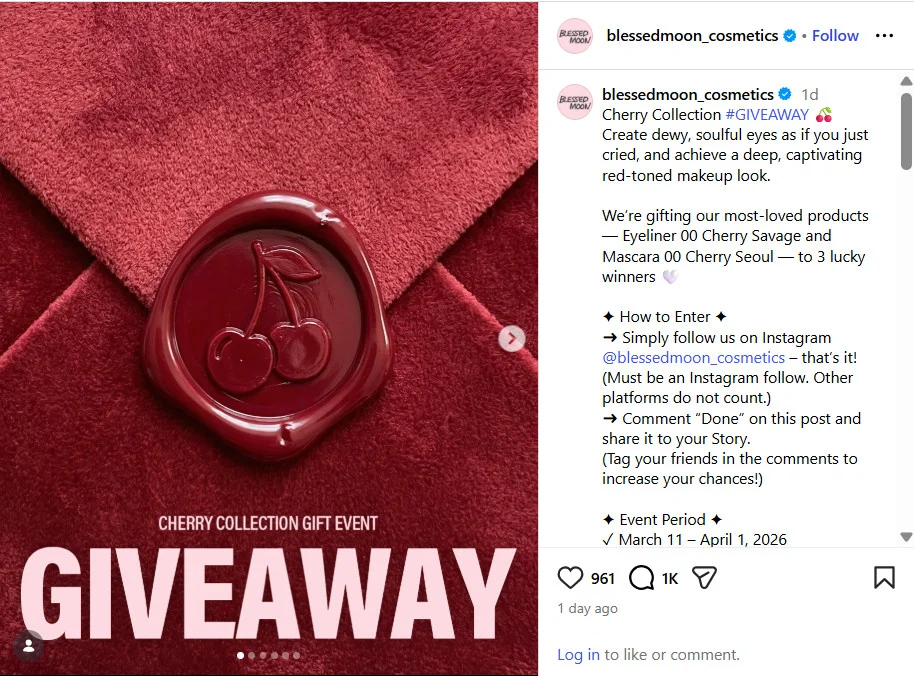
That’s it. Each tag brings a new potential follower to your page. Each like tells the algorithm to push the post further.
To make your giveaways even more effective, you can:
- Partner with another brand
- Make it seasonal
- Tie it to UGC
- Keep the entry barrier low so more people can participate.
Just make sure the prize is relevant to your brand. You want to attract people who are genuinely interested in beauty and not just freebie hunters.
6. Myth-Busting & Educational Content
Not every post needs to sell something. Some of the best-performing beauty content simply teaches something and, in the process, positions your brand as a trusted authority, not just another seller.
Beauty myths and misconceptions are everywhere, and your audience wants someone to set the record straight.
When beauty brands post educational content, it does a few powerful things:
- Builds authority – People start seeing you as the expert, not just the brand.
- Drives saves and shares – Informational posts get saved at high rates, which signals value to the algorithm
- Sparks conversation – Hot takes and myth-busters tend to generate strong comment sections
- Works across all formats – Carousel posts, short videos, Stories with text overlays, even simple text-based posts
For small beauty and wellness businesses, educational content is one of the easiest ways to stand out.
Note: You do not need to try all these formats at once. Create a weekly content mix that includes 3-4 of the above categories that feel natural to your brand. Then start creating content and make sure to keep a mix of value-driven and promotional content. Always lead with what your audience wants to see and not what you want to sell.
Planning content in your head is one thing, but actually staying consistent with it is another.
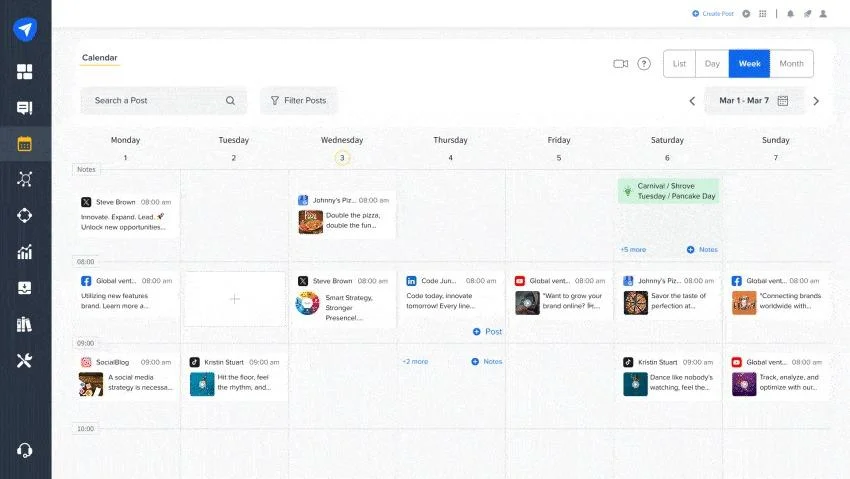
That’s where a content calendar makes all the difference. With SocialPilot’s Social media content calendar, you can batch-plan your entire month in one sitting.
It allows you to map out your tutorials, UGC reposts, product demos, and educational posts so you always know what’s going live and when.
Need to shuffle things around? Just drag and drop posts to reschedule them instantly. No deleting, no recreating, just move your posts where they make sense.
Try SocialPilot Today!
It’s one thing to talk about strategy. It’s another to see it in action. Let’s look at three beauty brands that used social media to achieve massive results and, more importantly, what small and medium beauty businesses can learn from each one.
1. Fenty Beauty
When Rihanna launched Fenty Beauty in 2017, she didn’t just launch a makeup line — she started a conversation. The brand debuted with 40 foundation shades (later expanding to 50), covering a range of skin tones that most beauty brands had been ignoring for years.
Social media exploded. People posted side-by-side swatch comparisons, celebrated finally finding their shade, and tagged friends who “needed to see this.” The brand didn’t have to push the message; the community carried it.
As a result, Fenty Beauty generated $100 million in sales within its first 40 days and went on to hit $570 million by 2018.
What made this work wasn’t just a great product. It was that the brand stood for something real. Inclusivity wasn’t a marketing angle – it was baked into the product itself. And social media became the place where that message spread organically, driven by real people who felt seen for the first time.
The lesson for SMBs:
You don’t need Rihanna’s fame to make this work. You need a genuine point of view. Maybe your brand is built around clean ingredients, sustainability, celebrating natural hair, or serving a niche that bigger brands overlook.
Whatever it is — lean into it. When your brand stands for something, people don’t just buy from you. They advocate for you.
2. Glossier
Glossier didn’t start as a beauty brand. It started as a blog — Into The Gloss — where founder Emily Weiss interviewed real women about their skincare routines. By the time Glossier launched its first products, it already had a loyal audience that felt like they’d helped build the brand. Because in many ways, they had.
Glossier’s entire product development strategy was shaped by social media. They read comments, DMs, and forum threads to understand what their audience actually wanted. When customers said they wanted a simple, everyday brow product, Glossier created Boy Brow, which went on to sell one unit every 32 seconds in 2018.
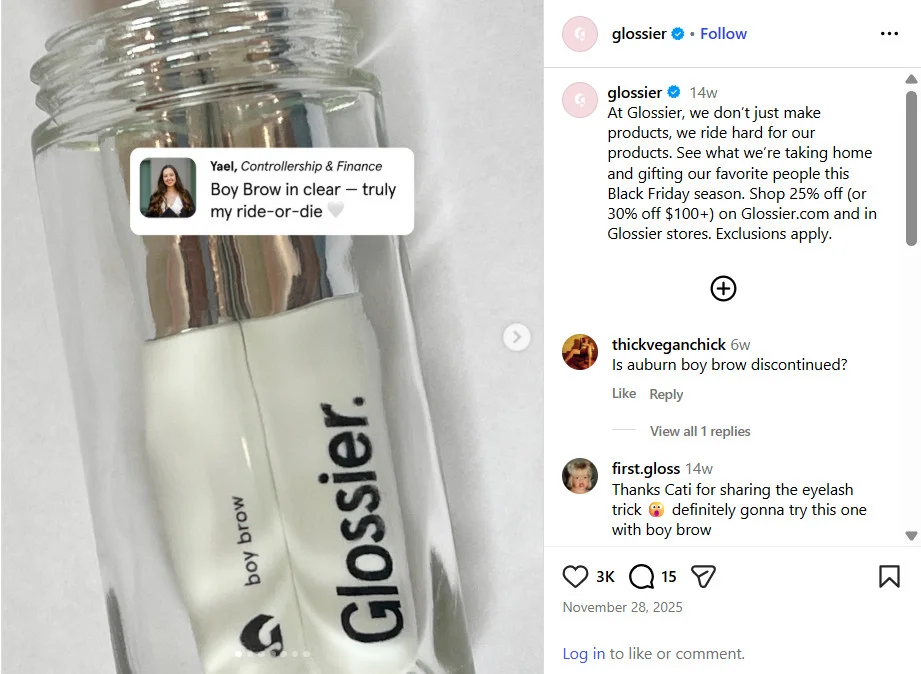
The brand also leaned heavily into user-generated content. Instead of polished campaigns with supermodels, Glossier reposted real customers wearing their products. Their Instagram became a community feed, not a brand catalog.
That approach turned everyday customers into brand ambassadors who promoted Glossier simply because they loved being part of it.
The lesson for SMBs:
Your comments section is more valuable than you think. The questions people ask in your DMs, the feedback they leave on posts, the things they wish existed – that’s all free market research.
Just listen to your audience and let them know you’re listening. When people feel heard, they become loyal, and they promote your products without being asked.
3. CeraVe
CeraVe had been a quiet, dermatologist-recommended drugstore brand for nearly two decades. It wasn’t trendy. It wasn’t flashy. And then TikTok happened.
In 2020, skincare influencer Hyram Yarbro started recommending CeraVe products in his videos. He wasn’t paid by the brand; he just genuinely liked the products and said so. His followers listened. Other creators followed.
Before long, CeraVe was everywhere on TikTok, with a single influencer-driven campaign generating 132 million views and bringing in 300,000 new followers.
The brand didn’t go viral because of a massive advertising budget. It went viral because one creator with a trusted voice said something authentic, and the TikTok algorithm did the rest. CeraVe eventually leaned into this momentum with more influencer partnerships, but the initial spark was completely organic.
The lesson for SMBs:
You don’t need to partner with a mega-influencer or spend thousands on a campaign. Sometimes, one right creator — even a micro-influencer with a small but loyal following — can change everything.
Find people who genuinely align with your brand, send them your products, and let them share their honest experience. You can’t manufacture virality, but you can create the conditions for it by putting your products in the hands of people who will genuinely love them.
Having a presence on social media is one thing. Having a presence that actually drives results is another. Here are some practical tips to help your beauty brand stand out and build real momentum.
1. Create High-Quality Visual Content
In the beauty industry, your visuals are your first impression. Poor lighting, blurry images, or inconsistent aesthetics can make even a great product look unreliable.
You don’t need a professional studio to create high-quality images and great content. All you would need is good lighting, a consistent aesthetic, and your product in action. When producing content, prioritize videos on every major platform because they consistently outperform static images. Short-form videos should be a core part of your content mix.
Don’t forget to add thumbnails that stop this scroll. A strong thumbnail can be the difference between someone watching your video and scrolling right past it.
2. Leverage Influencer Partnerships
We’ve already covered why influencer marketing works for beauty brands. But here are a few additional tips to get the most out of your partnerships:
- Start by building a long-term relationship with creators. A creator who consistently features your products over several months becomes a trusted voice for your brand.
- Work with influences across different platforms, skin types, age groups, and aesthetics. This helps your audience believe that your product is for everyone.
- Re-purpose the influencer content with their permission across different channels, websites, and even in paid ads.
- Use unique discount codes, affiliate links, or UTM parameters to measure the ROI that each partnership actually delivers.
The video below shows an influencer collaboration between Clay.Co and slowburn.er
For more details, read this guide on how to work with influencers, which talks about how brands can create impactful and long-term influencer partnerships.
3. Create a Hashtag Strategy
Hashtags are still one of the most effective ways to get your content discovered, especially on Instagram, TikTok, and Pinterest. But throwing random hashtags on a post isn’t a strategy.
Here’s how to build one that works:
- Create a branded hashtag that is short, memorable, and easy to spell.
- Use a combination of broad hashtags, niche hashtags, and branded hashtags for every post.
- Look at what hashtags top-performing brands and creators in your niche are using.
You can also use SocialPilot’s hashtag generator tool to come up with some of the most trending, relevant, and post-related hashtags for different social media platforms.
4. Build an Authentic Brand Voice & Community
In a crowded beauty market, the brands that win are those with a genuine brand voice and an engaged community. It is important for brands to define their personality before they begin to post anything on social media.
Ask yourself:
- If your brand were a person, how would they talk?
- What tone do your ideal customers respond to?
- What values does your brand stand for, and how do you communicate them?
5. Engage, Don’t Just Broadcast
Posting content is only the first half of your job; the other half is showing up in comments, DMs, and conversations on social media.
- When brands reply to comments, it shows that there is a real person working behind them.
- Ask questions in the captions to invite interaction.
- Use interactive story features like polls, quizzes, stickers, and sliders to get people involved.
- Give shoutouts to your loyal customers, feature UGC, and celebrate milestone moments.
6. Embrace Transparency
Transparency has become an integral part of the beauty industry. People today want to know what’s in the products, how they are made, and who’s behind the brand. Social media is the perfect place to show that.
- Create BTS content showing how your products are formulated, packaged, and tested.
- Be upfront about the ingredients you use.
- If something goes wrong, address it openly, instead of staying silent.
- Show the real people behind your brand, share founder stories, team introductions, and day-in-the-life content.
Measuring What Matters: Analytics for Beauty Brands
Unless you measure the results of your campaign, you’re simply guessing. This is where using the right social media analytics tools and tracking the right metrics becomes very important.
You are some key metrics to track:
- Engagement rate – Engagement rate tells you whether people are liking, sharing, saving, and commenting on your posts. A higher engagement rate indicates genuine interest in a brand.
- Reach and impressions – Reach tells you if your posts are reaching new audiences. This metric is critical for brand discovery.
- Follower growth – A steady increase in followers signals the success of your content strategy on social media.
- Click-through rate (CTR) – Is your social media account helping you drive traffic to your website or online store? If your CTR is low, you need to work more on your CTAs.
- Conversion rate – That’s the ultimate goal of any beauty brand. Conversion rate tells you if people are taking the desired action after reading your posts.
Based on the metrics, you must A/B test your content strategy for performance. Test the different content formats, posting times, captions, and CTAs to understand what works.
Read our social media analytics guide to learn more about how to track, analyze, and act on data.
Your Next Move as a Beauty Brand
Social media is a powerful tool for beauty businesses of all sizes. Whether you’re a solo makeup artist, a local salon, or a growing e-commerce skincare brand, the opportunity to reach, engage, and convert your audience on social media is massive.
But to make it big on social media, you must choose the right platform, create authentic content, and build a community that feels connected to your brand. Also, you don’t have to do everything at once.
Start small – pick two platforms, plan a week of content, and commit to showing up. Track what works, learn from what doesn’t, and adjust as you go.
As you grow your online presence, you will need the right social media management tools that help you show up consistently across different digital platforms. This is where SocialPilot can help. It helps you pre-plan social media content, post it at the best time slots, and even analyze what’s working for your brand.
Start your free trial with SocialPilot and manage your social media like never before.