“Facebook is dead.”
For the past few years, that’s been the easiest conclusion to draw. Reach kept shrinking, traffic felt unpredictable, and posting on Facebook slowly started to feel more like a chore than an opportunity. Many marketers and businesses quietly moved on, not because they wanted to, but because it stopped feeling worth the effort.
But behind the scenes, Facebook has been changing how its platform works.
The feed is no longer built only around who you follow. It is increasingly guided by AI, discovery, and what Facebook thinks each person will actually care about. Recent Facebook trends show this shift clearly, especially in how people discover and consume content today.
This guide breaks down how the Facebook algorithm works in 2026, what has changed, and how to use this new system to your advantage instead of fighting it.
Key Takeaways
- Content that encourages meaningful interaction beats posts that only collect likes.
- The only sustainable way to grow is to create content that people find valuable.
- Use Reels for discovery, Feed for depth and authority, and Stories and Groups for relationships and trust.
- A large part of the feed is AI-recommended, meaning great content can reach new audiences even from scratch.
Why Facebook Is Becoming Powerful Again in 2026
According to Meta’s late-2025 reports, the platform’s reach is larger than ever, with 3.07 billion monthly active users (MAU).
The primary driver is the shift from a Social Graph (showing you content from friends) to a Discovery Engine (showing you content you actually care about).
Three key factors are responsible for this 2026 comeback:
- AI Precision: The “Andromeda” update has replaced traditional interest-based targeting. This uses predictive modeling to match content with user intent in real-time, focusing on “creative signals” rather than manual audience definitions.
- Referral Rebound: After years of decline, referral traffic from Facebook has stabilized. In early 2026, some publishers have reported referral traffic quadrupling year-over-year compared to 2025. This is because the algorithm now prioritizes “External Value” signals and meaningful interactions over passive scrolling.
- The Scale of Meta AI: By integrating Meta AI directly into the Feed and Messenger, Facebook has become an “all-in-one” hub. Users now discover, research, and purchase without ever leaving the app, with AI agents increasingly managing these localized commercial interactions.
What is the “Andromeda Update”?
The Andromeda update is Meta’s new AI system for deciding who should see your ads and content.
In the past, Facebook used a “Social Graph” to match ads to people based on who they followed and their static interests. Andromeda flips this: it is a Discovery Engine that uses deep neural networks to “read” your content and find the right audience for you in real-time.
Why It’s an Excellent Move for 2026:
- Creative is the New Targeting: The AI analyzes your video’s tone, visual elements, and hooks. It then matches that “creative signal” to users showing active intent right now.
- Predictive Intent: It doesn’t just look at what you liked yesterday; it predicts what you want next based on your current browsing sequence across Facebook, Instagram, and WhatsApp.
- Efficiency Boost: Powered by custom NVIDIA Grace Hopper hardware, the system is 10,000x more complex than previous models, allowing it to process millions of potential ad matches in milliseconds.
The Bottom Line for You:
Stop trying to “hack” the targeting settings. Under Andromeda, your job is to provide high-quality, diverse creative that clearly signals to the AI who your product is for. If the AI understands your content, it will find your customers for you.
How the Facebook Algorithm Actually Works in 2026
The biggest change in 2026 is that the Facebook algorithm no longer prioritizes what is “viral” globally. Instead, it prioritizes what is deeply relevant to a particular user at that exact moment. This is why a post with 50 thoughtful, long-form comments can easily outrank a post with 5,000 passive likes.
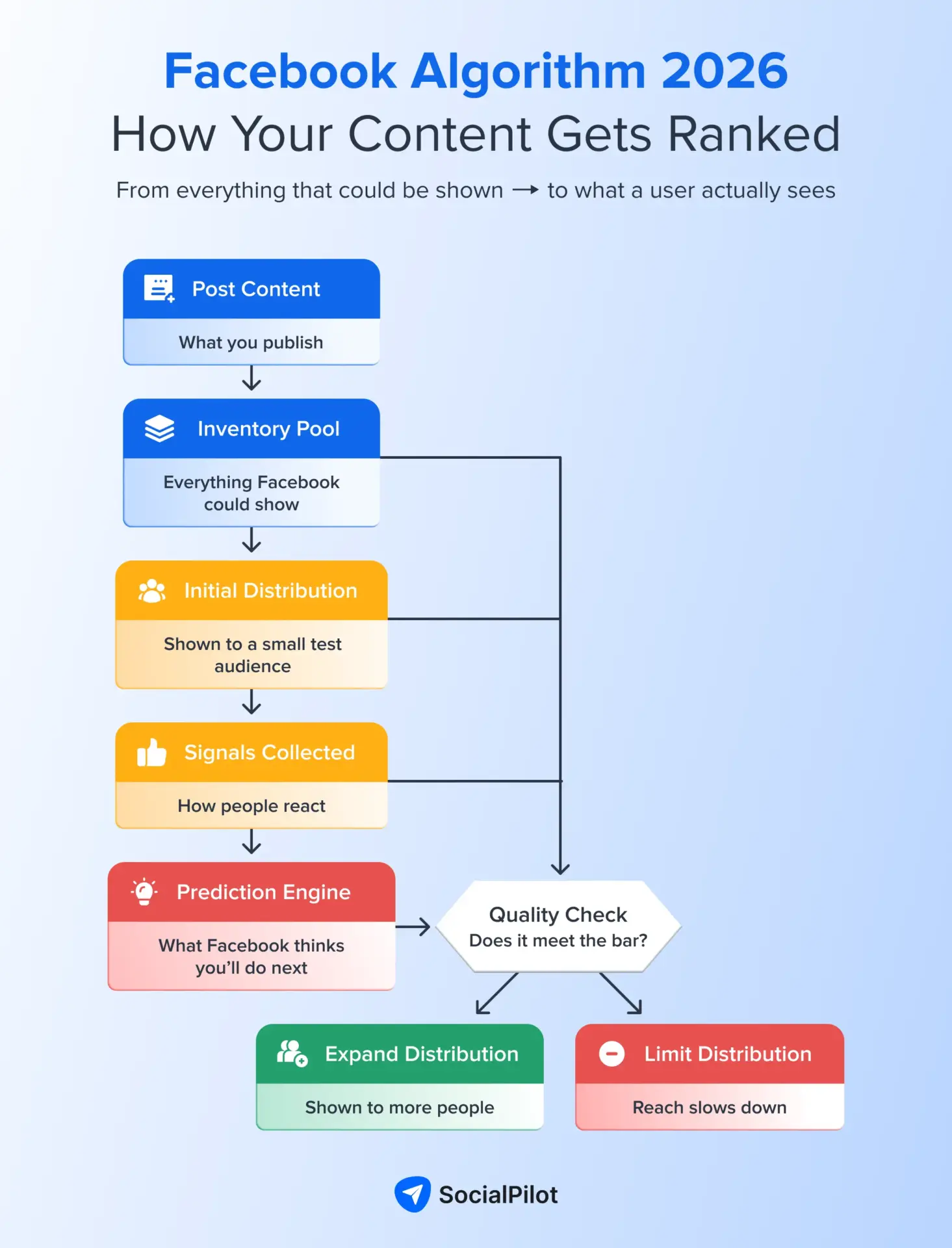
In practice, Facebook no longer ranks content once and moves on. It tests content, measures real behavior, scores it, and only then decides whether to expand or stop distribution. This entire process runs in milliseconds every time someone opens their feed.
From Post to Distribution: How the Facebook Algorithm Actually Works
Every time a user refreshes their feed, Facebook runs a multi-stage process that looks like this:
Step 1: Inventory (The Pool)
First, the system gathers every post that could be shown. In 2026, this pool will be much bigger than before.
It still includes posts from friends, followed Facebook pages, and joined Groups, but it also includes a large volume of recommended content from accounts the user does not follow yet. In fact, roughly 50% of a user’s feed is now made up of recommended posts from accounts they don’t follow. This is what Meta calls Unconnected Distribution.
This is where the Discovery Engine comes into play.
Step 2: Initial Distribution (The Test)
Before anything goes viral or gets a wide reach, Facebook shows your post to a small test audience. This group is chosen based on topic, past behavior, and interest patterns.
This initial push is not about reach. It is about collecting data.
Step 3: Signals (The Clues)
As this test group sees your post, Facebook starts collecting thousands of signals, such as:
- Content format: Is it a Reel, a carousel, or a text post?
- Creator history: How have users interacted with your content in the past?
- Context: Time of day, connection speed, and even how long someone hovers on similar posts.
- Most important: watch time, saves, shares, comments, and scroll-past behavior.
Step 4: Predictions (The Guess)
This is the core of the 2026 system. Based on these early signals, the AI predicts specific actions:
- Will this person watch the video to the end?
- Will they leave a meaningful comment?
- Will they save it or share it privately?
Facebook is no longer ranking posts. It is ranking predicted user behavior.
Step 5: Relevance Scoring (The Rank)
Using those predictions, every post receives a personalized relevance score for each user. The higher the score, the higher the post appears in that person’s feed.
This is why two people can open Facebook at the same time and see completely different feeds, even from the same creators.
Step 6: Quality Check (The Real Verdict)
Now comes the most important part. Facebook compares its predictions to real-world performance:
- Are people actually watching?
- Are they actually saving, sharing, and commenting?
- Or are they scrolling past?
If real engagement matches or beats expectations, distribution expands, and the post is shown to more people, including non-followers. If performance is weak, distribution slows or stops, and the post quietly fades out.
How Ranking Works for Feed, Reels, and Stories
1. The Feed: The “Value and Connection” Mix
The feed is still the most complex surface on Facebook’s platform. In 2026, it runs on a near 50/50 mix. One half is connected content from friends, family, and followed Facebook pages. The other half is discovery, meaning the Facebook algorithm now fills a large part of a user’s feed with recommended posts based on user behavior and past behavior.
Primary Signal: Dwell time.
The feed algorithm measures how long a particular user actually stops and consumes your post. This matters more than raw likes.
How to Rank:
In 2026, “long-form” is back. High-resolution photo carousels (5+ slides) and text posts that encourage “See More” clicks perform exceptionally well. The goal here isn’t to be fast; it’s to be deep. If a user spends 15 seconds reading your caption, the Feed algorithm marks your content as “High Value Content” and pushes it to more of your followers.
2. Reels: The Discovery Playground
Facebook Reels are now the main driver of unconnected discovery. This is where the reels algorithm and machine learning do most of the work. Facebook statistics for 2026 show that Reels and user interactions are dominating activity metrics and retention benchmarks. Unlike the Feed, the Facebook Reels algorithm largely ignores who follows you and focuses entirely on the “Content DNA.”
Primary Signal: Re-watch Rate & 50% Retention.
How to Rank:
Success on Reels depends on the “Loop Factor.” If a user watches your original videos 1.5 times, the algorithm reads that as strong interest and prioritizes content for wider distribution. Reels published within the last 12 hours receive a “Velocity Boost.”
This is why creators are moving toward Micro-batching, posting 2–3 shorter Reels (7–10 seconds) daily rather than one long masterpiece. Knowing the best time to post on Facebook can help you hit that window more consistently.
3. Stories: The Inner Circle
Facebook Stories are the only place on Facebook that remains almost entirely Connection-based. It is the digital equivalent of a “close friends” list.
Primary Signal: Direct Interaction Velocity
Replies, emoji reactions, and link taps matter more here than passive views.
How to Rank:
Your position in the Stories bar is related to your relationship strength with the viewer. If someone frequently replies to your Stories, your content stays at the top of their feed because it signals strong user interaction and genuine engagement.
Pro Tip for 2026:
Use the “Poll” or “Question” stickers in your first Story of the day. This “warms up” your engagement signals and ensures your subsequent Stories for the next 24 hours are prioritized in your followers’ feeds.
4. Why Facebook Groups Are Winning Again
Even as organic reach on Facebook pages struggles, Facebook groups have great visibility. More than 1.8 billion people engage with Facebook Groups every month, making them a major source of relevant content and active conversation online.
Groups generate deeper user interaction and stronger, meaningful engagement than most feeds or page posts. Comments, questions, and community discussions give the Facebook algorithm clear signals about what content users find valuable. This helps Facebook distribute content more effectively and rank it higher within those communities.
From a Facebook strategy perspective, Groups let you build micro-communities around specific topics. This helps you better understand your target audience and create high-quality content that actually sticks. They’re useful for testing ideas, building trust, and increasing engagement before wider distribution via the Facebook feed algorithm
What Signals Matter Most on Facebook Today
In 2026, the algorithm has officially moved from “vanity metrics.” To rank in the top 1% of feeds, you must optimize for Depth of Interaction. Meta’s AI now prioritizes Active Signals, actions that require effort and indicate a genuine human connection.
AI-driven systems now deprioritize single-word or emoji-only comments as “low-value.” In 2026, comments containing five or more words are weighted 3x more heavily, as they signal meaningful dialogue to the algorithm.
For practical tips on posts that actually generate meaningful engagement, check our blog on how to create engaging posts on Facebook.
Private shares via Messenger or WhatsApp are currently the strongest indicator of content quality. When a user sends your post to a friend, the AI views it as “essential” content, often causing an immediate boost in broader distribution.
3. The 50% Retention Benchmark
For Reels, the “first 3 seconds” is just the entry fee. The 2026 algorithm specifically looks for a 50% retention rate halfway through the video. Crossing this threshold can quadruple your reach by signaling high interest to the discovery mechanism.
4. External Value & Dwell Time
If a user clicks your link and spends more than 30 seconds on your site (measured via the Meta Pixel), Facebook rewards your post for providing a “quality destination,” increasing its future visibility.
How Facebook Shows Your Content to People Who Don’t Follow You
The Facebook algorithm doesn’t care if someone follows you. It looks at user behavior and past behavior to decide what a particular user might find interesting.
It does this in three main ways:
- The Content “DNA”: Using machine learning, Facebook “reads” your reels, videos, and other content to understand themes and group them with similar posts.
- Interest Matching: If a non-follower frequently watches “DIY home renovation” Reels, the AI will inject your high-performing renovation post into their feed with a “Suggested for You” label, even if they’ve never seen your brand page before.
- The Test Phase: Every new post is initially shown to a small “seed group” of non-followers who share interests with your current fans. If user engagement is strong, especially through Saves and shares, Facebook will rank content higher and push it further.
What Hurts Your Reach on Facebook in 2026
In 2026, the Facebook algorithm is as much about what it hides as what it shows. Meta’s Integrity AI has become extremely good at filtering low-quality and misleading content that hurts the user experience.
If your reach has flatlined, you are likely triggering one of these four modern penalty signals. These are all rooted in how the Facebook algorithm ranks content and how Facebook chooses to prioritize and distribute content across its social media platform.
1. Unoriginal Re-aggregators
Posting content that you had no meaningful role in creating is now one of the fastest ways to lose visibility. Meta’s Limited Originality guidelines make it clear that unoriginal content and low-effort reposts will not rank content well, even if they previously performed.
Simply adding a logo, background music, or subtitles does not count as creating original videos or high-quality content.
The fix: You must add real creative value. Use voiceovers, split-screen commentary, or meaningful editing that adds context and insight. The goal is to transform the content, not just repost it.
2. Engagement Baiting
The algorithm actively demotes posts that try to manipulate user engagement. According to Meta’s policies, asking people to like, share, or comment purely to boost your reach is treated as engagement bait.
The consequence: These posts are shown to fewer people because the system now heavily favors genuine engagement, meaningful interactions, and natural user interaction over artificial signals.
3. Labeling and Transparency for AI Content
Transparency is now a core ranking factor. Meta requires “Made with AI” labels on photorealistic video, audio, and images created or altered by AI.
The consequence: AI content is not banned, but low-effort, generic, or heavily automated posts that fail to earn real user interaction will struggle to rank higher. Starting August 2026, new EU regulations will also enforce disclosure, making transparency a non-negotiable part of any serious content strategy.
4. Low-Quality Link Experiences
Facebook increasingly evaluates the experience after the click. In its Transparency Center, Meta outlines that it may reduce the distribution of problematic or low-quality content that doesn’t necessarily violate community standards but harms the user experience.
If your Facebook posts send people to slow, ad-heavy, or spammy pages, the Facebook feed algorithm treats that as a negative signal. This is especially true for news content and commercial links.
Key benchmark: Fast mobile experiences are non-negotiable. Pages that behave like a low-quality webpage or fail to provide value will see reduced distribution across the platform.
To avoid these penalties and improve your visibility, make sure you’re following best Facebook practices that focus on real engagement, creative value, and the signals the algorithm actually rewards.
How Can You Increase Your Reach on Facebook in 2026
First and foremost, you must stop posting in a vacuum. The Facebook algorithm now rewards content that “cross-pollinates” across different surfaces (Facebook Reels, Facebook groups, and the Facebook feed).
For a more complete look at how all these pieces fit into a winning long-term approach, check out our Facebook marketing strategy guide.
Use the following 72-hour execution plan to help the system distribute content more effectively and push your Facebook posts to more users, including people who don’t already follow your brand page.
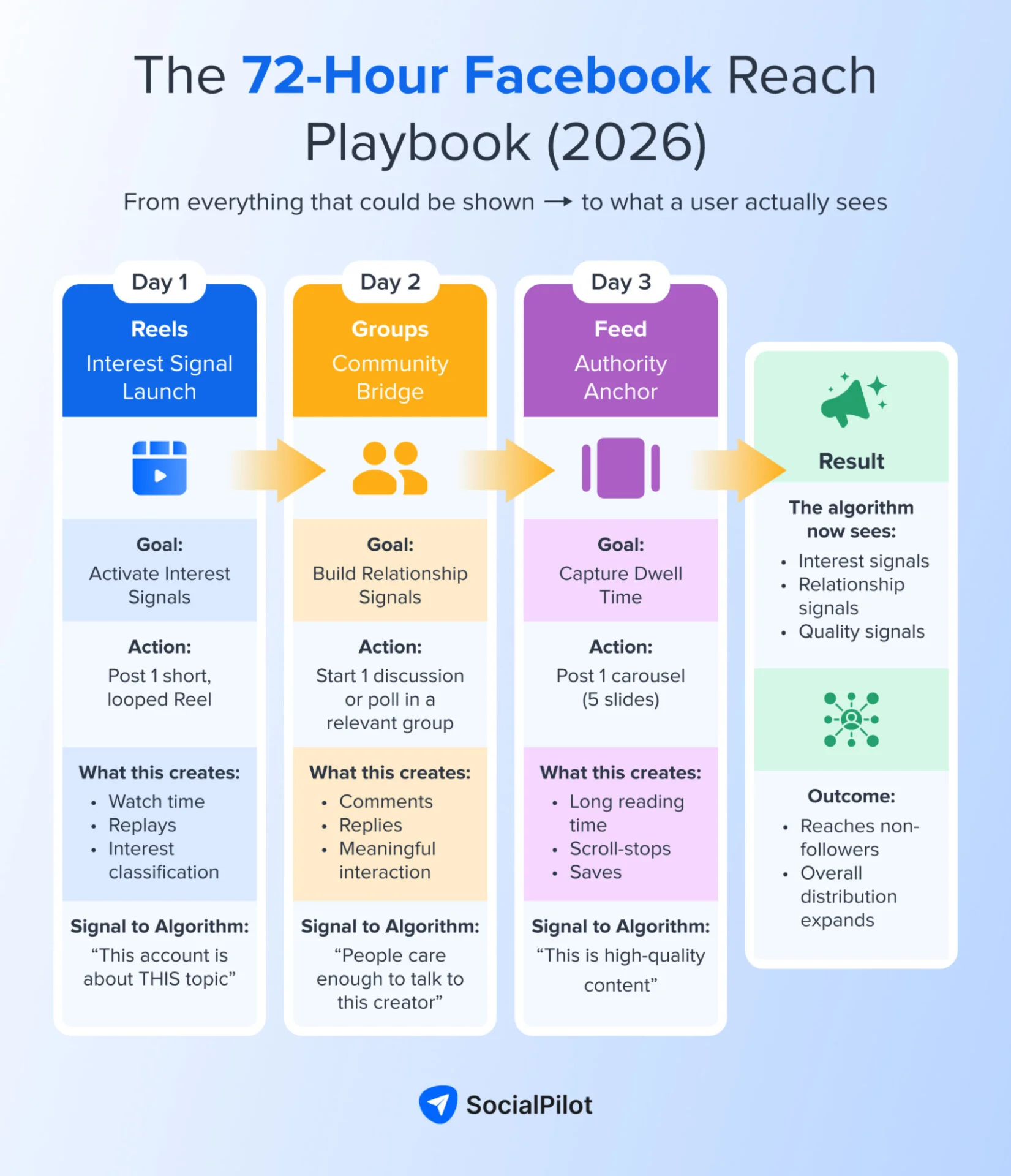
Day 1: The “Interest Signal” Launch (Reels)
Start with a Reel. In 2026, short-form video content is the primary way the Facebook algorithm understands what your account is about and who your target audience is.
Action: Post a 15-second Reel with a “closed-loop” (the end flows easily back to the beginning).
Aim for the 70% retention benchmark at the 7-second mark. If the system sees strong user engagement and re-watches on your vertical video, the reels algorithm is more likely to prioritize your content and push it to more people over the next 48 hours.
On Day 2, do not post to your Page. Instead, take the key insight from yesterday’s Reel and start a poll or discussion in a high-affinity Facebook group.
Action: Ask a question that requires a 5-word or more answer.
When group members engage with you, it creates strong and meaningful user interaction. This strengthens your relationship signals with those users, making it much more likely that your next post will appear higher in the user’s feed.
Now that you’ve “warmed up” the system with video and community signals, post a high-dwell-time Carousel to your main Facebook feed.
Action: Create a 5-slide Carousel that expands on your Day 1 Reel.
The goal is to maximize the ‘Dwell Time.’ When a particular user spends 15+ seconds consuming your post, the Facebook algorithm ranks it as high-quality content, which can lead it to rank higher and generate wider distribution, including to non-followers.
Stop Chasing the Facebook Algorithm
The Facebook algorithm isn’t something to beat or trick. It’s a system built to reward content that people actually want to spend time with.
If you stop chasing reach and start building content that earns attention, the algorithm will follow.
So the real question is not “How do I beat the Facebook algorithm?” It’s:
“Would I genuinely stop scrolling for my own content?”