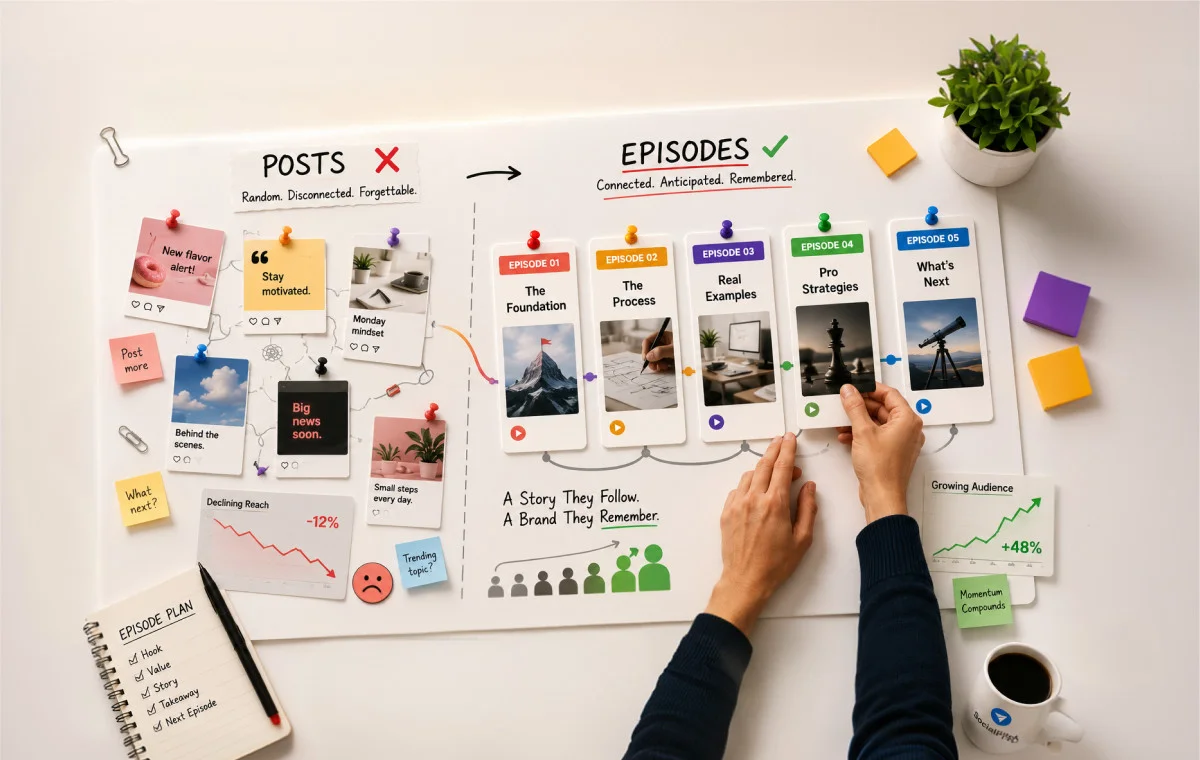
You have spent months building a content calendar that actually works. Consistent publishing schedule, visuals that are on-brand, captions that sound like a human wrote them. You are doing the job well, but the engagement on your posts is still going down.
On the flipside, SocialInsider’s Social Media Benchmark Report 2026, shows that Instagram average engagement rates rose 12% year-over-year, while engagement on LinkedIn rose 14% YoY.
This means that audiences are not really switching off; they are just becoming more selective with what they consume on social media.
If your numbers are flatlining on social media despite doing everything right, the problem is not effort. It is format. Platforms are rewarding content that earns more saves, shares, and replays. But one-off posts reset to zero every time you publish. There is no through-line and no reason for your audience to come back for more.
This is where the episodic content wins – a recurring series with a consistent premise, a recognizable format, and episodes that drop on a schedule. Content that audiences do not just stumble across once but come back for.
That is what this article is about. Not the theory of episodic content, but what it actually looks like when a small team builds it, why it compounds where one-off posts do not, and how you design your first series without rebuilding your entire workflow.
Why Posting Consistently Isn’t Enough Anymore
If you have been in a content role for more than two years, you have probably already felt this shift. The posts go out. The metrics look fine on the surface. But the feeling that you are building something, an audience that actually knows who you are, keeps getting harder to locate.
This is now the reality on most platforms, but the usual advice to “post consistently” hasn’t kept up.
Algorithms now reward return visits, not just reach
For years, the social media rule was simple: post regularly, and the algorithm would boost your reach. That’s changed now.
In 2026, platforms focus on retention, not just reach. Saves, completion rates, return viewers, and shares now matter more than impressions. Accounts posting five times a week with little engagement are losing to those posting less but getting saves, replays, and eager comments.
Brand strategist Allie Wassum highlighted this in her LinkedIn Pulse article:
‘’Everything should revolve around specific shows with a defined audience and narrative arc. Much of what happens today in social is ‘random acts of content’ with no repeatability, tune-in value, or consistency.’’
The term “random acts of content” perfectly describes most brand feeds. Each post is fine on its own, but together, they don’t add up to anything meaningful.
The downside of starting from scratch with every post
When every post is a one-off, you’re not building an audience – you’re just making a series of first impressions, and those lose impact over time.
The series content changes that math. Each episode benefits from those that came before it, and as soon as someone watches one episode, social media platforms will also recommend other episodes.
A Reddit thread discussing whether content series are more effective than standalone posts also points this out.
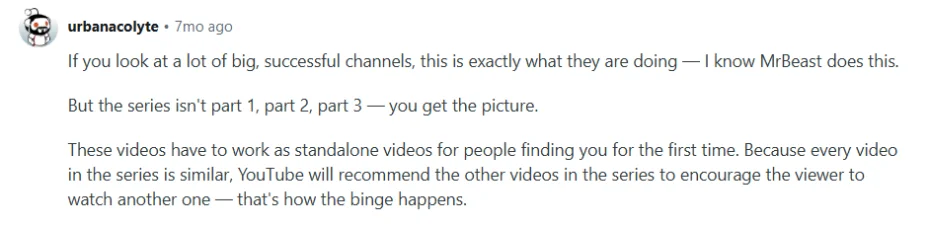
Episodes encourage your audience to return, not because you post more often, but because you post less and offer something they want to come back for.
Brand strategists can build a stronger social media content strategy for businesses with just this one format decision.
What “Thinking in Episodes” Actually Means
Before getting into what this looks like in practice, it is worth being precise about what episodic content actually is.
Episodic content is a recurring, serialized format. It is a branded show with a consistent premise, character, or structure that audiences can find, follow, and return to. Unlike a one-off post, each episode is part of a through-line. A viewer can discover Episode 4, go back to Episode 1, and build a relationship with the content over time.
Posting regularly is about how often you share content. Episodes focus on a format that builds over time.
Why is this not the same as content pillars?
Social media content pillars tell you what topics to cover. A content series tells you what format viewers come back to. Most brands have pillars and no series, which is why their content looks organized and still does not build an audience.
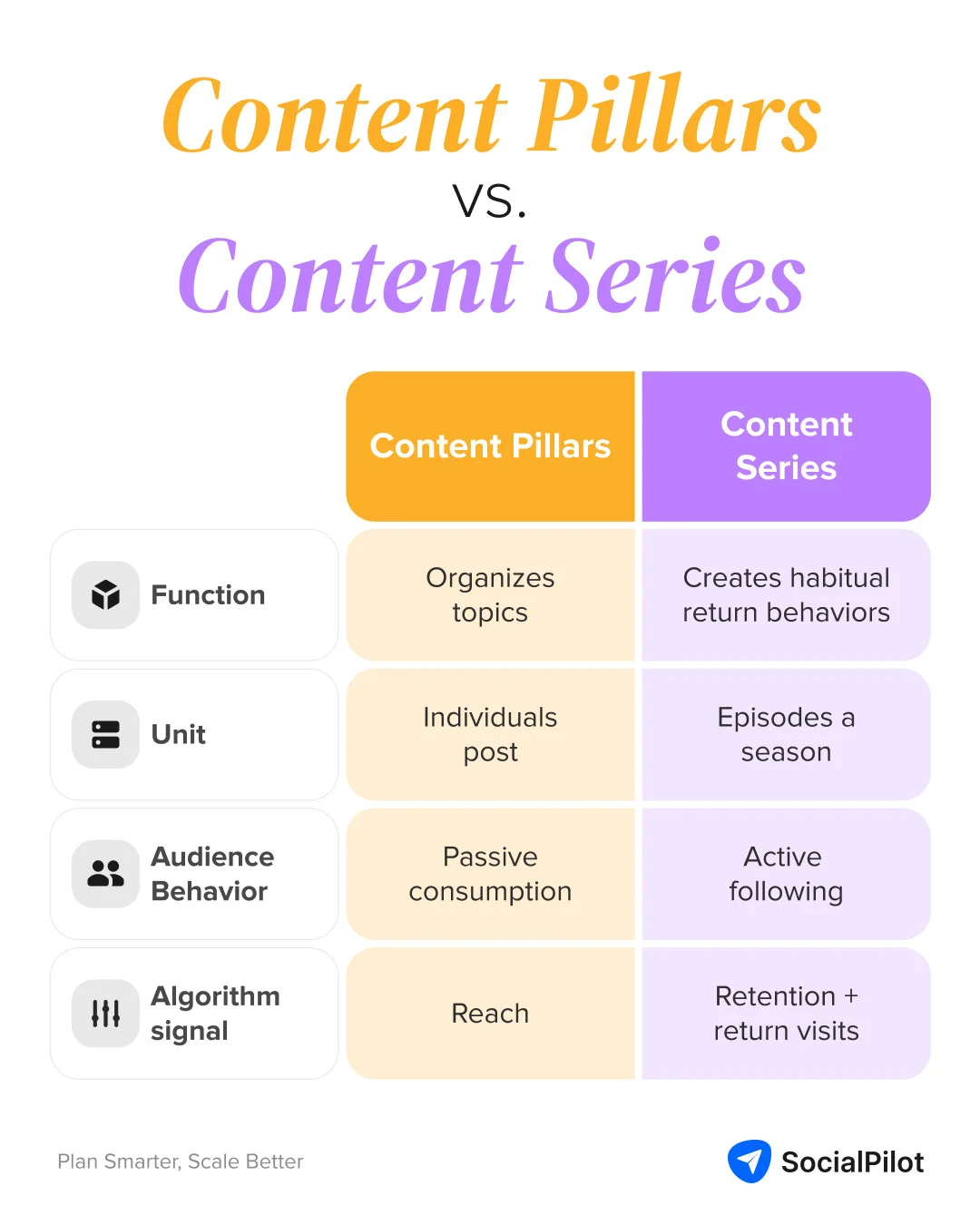
Covering “industry news” every Tuesday is not the same as running a show called “Five Minutes of News You Actually Need.” The first gives you a topic. The second gives you a reason to come back.
It is still important to build content pillars consistently. However, having pillars without episodes is like a TV network with only genres and no real shows.
The business case for making the shift from Posts to Episodes
According to the Social Media Content Strategy Report 2026 by Sprout Social, 70% marketers believe that a brands social media content strategy is very important and they are largely looking to prioritize episodic content for their brands in 2026.
Also, more and more social media users now expect brands to produce such content. The question is whether you are giving them one.
What the Brands Winning in 2026 Are Actually Building
None of the brands below had a dedicated production team when they started their series. What they had was a format they committed to, and an audience that came back for it. Here is what that actually looked like.
Anti-Recidivism Coalition: “The Formerly Incarcerated Office”
The Anti-Recidivism Coalition (ARC) is a nonprofit organization that supports people who have been incarcerated. Their content team is four people. No production studio, no professional camera crew.
What they built was a mockumentary series called “The Formerly Incarcerated Office”, shot to look like The Office; their format itself was the entire strategy. By using a recognizable mockumentary structure, they gave the content an immediate context that viewers understood without any introduction.
The series soon crossed 200,000 views.
The key takeaway is not just to use a mockumentary format, but to choose a format that your viewers already understand, as it does much of the storytelling for you. ARC did not have to teach their audience how to watch; they used a style the audience already liked.
National Gallery of Art: Alison Luchs and the Curator Series
The National Gallery of Art in Washington D.C., built a content series around Alison Luchs, a 77-year-old curator who had spent decades with the collection. The filming setup was minimal. No elaborate lighting rig, no production crew.
The series got 9 million views.
The series worked because of one clear decision: it focused on a recurring character who was genuinely interesting. The curator brought decades of experience and a real connection to the art, something you cannot fake in a content brief. The series gave viewers a reason to return to the same person, voice, and type of story each time.
Here is one such viral reel from NGA’s Instagram page
Rachel Karten broke down their strategy in one of her articles, “The museum with an unexpected star” where she explains how their social media strategist designed the format around a single recurring character with genuine expertise.
This is what BalanceCreative Studio described in their LinkedIn Pulse analysis:
“By giving audiences familiar characters, predictable cadences, and human-centered narratives worth following, brands move from being passively consumed to actively sought out.”
That shift, from passively consumed to actively sought out, is the clearest way to describe what episodic content is actually trying to accomplish.
Bilt: Roomies
Bilt is a fintech company built around rent payments. Their content series, Roomies, followed a group of New York City roommates as they navigated apartment life. Scripted, episodic, shot like a short-form TV show.
Here is an episode of Roomies on TikTok:
The series generated over 8 million organic views and won a Webby Award. According to eMarketer’s analysis of the Roomies series, it functioned as a conversion mechanism, moving entertainment viewers into the Bilt product ecosystem without ever running a traditional ad. Rachel Karten’s deep dive into the Roomies strategy is worth reading before you build your own.
The brand appeared in the show the way a product appears in a person’s daily life: naturally, contextually, without interrupting the story. Bilt did not explain rent rewards; the characters simply used them. By Episode 3, viewers understood the product better than they would have with an explainer video.
The success was not about high production quality. It was about sticking to the main idea. Each episode took place in the same world, with the same characters and setting. Viewers got to know the show, and the product became part of the story.
The lesson here is that you do not need a script about your product. You need a world your audience wants to spend time in, where your product belongs.
The real barrier is not the budget. It is the willingness to commit to a format.
ARC filmed with just a smartphone. The NGA recorded in a basement. Bilt spent a bit more, but much less than you might expect for a “Webby Award winner.” What all these brands shared was not a big budget, but a strong commitment to their format.
What Makes This Format Worth Coming Back To
Most brands that stop after two or three episodes do not fail because the idea was bad. They fail because they never clearly defined the format. They kept covering a topic, but did not create a show to keep running.
A format that builds return behavior has three specific elements:
1. Recurring premise: The consistent situation or question every episode inhabits. Not the topic. The setup. Immi Ramen’s “Ramen on the Street” is not about ramen. It is about what happens when you hand a stranger a bowl and ask what they honestly think. The food changes. The people change. The setup never does.
2. Consistent character or POV: Someone or something has to anchor the show. A founder, a product character, a recurring perspective. The NGA’s Alison Luchs was the anchor. Roomies had its cast. Without a consistent anchor, the series feels like a topic playlist rather than a show.
3. Predictable cadence: Viewers need to know when the next episode drops, and that expectation needs to be met. Most brand series break down here, not in concept but in execution. An episode drops in week one, then nothing for two weeks. The habit never forms.
Episode content format options by resource level
| Format | What you need | Example |
| Interview or talk show | One host, a camera, a consistent backdrop | Founder interviews customers or partners weekly |
| Behind-the-scenes documentary | Access and a camera | NGA curator series, Bilt Roomies |
| Mockumentary or comedy series | A script concept and commitment to the bit | DoorDash run club, ARC Formerly Incarcerated Office |
| UGC-led series | An active community and a consistent prompt | Community members become the episode cast each week |
| Challenge or recurring test | A premise and something new to test each time | “We tried every [X] so you do not have to” |
The simplest formats need very little production. What really matters is having a setup you can repeat and publishing on a regular schedule.
This is also where user generated content strategy becomes a series tool. A UGC-led format where your community is the recurring cast is one of the most cost-efficient series structures available, and every person who appears in an episode brings their own audience back to your feed.
The creator economy signals you should not ignore
Brands are now using creators to build original digital series, not just to publish sponsored posts. Brands are signing creators for multi-episode series deals rather than single-post integrations. That is a business model shift. When brands start repricing episodic against one-off posts in their creator contracts, it tells you where the ROI is landing.
James Nord, CEO of influencer marketing firm Fohr, talked through this in the Negronis With Nord episode on episodic branded content. His framing: brands pitching series content internally are comparing it to commissioning a TV show, not defending a social post. The pitch language has changed.
This social media branding guide offers you a broader view of how to build your brand presence in a way that supports this approach. It covers the foundational decisions that make series content feel like a natural extension of the brand.
How to Design Your Brand’s First Series
Most brand series fail because they skip the design phase. The team pointed a camera at something, called it Episode 1, and then had no idea what Episode 3 was supposed to be. Work through these steps before you start filming anything.
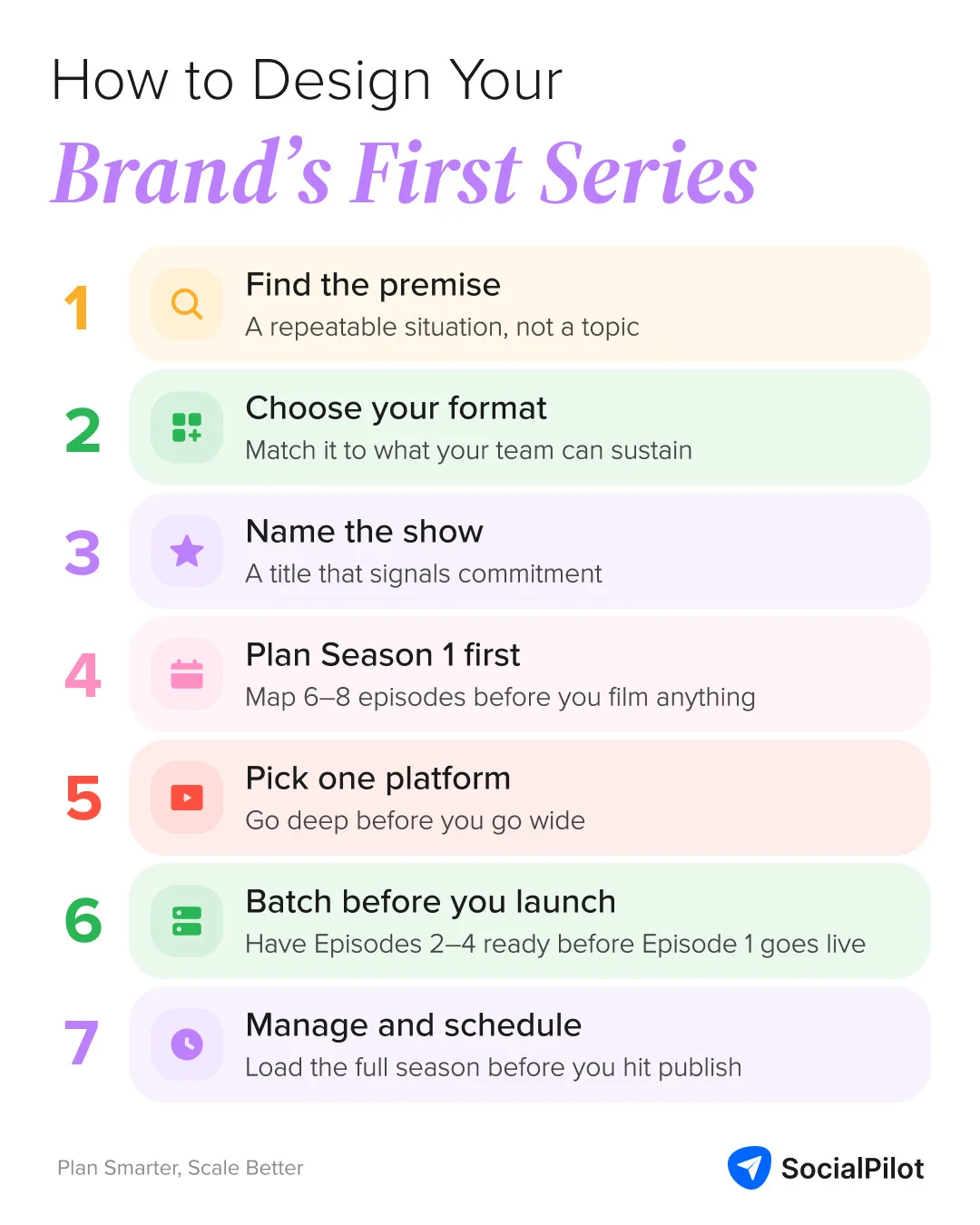
Step 1: Find the premise, not the topic
What recurring situation does your brand own? Not a topic. A situation. For instance, Cava’s Bowlmates is built around the moment two strangers discover they ordered the exact same bowl. That is it. Repeatable, human, interesting every time it plays out differently.
Your premise should answer: What is happening in every episode of this show? If the answer changes with each episode, you have a topic. If the answer is always the same setup with different content inside it, you have a premise.
Test it by writing six episode concepts from the premise alone. If you struggle past episode two, the premise needs more definition.
Step 2: Choose the format based on what you can actually sustain
This is the most honest step in the process. The best format is not the most impressive format. It is the one your team can execute for eight episodes in a row without missing a week.
One person with a smartphone and a consistent filming location: interview format or behind-the-scenes format. A small team that can dedicate one production day per month: documentary or mockumentary format. A brand with an active community: UGC-led format.
Choose a format that matches what your team can really handle, not what you wish you could do. A simple interview series filmed on a smartphone and published every two weeks will do better than a fancy documentary that only manages three episodes before running into delays.
Step 3: Name the show
A series needs a title. Not a content pillar label, not a category descriptor. An actual name that could go in a pinned TikTok post or a YouTube channel section header.
“Bowlmates.” “Roomies.” “The Formerly Incarcerated Office.” These names do two things: they signal a commitment to a show rather than just a content type, and they make the content findable and shareable in a way that “our weekly food content” never will be.
Naming your show also helps your team stay committed. Once it has a name and a launch date, it is harder to drop the project after just two episodes. The show feels real and has its own identity, so stopping becomes a clear choice, not something that just happens.
Step 4: Plan Season 1 before you publish Episode 1
Map out your first six to eight episodes before you publish anything. This is not about overthinking the content. It is about proving to yourself and your team that the premise is genuinely generative.
If you cannot come up with six episode concepts without repeating the same idea in slightly different packaging, the premise needs more work. If the episode ideas come quickly and each one feels like a distinct, natural installment in the show, you have something worth building.
You need at least six episodes in a series before viewers start forming habits. If you launch Episode 1 without having Episodes 2 to 4 ready, your series is likely to lose momentum.
Season 1 also gives you a natural evaluation arc. By the time Episode 6 or 8 drops, you have performance data, audience comments, and a real sense of what direction the series wants to go in Season 2. You cannot get any of that from a three-episode trial run.
Step 5: Pick one platform and go deep before expanding
Resist the urge to launch across every platform at once. Pick the primary platform based on where your audience actually is and what format the platform rewards right now.
Here are some popular platforms to choose from:
- TikTok – strongest home for short-form episodic content if your audience is there and your format works in under 90 seconds
- Instagram Reels – best for visually driven series with an existing follower base; discovery is lower than TikTok, but engagement from warm audiences is higher
- YouTube Shorts – better cross-platform longevity; episodes stay discoverable long after publishing, unlike TikTok, where the discovery window closes faster
- LinkedIn – best fit for B2B series, especially interview or thought leadership formats where the audience expects longer, professional content
Start on one platform, establish the format, establish a consistent production rhythm, and then repurpose content across platforms once the core series is stable.
Step 6: Batch before you launch
Do not publish Episode 1 unless Episodes 2 through 4 are already created and ready to go. The first episode will underperform because no one knows the show yet. If you do not have episodes ready to follow it on schedule, the gap between Episode 1 and Episode 2 will be long enough that whatever early audience you started to build has moved on by the time the next one drops.
Batching also changes how you approach production in a useful way. When you are creating three episodes in a single session, you naturally find the patterns in the premise, the format details that work, and the pacing that feels right. You cannot find those things by creating one episode at a time and waiting to see what happens before filming the next one.
Step 7: Manage, schedule, and stay consistent
Consistency is key when running a series. Missing a week is not just a gap in your schedule – it breaks the habit you have worked to build. If viewers expect Episode 4 after Episode 3 and it does not appear, they may not return later.
For small content teams at SMBs, the hardest part of running a series is not making the episodes, but staying on schedule every week while handling other tasks. When production and publishing compete for your time, publishing often gets pushed aside, and that is what causes a promising series to fail.
The solution is to handle publishing in advance, before the season begins.
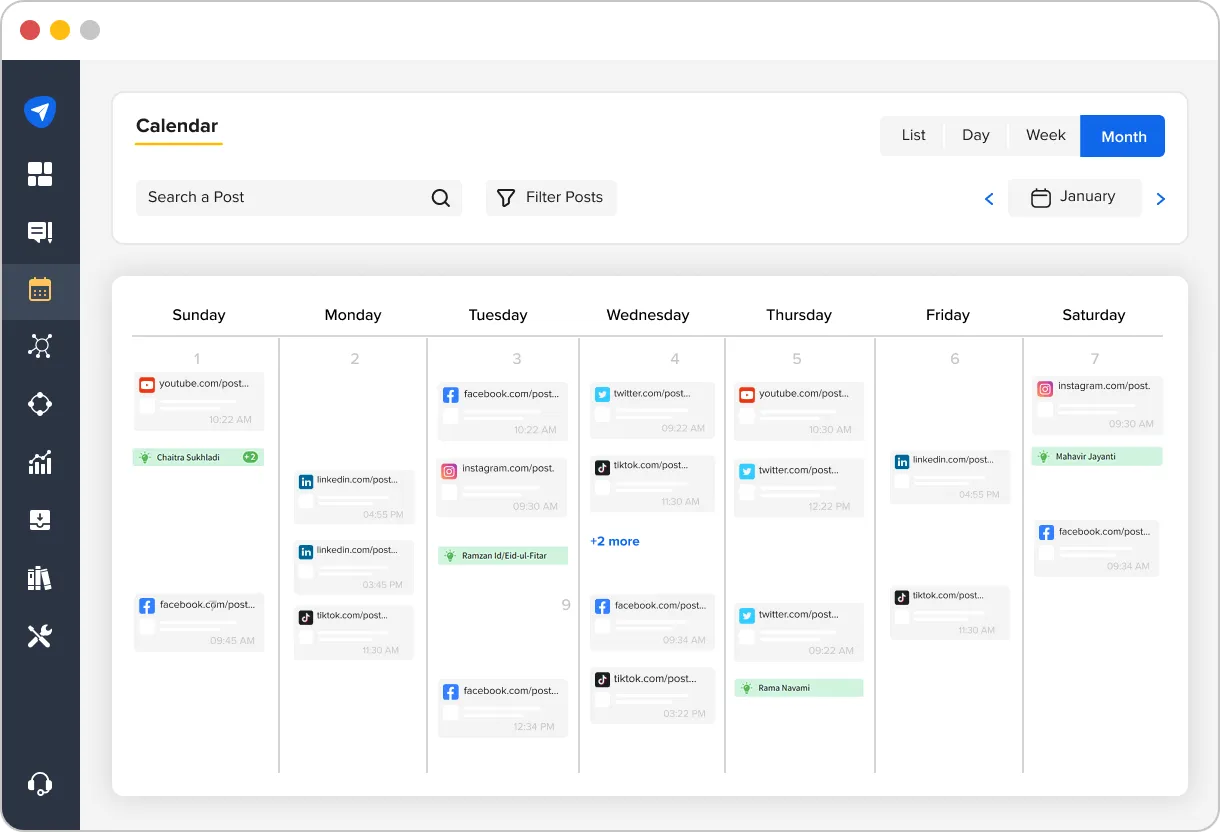
SocialPilot’s Content Calendar lets you map the full season arc in one view and schedule every episode drop in advance – across TikTok, YouTube, Instagram Reels, and LinkedIn. Once your batch of episodes is ready, use SocialPilot’s Bulk Scheduling to load the whole season in one session, and the series runs on schedule without weekly manual intervention.
If you are also producing captions for each episode, AI Pilot generates platform-specific captions from your episode content, adjusts tone per platform, and adds hashtags, so the publishing prep that usually takes an hour per post takes minutes.
These features help small content teams stay on schedule while also doing everything else.
How to Know If Your Series Is Working
One of the biggest reasons brands give up on episodic content too early is that they measure it against the wrong benchmarks. If you evaluate a series using the same metrics you use for individual posts, it will always look underperforming.
The metrics that do not tell you what you need to know
Stop tracking these as primary indicators for a series in its early episodes:
- Reach per post.
- Impressions per episode.
- Follower count growth from any single episode.
These measure a post’s ability to find new people in a single moment. A series is not trying to do that.
What you should actually be watching
Here are some metrics to watch for in episodic content:
- Saves and shares per episode. Saves tell the algorithm this content is worth returning to. Shares tell your network this show is worth following. Both matter more than a series’s view count.
- Comment quality. “Great video!” versus “When does Episode 4 drop?” is the difference between passive appreciation and active following. Comments asking about the next episode are the clearest signal that an audience is forming.
- Follower growth rate during the series run. Compare your growth rate before launch to your growth rate during Season 1. If the series is working, this number shifts noticeably over six to eight episodes.
- View completion rate. Are people watching to the end? A completion rate that climbs across the season means the audience is growing more invested, not less.
- Compounding engagement. Is Episode 5 outperforming Episode 1? If yes, the series is doing what series are supposed to do.
For episodic content, do not just ask, “How did this post perform?” Instead, ask, “Is engagement growing across the whole series?”
The Season 1 evaluation question
At the end of Season 1, ask one question: did this series build something, or did it just fill the calendar?
If you can point to people who actively followed the series, if comments and shares shifted over the run, if follower growth moved during the episodes, you built something. Plan Season 2.
If your metrics do not improve and there is no sign of repeat viewers, you need to rethink your format or platform before starting another season.
For the full set of content marketing KPIs to track across your broader strategy, the series-level metrics above should sit alongside your standard account-level indicators.
Build the Show, Not Just the Calendar
The difference between brands that build real audiences in 2026 and those just filling up their calendars is simple: are you just posting, or are you running a show?
Posting is a weekly choice. Running a show is a decision you make once and then follow through on consistently.
You do not need a Gap-level budget to create episodic content. All you would need is a premise that is repeatable, a format your team can sustain, and a publishing workflow that keeps the series on cadence even when the week is busy.
If you are ready to launch your first series, begin by planning the full episode arc in your content calendar before filming. Once you have a batch of episodes ready, schedule them all at once with SocialPilot. This keeps your series on track without adding extra work each week.
See what SocialPilot plan fits your team.