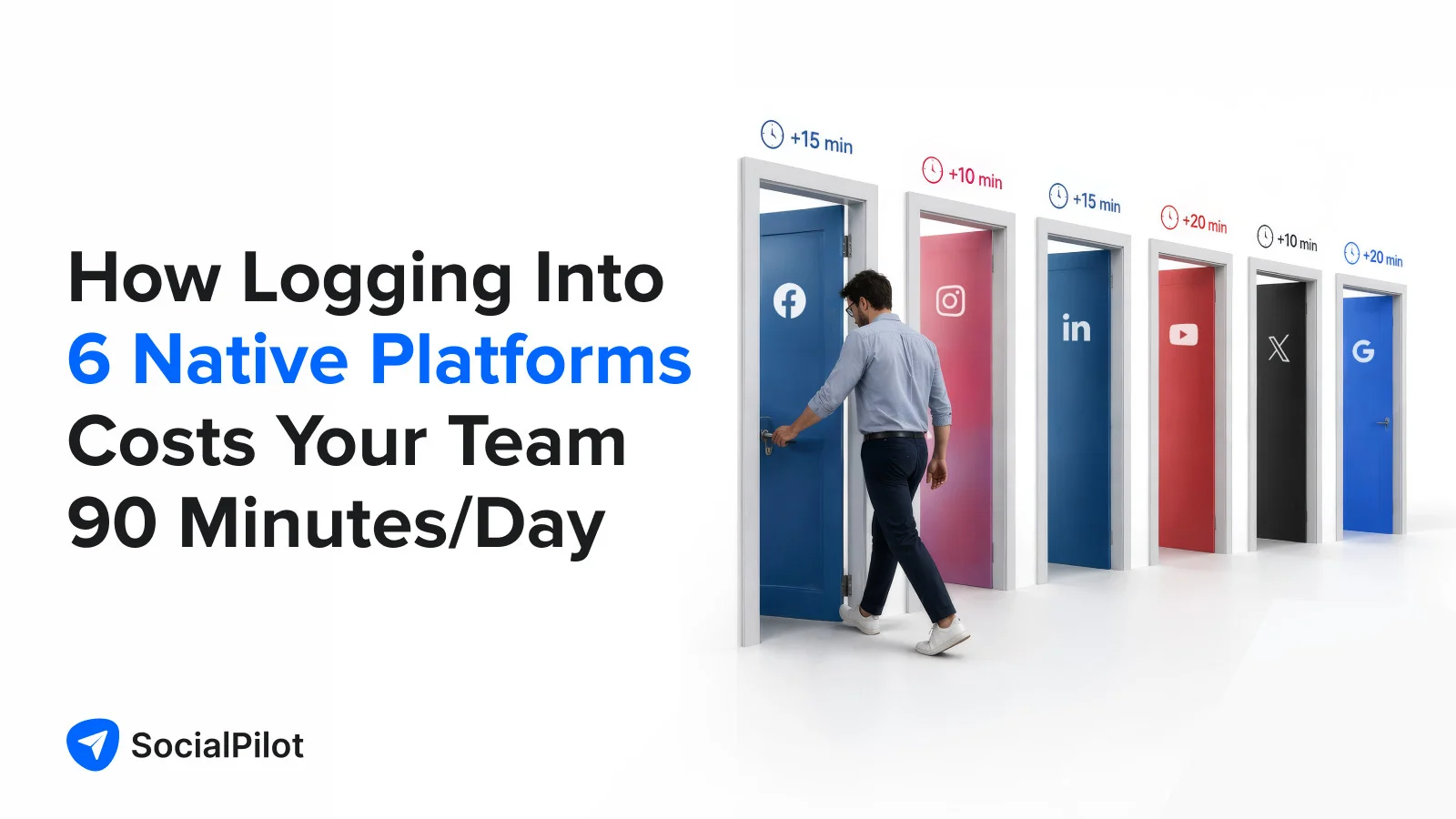
It’s Monday; one of your social media team members opens their laptop at 9am.
By 9:15, they’ve already logged into a client’s Instagram; they navigate the content queue and then switch to Facebook. After repeating the same process on Facebook, they move to LinkedIn. There too, they check the inbox and then jump to TikTok to search for a draft that they saved yesterday. After that, they finally switch to X and repeat the same actions, here too.
Almost 1.5 hours are gone by now, and they still haven’t started their actual work yet.
These 90 minutes that they just spent analyzing client’s accounts will not show up on their timesheet, but they will show up on your payroll – every single day.
Also, this is not just one person — it’s everyone on your team, running the same circuit, burning the same overhead.
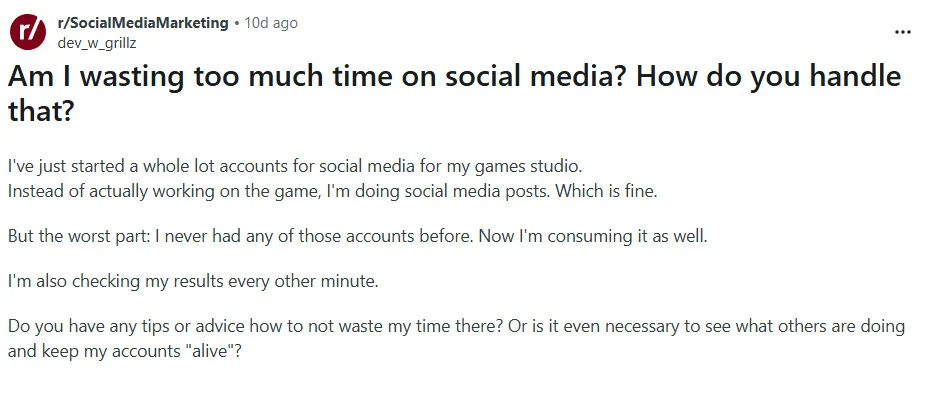
We have often heard agency owners and social media managers complaining about the time they spend on social media every single day. There are also multiple threads on Reddit around the same problem.
Especially if you are a small agency with a team of 3-5 people handling 8 to 20 clients, this structural leak can get worse with every new client you add.
Where do These 90 Minutes Actually Go
These 90 minutes may not always go by in one block. This time usually bleeds across the morning in small chunks that feel normal because everyone on the team experiences them the same way.
This is how your social media team is spending these 90 minutes:
| Task | Time per platform | Platform | Daily Total |
| Login + authentication | Approx 3 mins | 6 | 18 mins |
| Post + reformat per platform | Approx 7 mins | 6 | 42 mins |
| Monitor comments/DMs | Approx 5 mins | 6 | 30 mins |
| Total per manager/day | 90 mins |
But it’s not just these 90 minutes. Research from Cornell University Idea Lab shows that it takes an average of 9.5 minutes for workers to return to a productive workflow after switching between digital apps.
None of these tasks feel like a waste at the moment; each of these activities looks legitimate. The problem is that doing them six separate times, for six separate platforms that don’t share a login, a dashboard, or a notification feed – is where the overhead hides.
What This Costs a 3-Person Agency Every Year
Now scale that to a team of three, which is what most 8–20 client agencies run:
| Daily | Per year (250 days) | At $50/hr loaded cost | |
| Per person | 90 min | 375 hours | $18,750 |
| Team of 3 | 270 min (4.5 hrs) | 1,125 hours | $56,250 |
Your team is losing $56,250 a year in platform-switching overhead alone.
But this is not just an overhead problem, it’s also an efficiency problem.
According to Sprout Social’s productivity report, 63% of social media marketers say that manual tasks prevent them from doing high-impact work. 48% say that they sometimes or rarely have enough time to get their work done.
Due to all this tool switching, your strategy sessions get pushed. Preparing those client reports takes three times as long because the data lives on six separate dashboards, and even the posting gets delayed because the approvals are buried in email threads.
How Agency Owners Try Fixing It (And Why It Falls Short)
When agency owners first recognize this problem, they reach out for one of these three fixes.
- Time blocking: Assign 8–9am to publishing, 4–5pm to monitoring. The logic is sound until a comment needs a response, a post fails to go live, or a client calls. The context switches return regardless of what the calendar says.
- Browser profiles per client: One Chrome profile per client with saved logins. This trims some login friction but doesn’t eliminate the cognitive cost of switching between profiles. It does nothing for approval chaos, fragmented reporting, or keeping the team coordinated across clients.
- A VA to handle the publishing. This moves the 90-minute overhead to a cheaper hourly rate. But it doesn’t completely eliminate overhead. You’re still paying for it; just paying someone else to experience it.
All three of these solutions will fix the symptoms, but they will not help change the structure that keeps generating it.
Why Hiring More People Will Make This Problem Worse
When your team is effectively working 6.5 productive hours a day instead of 8, things start slipping. There is a visible gap between what’s getting done and what needs to be done.
To some agency owners that start to look like a staffing problem.
So, you open a job listing. You budget for a new hire, thinking that hiring one more person will close the gap. You put in another $60,000-$65,000 a year, the average salary of a social media manager being $63,639/year in the US.
But here’s what happens on their first day.
They log into a client’s Instagram, navigate the content queue, then switch to Facebook, log in again, and do the same for all 6 platforms. And before you know it, they also became a part of the structural problem that already existed before them.
With every new hire, your platform switching overheads become worse:
| Daily overhead | Per year | At $50/hr loaded cost | |
| Team of 3 (current) | 4.5 hrs | 1,125 hrs | $56,250 |
| Team of 4 (after new hire) | 6 hrs | 1,500 hrs | $75,000 |
| Team of 5 | 7.5 hrs | 1,875 hrs | $93,750 |
Every person you hire adds $18,750/year in platform-switching overhead before they complete a single billable task. The problem just gets worse with hiring more people.
A Structural Setup That Will Help Close the Gap
You don’t need better habits or tighter schedules. The overhead isn’t caused by how they work – it’s caused by where they work.
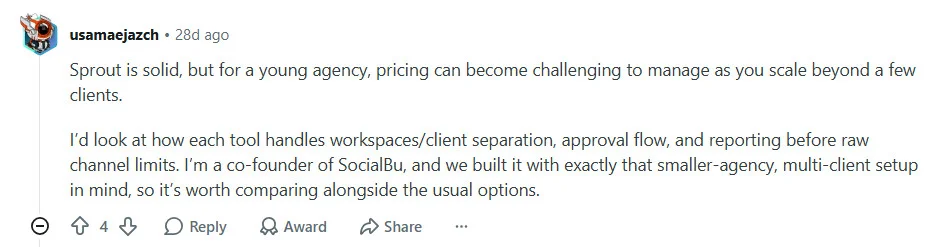
When your team operates across six separate platforms, the switch is baked into the workflow itself. This constant switching creates a lot of time drain as mentioned in the below thread and this is when you need a structural setup that helps make things smooth.

Consolidation really helps. When scheduling, publishing, inbox monitoring, approvals, and reporting all live in one system, the platform switches stop happening, because your team is already looking at everything from one place.
The login overhead drops to near zero. The reformatting that took 42 minutes across six platforms becomes one scheduled action. Comments and DMs from all platforms surface in one feed instead of six. Client approvals happen inside the same tool your team is already working in, not in a WhatsApp thread from three days ago.
Here is what the math looks like after you switch to a consolidated social media tool:
| Task | How it changes | Daily total |
| Login + authentication | One login for all clients and platforms | ~2 min |
| Post + reformat per platform | Bulk schedule via CSV — one upload, all platforms | ~10 min |
| Monitor comments/DMs | One unified inbox for all platforms and clients | ~15 min |
| Total per manager/day | ~27 min |
That’s a shift from 90 minutes of overhead to roughly 27 — a saving of about 63 minutes per person, per day.
For a three-person team, that’s over 3 hours of daily capacity returned to client work, strategy, and the output your retainer rates are supposed to cover.
Teams that make this shift consistently recover 5 to 15 hours per person per week.
The results of this switch will be pretty evident. For a three-person agency, it means saving 45 hours of weekly capacity for the real, billable work – without adding headcounts.
Why This Switch Actually Works
When you switch to one unified dashboard – one login, all clients, all platforms – it removes the structural friction your team is fighting every day.
The table below shows how much you end up spending when you hire a new social media manager vs you switch to an efficient social media tool:
| Hire a social media manager | Unified management tool | |
| Annual cost | $63,653 avg salary (Indeed) + ~30% benefits ≈ $83K | ~$100–200/month = ~$1,200–2,400/year |
| Time to impact | 3–6 months (hiring + onboarding) | Days |
| Time reclaimed | Adds capacity, doesn’t fix the loop | 1,125 hours/year for a team of 3 |
| Risk | Wrong hire = 6+ months wasted | Low — cancel anytime |
This isn’t an argument against hiring, because we know that good people matter. But the right sequence is to first fix the system and then see what you actually need.
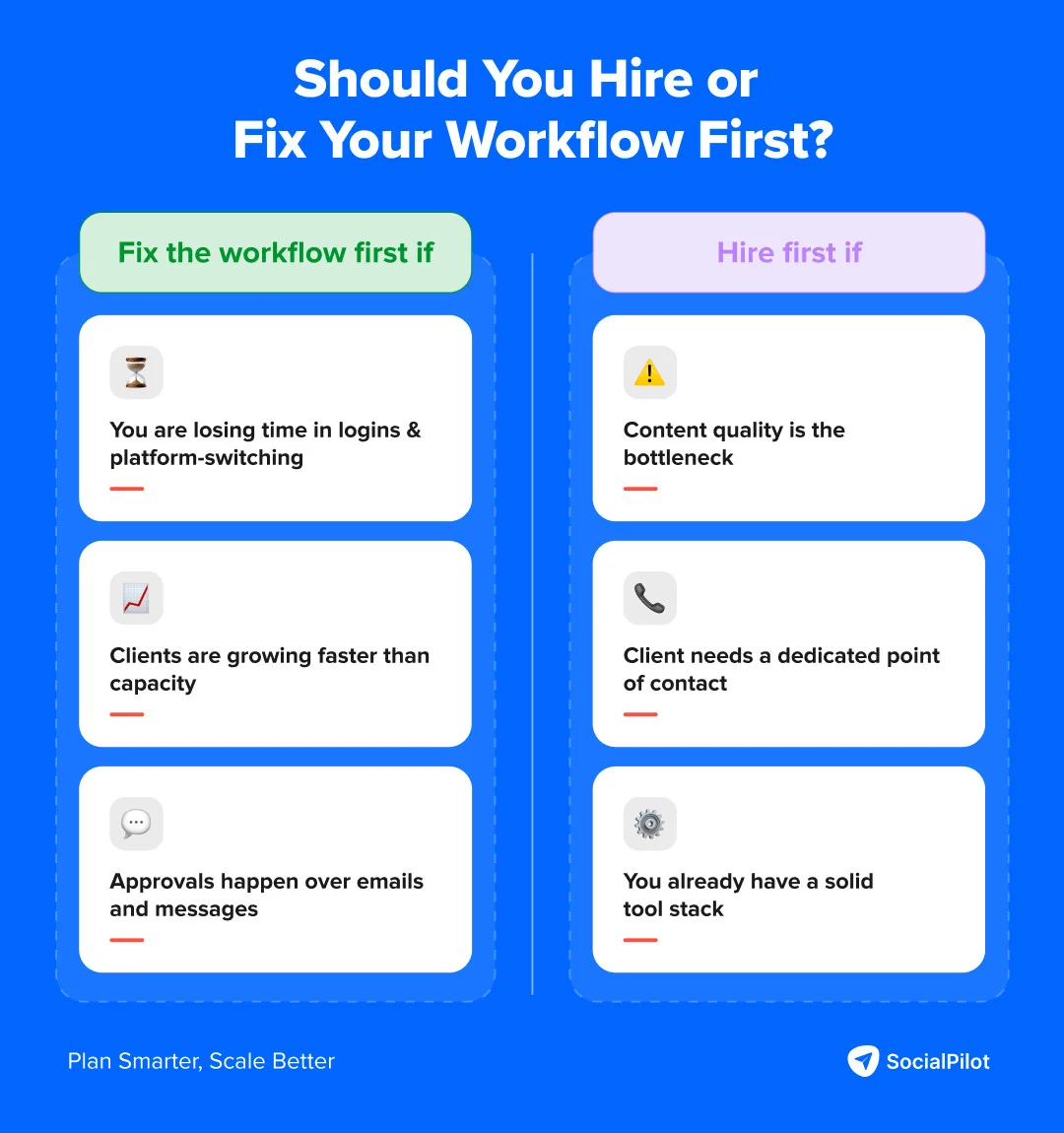
Most agencies that run this audit find that they have a workflow problem.
If your agency also falls in that category, you need social media tools that are specifically built around the features that address these three tasks: logins, publishing, and monitoring.
Here’s a comparison of some popular tools based on the features you would need most:
| Feature | SocialPilot | Hootsuite | Sprout Social | Later | Metricool |
| Single login for all client accounts | ✅ | ✅ | ✅ | ⚠️ Limited | ✅ |
| Bulk scheduling (CSV upload) | ✅ 500 posts | ✅ 350 posts | ⚠️ Limited | ❌ | ✅ |
| Built-in client approval workflow | ✅ | ✅ Higher plans | ✅ | ⚠️ Higher plans | ⚠️ Limited |
| Unified inbox (all platforms) | ✅ | ✅ | ✅ | ⚠️ Limited | ✅ |
| White-label reporting | ✅ | ❌ | ❌ | ❌ | ✅ Some plans |
If you are looking for a tool that checks all the boxes, SocialPilot, Hootsuite and Sprout Social all do a decent job. But if you’re running a small agency, Hootsuite and Sprout can start to feel heavy on the pocket, as this founder puts it. [Source: Reddit]
SocialPilot gives you a unified dashboard for all client accounts, bulk scheduling for up to 500 posts via CSV, and a built-in approval workflow that cuts out the email and WhatsApp back-and-forth. That’s 63 minutes saved per person, per day — all under one tool. Also, you just pay a flat rate of $170/month for unlimited users.
Your Team Was Never the Problem
Your team isn’t slow or unproductive; they’re just stuck in a workflow that was built to waste time.
Ninety minutes a day, per person. $56,000 a year for a three-person team – gone to six platforms that were never meant to work together.
The only thing that fixes this problem is a structure that has one login, one dashboard, and one place where the work actually lives. This is where social media management tools come into play.
There are several tools that can help you fix this structural gap at a fraction of what a new hire will cost you. Now the question is will you still let your team waste their 90 minutes on platform-switching, or will you make them do the work your clients hired you for?