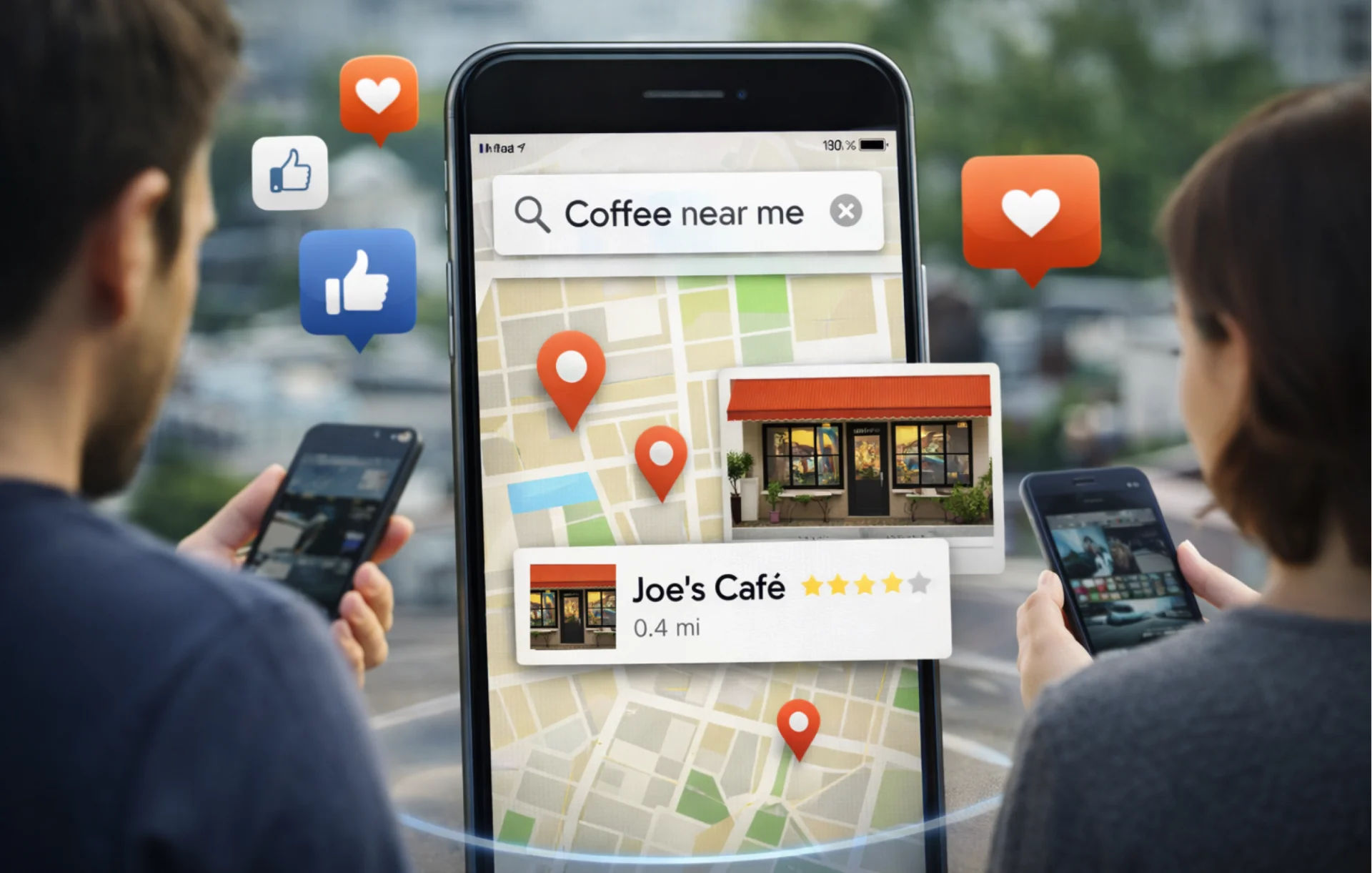
If you are a small business or have just started out, then running national and international campaigns initially can be a wasted investment. While hyperlocal marketing is used by all businesses, it is particularly effective for local businesses that generate most of their revenue from store walk-ins.
There is also an old proverb that says go local before you go global, and this is essentially what hyperlocal marketing is. It is a process wherein businesses build a strong local foundation in their small, specific geographic areas before expanding a national or global stage.
Even the statistics around hyperlocal marketing are pretty interesting. According to Soci Consumer Behavior Index, 80% of US customers search online for local businesses every week, while 32% of them look for local businesses every single day.
So, hyperlocal marketing is no longer a matter of choice, but it has become a compulsion for small businesses in today’s digital age.
In this blog, we will dive deep into the concept of hyperlocal marketing, covering its benefits and proven social media marketing strategies to help businesses navigate this trend effectively.
Let’s understand what hyperlocal marketing is:
Key Takeaways:
- Hyperlocal marketing is when businesses focus their marketing efforts on a small, defined geographic area (a few streets to a few kilometers). It uses GPS data, geo-targeted ads, GBP, local SEO, and social media location filters to reach nearby customers.
- 80% of US customers search online for local businesses every week, and “near me” searches have grown over 400% in recent years. Businesses that optimize for these searches capture high-intent buyers ready to take action.
- Social media is a powerful hyperlocal channel when used with clear intent. Facebook’s Local Awareness Ads, Instagram geotags, TikTok’s location-based algorithm, and platforms like Nextdoor give businesses precise tools to reach audiences based near their physical location.
- Partnering with local micro-influencers, encouraging user-generated content from neighborhood customers, participating in community events, and collaborating with nearby complementary businesses can help create authentic local credibility that ads can’t replicate.
What is Hyperlocal Marketing
Hyperlocal marketing is a targeted marketing strategy that allows businesses to reach their customers within a small geographical area. This area could be as narrow as a few streets or a 1–5 km radius. But it can also cover a few blocks or even an entire city, depending on the nature of the business.
The goal here is pretty simple: instead of casting a wide net and targeting customers from across the globe, businesses choose to concentrate their marketing efforts on a smaller, more defined audience to get better results.
So, how does hyperlocal marketing work? Well, it’s pretty simple. Businesses use GPS location data, geo-targeted ads, Google Business Profile, local SEO, and social media location filters to push their products or services in nearby areas. If anyone nearby is looking for a similar product/service, listing sites like Google recommends your business to them, and they might end up becoming your customer.
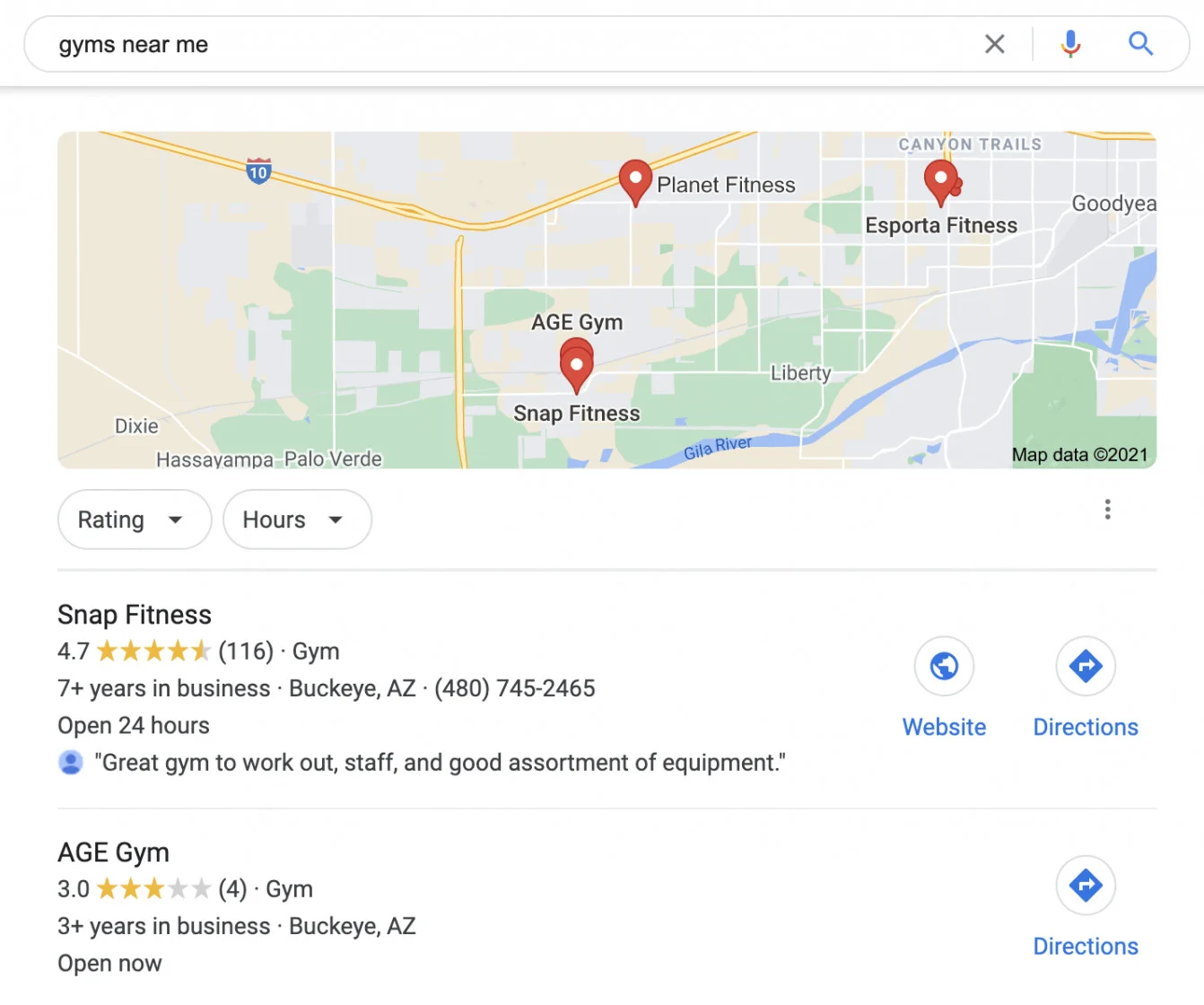
So, for instance, if someone shifts to Arizona and searches nearby gyms, the results shown by Google are not random; these are businesses that have implemented hyperlocal marketing strategies to appear in the top results in their areas.
Benefits of hyperlocal marketing
Let us now talk about some key benefits of hyperlocal marketing.
In the past few years, “near me” searches on Google have increased by over 400%. These searches highlight a shift in customer behavior towards finding immediate and local shopping solutions.
Hyperlocal marketing operates on a research-online-purchase-offline (ROPO) model that helps customers search for businesses online and then drive them to stores where they can make actual purchases. So, hyperlocal marketing strategies can drastically help increase the footfall in stores.
2. Better Conversion Rates and Higher ROI
Proximity to a business can also significantly increase the purchase intent of the customers. This is especially true for service-based businesses, retail stores, restaurants, clinics, and education centers. When users see that you are located nearby, their psychological barrier to taking action decreases.
Hyperlocal campaigns often result in higher click-through rates, more store visits, and improved lead-to-conversion ratios compared to city-wide or nation-wide campaigns.
3. Improves Brand Awareness
By optimizing your business for local searches and spreading the word in the local community, you can build brand awareness, increase recall and build familiarity.
When a brand appears consistently in local search results or posts localized content on its social media platforms, it increases its perceived authority within the community and they become a go-to option within their immediate surroundings.
4. Real-Time Relevance and Better Personalization
Hyperlocal campaigns allow businesses to tailor messaging based on specific neighborhood events, demographics, or community behavior. Brands can customize their offers for specific residential areas or create messaging that is aligned with local needs.
This personalization and contextual relevance improve engagement and strengthen brand perception.
5. Competitive Advantage in Saturated Markets
Marketing your products across cities or countries is often expensive and ineffective. Hyperlocal marketing, on the other hand, helps you dominate micro-markets before you choose to expand further.
You can focus on specific neighborhoods, build density within small service areas, and expand gradually based on your performance data. This creates a scalable growth model.
How to Get Started with Hyperlocal Marketing
Creating successful hyperlocal marketing campaigns is all about establishing deep connections with your local community, but how exactly do you start?
Let’s break down the process step-by-step.
Integrate Local SEO
To begin with, you would need a powerful local SEO strategy, so your business can appear in “near me” or location-based queries.
Integrating local SEO means aligning your website, listings, reviews, and citations with clear geographic signals so search engines understand exactly where you operate and who you serve.
Optimize Your Listings on GBP & Other Directories
A Google Business Profile (formerly Google My Business) listings is critical for businesses looking to appear in hyperlocal searches. Even customers are 2.7x more likely to trust a business with a complete Google Business Profile.
For GBP listings, start by filling in your details, such as the business name, address, and phone number (commonly called NAP).
Then go on to add other important details like your business description and operating hours. To further optimize your GBP profile, you can add some high-quality photos of your business, posts about events, hourly updates, or any special offers.
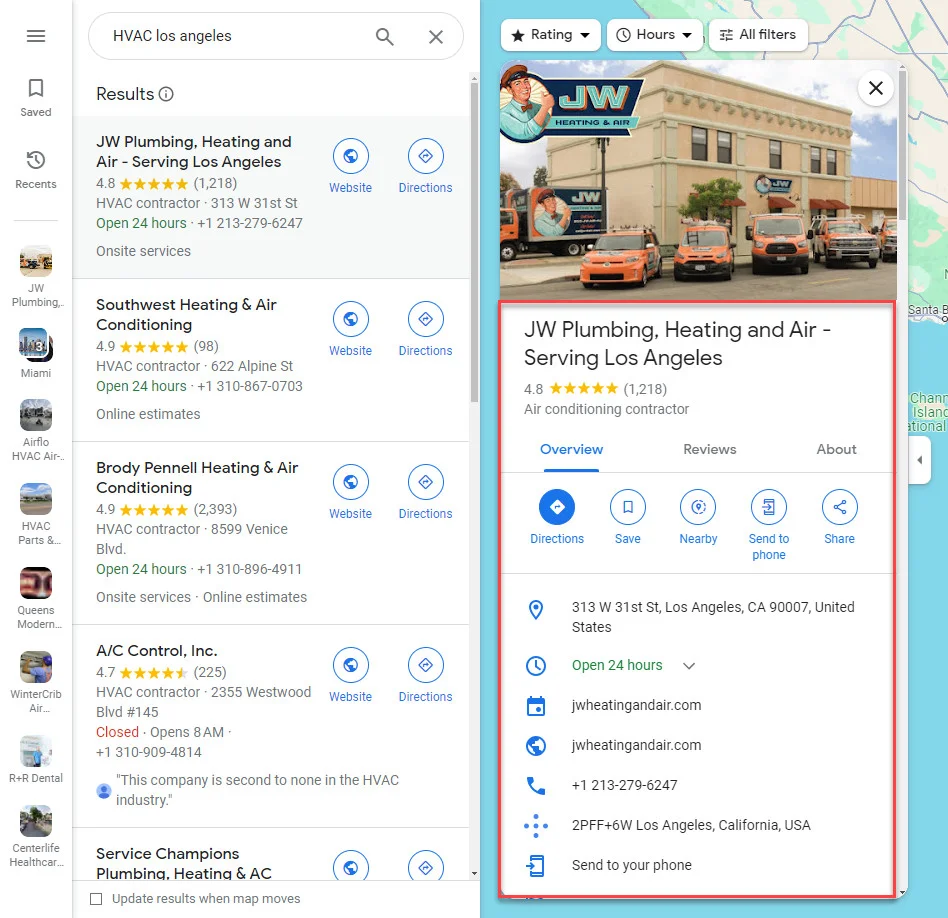
Adding some hyperlocal keywords in your business description is also a great strategy. Keywords with neighborhood names, service areas, and core offerings will improve your visibility in local pack results and Google Maps.
For instance, instead of writing “We offer plumbing services,” use a more specific keyword like “Plumbing, Heating, and Air Conditioning Services in Los Angeles.”
After you have optimized your listing on GBP, add your business to other directories. Local citations or mentioning your business name, address, and phone number across third-party platforms help build authority and trust.
B2C businesses can be listed on Yelp, Facebook, Foursquare, or industry-specific directories, while B2B businesses can list themselves on platforms like G2 or TrustRadius.
Geotag Your Online Presence
Search engines like Google also evaluate on-page signals to understand your location relevance.
Here are some ways that businesses can use to integrate geolocation signals:
- Include city and neighborhood names in title tags and meta descriptions.
- Create location-specific landing pages.
- Embed Google Maps on contact pages.
- Add schema markups for local businesses.
- Use location-based URLs
Businesses must also geotag their social media posts and images because creating local relevance across digital touchpoints strengthens their hyperlocal footprint and helps with digital marketing for local businesses.
Encourage and Manage Reviews
Search engines treat ratings and reviews as important trust signals. When businesses have great reviews, they attract more customers, and search engines consider increased engagement as an important social proof.
To leverage reviews effectively:
- Encourage satisfied customers to leave Google reviews.
- Respond to both positive and negative feedback.
- Address concerns professionally.
- Incorporate keywords naturally in responses when relevant.
- Monitor customer review frequency and sentiment trends.
Reviews, when managed well, will not just increase your click-through rates but also your rankings on Google.
Hyperlocal social media marketing is a powerful tool for businesses looking to connect with nearby customers who are most likely to visit their store and buy from them.
Implementing hyperlocal marketing strategies on social media – like tapping into neighborhood trends, joining local conversations on social media, and adding location tags to social media posts- helps you build genuine community trust and appear in “Near me” searches.
Social media also gives you real-time feedback from your local audience — comments, reviews, and DMs tell you exactly what your neighborhood wants, so you can adapt quickly.
Creating hyperlocal social media marketing is all about building a strong local presence on social media. Here’s how you get started:
Hyperlocal marketing is all about driving engagement and actions within a defined local community. Businesses must come up with well-defined social media goals and strategies that help them achieve these goals.
Some of the most common objectives behind hyperlocal marketing are:
- Increasing brand awareness and local credibility so that the business becomes easily recognizable within its immediate service area.
- Driving more foot traffic from surrounding areas.
- Highlight local promotions, store openings, seasonal offers, or community events tied to a particular branch or neighborhood.
- Get more engagement from the local audience through reviews, testimonials, and user-generated content.
Setting clear objectives ensures that your social media activity supports your broader hyperlocal marketing goals.
For hyperlocal social media marketing, businesses must create their social media accounts on platforms where their audience is most active.
For most local businesses in the USA, Facebook remains one of the strongest platforms for hyperlocal engagement, given its massive reach and granular targeting tools.
Facebook offers “Local Awareness Ads” that let local business owners target users within a specific radius of their physical location. Also, Facebook Groups are widely used by local businesses for local discussions and to promote local activities and events.
Besides Facebook, other social media platforms for business that work well for hyperlocal marketing are:
- Nextdoor: Particularly effective for home services, and has higher lead-to-sale conversion rates.
- Instagram: Ideal for visual-heavy hyperlocal marketing, businesses can use geotags and location stickers for better discoverability.
- TikTok: Its “For You” page algorithm suggests content based on a user’s current city and area.
- Snapchat: Use Snap Maps and custom geofilters to engage younger demographics in your area.
Selecting the right combination of social media channels allows businesses to concentrate on their efforts where they are most likely to reach local customers.
3. Analyze Your Competitors
Your competitors can be your biggest source of inspiration when running hyperlocal campaigns. Doing social media competitor analysis can reveal valuable insights about market demand, audience preferences, and promotional tactics that work in your area.
Here’s how to get started:
- Study their campaigns, messaging, and engagement patterns.
- Identify the gaps in the local market.
- Create and refine your own marketing approach.
Tools like SocialPilot also help you create competitor reports to track the growth, engagement, and activities of your competitors, so you can outperform them.
Businesses can also use social media listening tools to track the mentions of their competitors, engage in trending discussions, identify customer feedback, and emerging topics related to their industry and location.
4. Create a Content Strategy for Your Local Audience
Most businesses produce generic content that targets a broad audience, but, on the contrary, businesses must localize their social media content strategy using community-focused storytelling.
Create social media posts that reflect the interests, culture, and needs of a specific geographic community. Develop dedicated pages for each city, neighborhood, or service area your business serves. Also, make sure to add hyperlocal keywords to your website content and social posts; incorporate the names of cities, neighborhoods, and location-based phrases.
Additionally, you can leverage local and seasonal events and create content around them. This will help you stay relevant in local conversations.
Localizing social media content is not just about adding a city name to the caption; it is about creating content for specific locations, adding the relevant hashtags, and maybe even translating the captions if required.
SocialPilot’s AI Pilot can support this workflow in several ways. Whether you are a multi-location business struggling to keep a consistent brand tone or a small business focused on creating community-driven content, this tool can help you create localized captions with just a few prompts.
Additionally, it helps you:
- Expand or shorten the content.
- Add relevant hashtags
- Translate it into 10 different languages, depending on the local language of your TG.
Try SocialPilot Today!
Using local hashtags and geotags helps improve your discoverability among users looking for content related to their city, neighborhood, or a particular location.
Instead of using high-volume generic hashtags like #veganfood, using more location-specific hashtags like #VeganBakingAustin will help you reach a smaller but highly targeted audience. You can use SocialPilot’s hashtag generator, to simplify your search for niche or location-specific hashtags.
Free AI Facebook Hashtag Generator
Supercharge your Facebook posts with the perfect hashtags using SocialPilot’s AI-powered Facebook Hashtag Generator.
Here is the Generated Result
Similarly, geotags act as digital pins that associate your content with a physical location, making it discoverable on maps and location-based feeds. When adding geotags, make sure to tag your exact business location or a specific landmark, rather than a broad city name
Unlike large national influencers, local creators are deeply connected with their community, and their voices and opinions matter. People perceive them as highly authentic and relevant. So, finding the right social media influencers and partnering with them can help businesses increase their visibility among potential customers.
If you are an SMB:
- Start by looking out for micro-influencers (10,000 – 100,000 followers) in your area.
- You can search for them using location-based hashtags on Instagram and TikTok.
- When analyzing their profiles, go beyond the follower count and focus on their audience demographics, engagement quality, and content relevance.
Influencer marketing can also be combined with collaborations between complementary local businesses. For example, a café may partner with a nearby bookstore, fitness studio, or co-working space to run joint promotions.
Such collaborations will help you reach each other’s audiences and expand your reach within a specific neighborhood or community.
7. Leverage User-Generated Content
When businesses feature real people from the community interacting with their business, they look far more credible. But the challenge here is that customers would not create content for you just because you want it, you will have to give people a reason, a moment, and an easy way to share their experiences.
Here are some ways to encourage local UGC:
- Offer a discount for customers who post a photo or story from the location.
- Create neighborhood-specific offers tied to a branded hashtag. For instance, “Share your visit at our Brooklyn outlet and get 10% off your next order.”
- Run “post and tag us” campaigns during local events, weekends, or festivals.
- Keep QR codes at the counter to direct customers to review platforms or campaign pages.
Also, ask for UGC when the customer experience is still fresh; the closer the ask is to the positive experience, the higher the chance of participation. For more such insights, read our ultimate guide on user generated content (UGC) to make the most of your hyperlocal marketing campaigns.
8. Run Hyperlocal Ads
Hyperlocal advertising allows businesses to target customers within a very specific geographic area, ensuring that marketing budgets are spent on audiences who are most likely to visit or engage with the business.
So, instead of running ads in an entire city, businesses can target nearby neighborhoods or some specific zip codes where their customers are likely located.
Google and Facebook are two most effective platforms to run hyperlocal ads. Let us now understand how we can run hyperlocal campaigns on Google and Facebook.
How to Run Hyperlocal Google Ads
It’s pretty simple to create and run hyperlocal campaigns on Google. Google ads allow you to focus on specific neighborhoods, so that you don’t waste your resources by targeting far-fetched and unnecessary areas. This is extremely helpful if you are a business with hyperlocal customers.
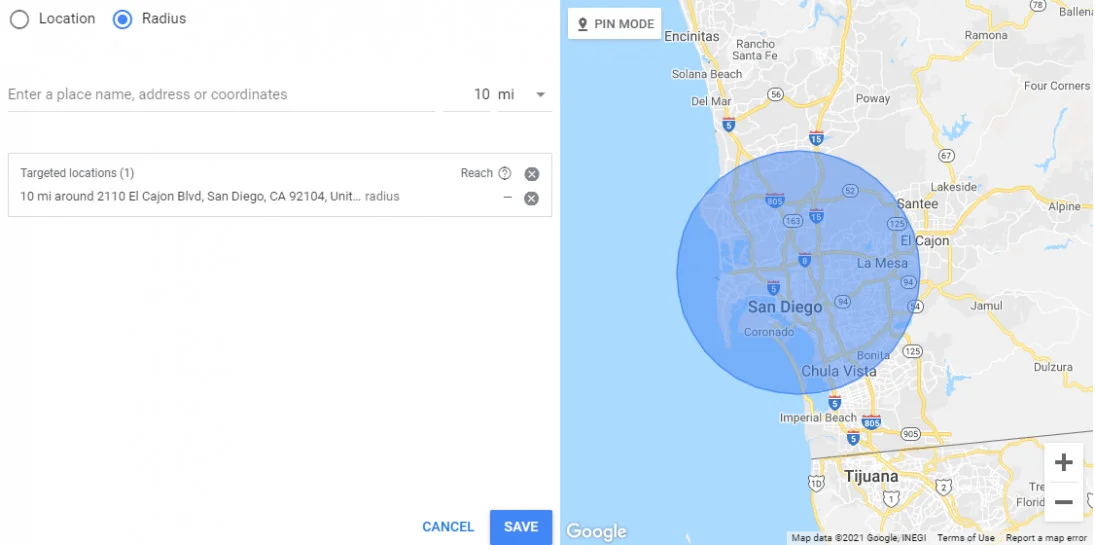
To get started, create a campaign as you would normally do, then go to “Settings,” then “Advanced settings.” Here you will get two options – Location and Radius. Pick the preferred option based on where your customers are situated.
When you choose Radius, you will have to pick the center of your campaign, which is usually your store’s physical location, and then you can choose a radius, say 10 miles.
When running hyperlocal ads on Google, make sure to target specific local keywords that specify your service and your area, like “gym in San Diego” or “24-hour drug store San Diego.”
How to Run Hyperlocal Ads on Facebook
You can also create highly targeted hyperlocal campaigns on social media. So, if you are creating a local brand awareness campaign on Facebook, start by going to the ad manager and creating a campaign.
Add the campaign details, like the name, budget, etc. In the campaign type, choose Brand awareness. Now comes the location part – choose a central point and desired radius, as shown below. You can increase or decrease this radius, depending on the areas you want to target.
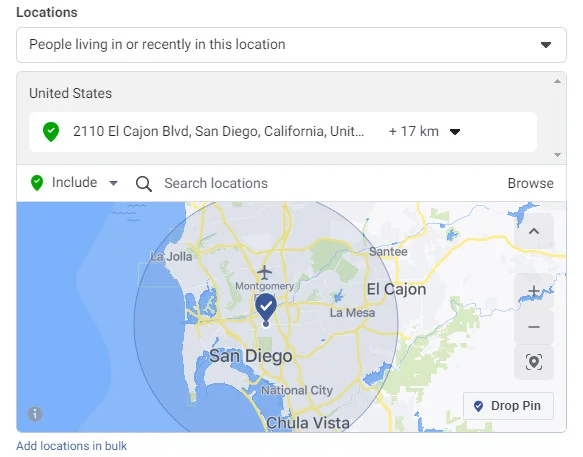
Once you have set the location and radius, go on to add the other details like the age, demographics, interests, etc. On Facebook, businesses also have an option to target visitors of an area, or its residents, or both.
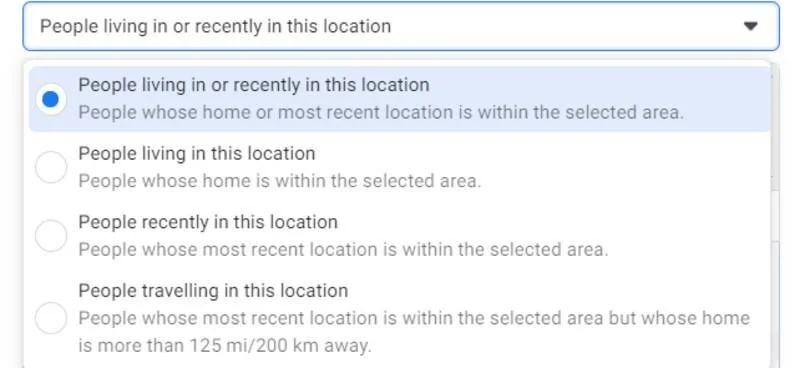
So, for instance, if you are running a restaurant in San Diego, you would want to target both residents and visitors, but if you are a car service station, you might only want to target the residents.
Running geo-targeted ads is a great way to gain immediate visibility in your targeted areas. Combined with other organic and local marketing efforts, hyperlocal ads can be extremely powerful for businesses looking to drive social engagement, reinforce credibility, and build trust.
Examples of Brands Implementing Hyperlocal Marketing Strategies
Let us now take a look at a few brands that have adapted their marketing messaging to meet the preferences of their local audience and deliver an exceptional customer experience.
Starbucks
Starbucks is often cited as one of the strongest examples of hyperlocal marketing at scale. While it operates thousands of stores across the United States, the company consistently adapts its messaging, community engagement, and social media storytelling to reflect local culture and neighborhood identity.
Instead of treating social media purely as a national branding channel, they often combine brand-level storytelling with local store experiences, community initiatives, and region-specific campaigns.
They frequently highlight individual store locations and neighborhood experiences across their social media channels. When new stores open or flagship locations launch, the brand promotes them through localized content featuring the architecture, artwork, and unique design elements inspired by the surrounding community.
For example, the opening of the Chicago Starbucks Reserve Roastery generated a large amount of localized social content showcasing the building, the city skyline, and Chicago-specific design details.
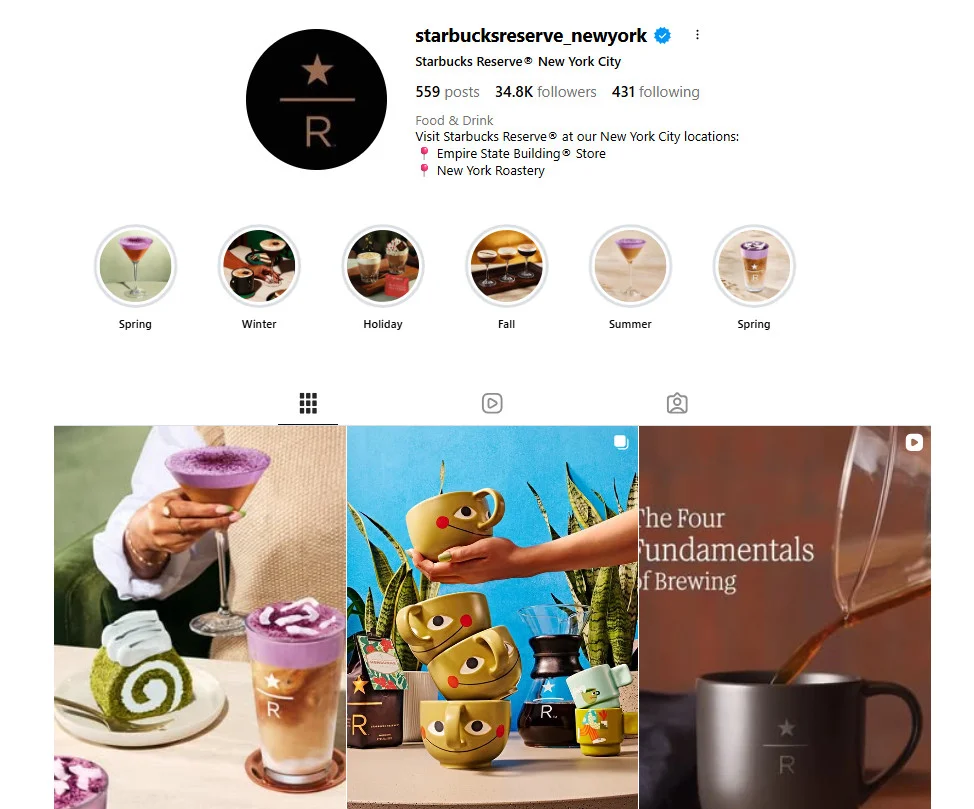
In many markets, they also promote local charity partnerships, community volunteer programs, and neighborhood festivals and events. They even collaborate with local artists to position themselves as active participants in local communities.
Not only do they use location tagging strategically on platforms like Instagram and Facebook, but they also post UGC when their customers share location-tagged content.
Overall, their marketing strategy balances global brand consistency with neighborhood relevance.
Whole Foods Market
Whole Foods Market started out as a local supermarket in Austin, Texas, but today it is the world’s largest retailer of organic and natural foods in the USA.
They have long emphasized local sourcing, buying all their produce from local markets, roadside stands, and mom-and-pop makers across the country.
Instead of relying solely on a centralized national social media presence, Whole Foods adopts a market-level social media approach. Many regions and cities operate their own social accounts that highlight the stories of their local suppliers, store events, neighborhood initiatives, and community partnerships.
Their local partnerships become opportunities for storytelling. On their social media accounts, they communicate in ways that feel more relevant to the audiences in a particular location.
For example, Whole Foods operates localized social pages such as Whole Foods Market Austin, which regularly shares posts about local farmers, Austin-based food brands, store-specific events, and local community initiatives.
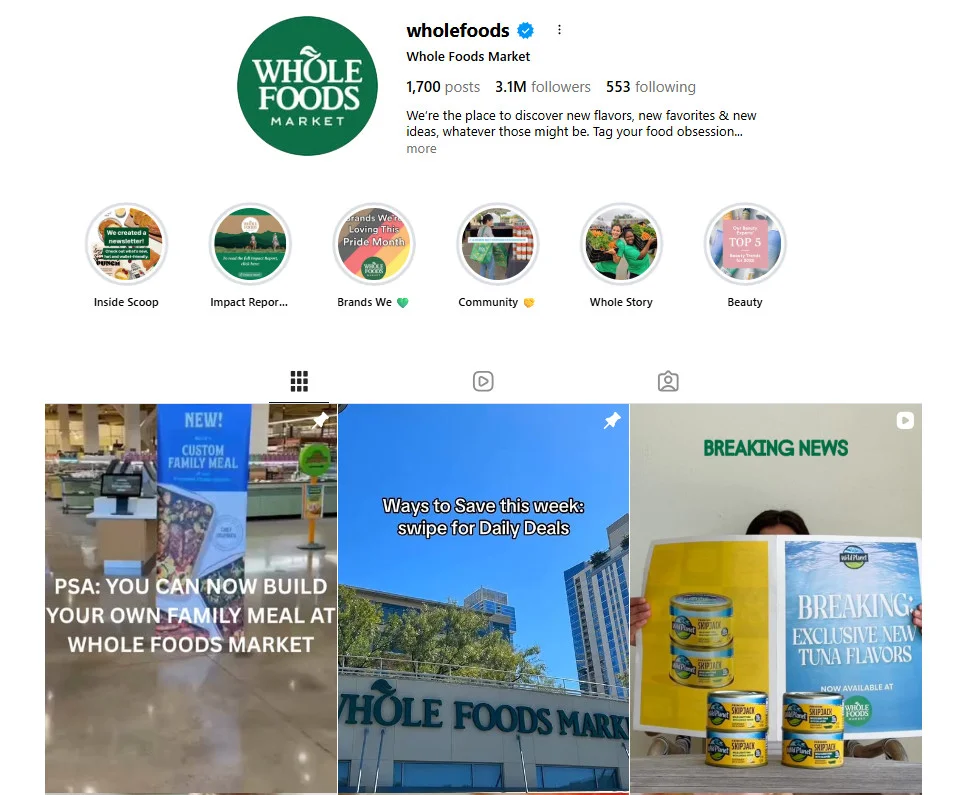
Because their content is closely tied to a specific location, it resonates strongly with people who live in the surrounding neighborhoods.
Expert Tips to Strengthen Your Hyperlocal Marketing
Let us now discuss expert tips to help businesses strengthen their hyperlocal marketing strategies and build a stronger presence in local markets.
1. Define a Very Specific Target Area
Hyperlocal marketing works best when the target geography is clearly defined and narrow enough to allow for highly relevant messaging. Use tools like Google Business Profile insights and local search data to understand where your customers are actually coming from and focus your efforts on those high-value zones first.
2. Build a Local Team
Hire employees who are familiar with the neighborhood and community that you are serving. They often follow local news and better understand local trends, customer preferences, and community events. Local teams can help businesses create more authentic and relevant content that makes them appear more approachable and connected to the neighborhoods they serve.
The social media profiles of your business must clearly reflect your location and service areas. Add accurate addresses and contact details, use location-specific geotags and hashtags, and share content that highlights local events, partnerships, and community stories. Pin location-relevant posts and encourage UGC from local customers to boost discoverability and credibility.
Community engagement is a powerful way for businesses to build trust in hyperlocal markets. You can sponsor local festivals, sports teams, or charity events, or host workshops, demonstrations, or meetups with local people. Partnering with local organizations and nonprofits also reflects your local involvement.
Managing hyperlocal campaigns across multiple locations and platforms can become challenging without the right tools. Social media management platforms can help businesses streamline their content planning, publishing, and performance tracking. These tools also help you monitor engagement and performance metrics to understand the impact of your hyperlocal marketing strategies.
Time to Create a Hyperlocal Marketing Strategy for Your Business
Contrary to the popular notion, hyperlocal marketing is not just a tactic for small neighborhood businesses. In fact, today it has become a powerful strategy for all businesses to connect with different communities across the world.
But executing successful hyperlocal marketing campaigns can be challenging. Managing multiple social profiles, planning location-specific campaigns, coordinating approvals, and tracking performance across locations can quickly become complex without the right tools.
This is where SocialPilot can make a difference. With features like a centralized content calendar, multi-location social media management, advanced scheduling, and analytics, SocialPilot helps businesses plan, publish, and measure hyperlocal campaigns more efficiently.
Start your 14-day free trial of SocialPilot today and manage your localized social media campaigns at scale.