
Social media is no longer just a platform for brand awareness, it has become one of the most powerful channels for generating high-quality leads. Businesses of all sizes use social platforms to attract, engage, and convert potential customers into inquiries, calls, and sales.
With the right strategy, social media can create a consistent flow of leads without relying entirely on paid advertising. From organic content and lead magnets to targeted ads and retargeting campaigns, companies now use structured systems to turn followers into qualified prospects.
In this guide, we’ll break down practical, real-world social media lead generation strategies that businesses actively use and how you can implement them effectively.
1. Content-to-Lead Funnel (Most Reliable Organic Strategy)
The Content-to-Lead Funnel is one of the most effective organic lead generation strategies because it turns valuable content into a consistent lead capture system. Instead of directly selling, businesses educate their audience, build trust, and then guide them toward a specific action.
This strategy works because people are more likely to share their information after receiving helpful insights that solve a real problem.
How This Strategy Works?
At its core, the Content-to-Lead Funnel follows three simple steps:
- Attract attention with educational content
- Build trust by solving a specific problem
- Convert interest into a lead using a soft call-to-action
Rather than aggressively promoting a service, you first provide value. Once the audience sees your expertise, they are more willing to take the next step.
How to Implement It Effectively?
To use this strategy properly:
- Focus each post on solving one specific problem.
- Keep your CTA simple and action-oriented.
- Offer a relevant lead magnet (checklist, template, guide).
- Use automated DM tools or manually respond quickly.
- Stay consistent with posting (3–5 times per week).
The goal is not to go viral, the goal is to attract the right audience and convert them into leads.
Authority-building content focuses on establishing credibility before asking for a sale. Instead of directly promoting your service, you demonstrate expertise through proof, insights, and consistent value. When your audience sees real results and deep knowledge, trust increases and leads come naturally.
This strategy works because people prefer to buy from experts they trust rather than brands that constantly sell.
How This Strategy Works?
Authority-building content positions your business as:
- Experienced
- Results-driven
- Knowledgeable
- Reliable
When people repeatedly see proof of your expertise, they begin to associate your brand with solutions. Over time, this creates inbound inquiries without aggressive selling.
The formula is simple: Value + Proof + Consistency = Trust
Types of Content That Build Authority
Businesses generate organic leads by regularly sharing proof and expertise, such as:
- Case studies showing real client transformations
- Before-and-after results with measurable improvements
- Client wins and testimonials
- Process breakdowns explaining how results were achieved
- Industry insights and trend analysis
- Myth-busting or educational deep dives
Try Strategic Content Series (Amplifying Authority)
Instead of posting randomly, successful businesses create structured content series. A series builds anticipation, keeps audiences engaged, and reinforces expertise over time.
Examples include:
“30 Days of Sales Tips”
- “Startup Growth Series”
- “Marketing Myth Breakdown”
- “Weekly Client Case Study”
A content series keeps your audience coming back regularly. With repetition, authority strengthens and engagement increases.
Why This Strategy Generates Leads
Authority content works because it:
- Reduces skepticism.
- Shortens the decision-making process.
- Differentiates you from competitors.
- Attracts higher-quality leads who already trust you.
When people consistently see proof of results, they don’t need convincing, they reach out themselves. The goal is not immediate conversion; it is long-term positioning. Over time, authority compounds and inquiries increase steadily.
3. LinkedIn Organic Prospecting (For B2B)
LinkedIn organic prospecting is one of the most effective ways to generate B2B leads without ads. Since LinkedIn is built for professionals, you can connect directly with decision-makers and start meaningful conversations that turn into business opportunities.
How This Strategy Works?
Instead of pitching immediately, you focus on building relationships. You connect with ideal clients, engage with their content, and start value-driven conversations. Over time, this creates trust and opens the door for sales discussions.
Practical workflow:
- Step 1: Optimize your profile to clearly show who you help and what results you deliver.
- Step 2: Send daily connection requests to your target audience.
- Step 3: Engage with their posts to build familiarity.
- Step 4: Send value-based messages, not sales pitches.
- Step 5: Move qualified conversations to a call.
This strategy works because it is personalized and targeted. You’re speaking directly to decision-makers instead of broadcasting to everyone.
4. Direct DM Strategy
The Direct DM Strategy focuses on starting conversations instead of waiting for people to fill out a form. Many service-based businesses generate the majority of their organic leads through private messages rather than website links.
Instead of passively posting and hoping for inquiries, you proactively engage with your audience. By starting natural conversations, you build relationships that can turn into qualified leads.
What to Do Daily
- Engage with followers’ Stories by replying thoughtfully.
- Message people who voted on your polls or asked questions.
- Welcome and start conversations with new followers.
- Reach out to users who consistently like or engage with your posts.
- Keep messages conversational and value-driven, not sales-focused.
DMs feel personal and low-pressure. When conversations start naturally, trust builds faster, making it easier to transition into discovery calls or service discussions. For many service businesses, DMs convert better than sending traffic to a link.
Many businesses now treat platforms like Instagram, LinkedIn, and TikTok as search engines. Users actively search for solutions, tips, and answers — which creates an opportunity to attract inbound leads organically.
How This Strategy Works
Instead of posting random content, you create posts based on what your target audience is already searching for. When your content matches those search queries, it appears in results and attracts high-intent viewers.
How to Use It
- Include searchable keywords in captions and on-screen text.
- Answer common customer questions directly.
- Create “How to…” and problem-solving content.
- Optimize your LinkedIn headline with clear keywords related to your service.
This strategy attracts people who are actively looking for solutions. Because the audience already has intent, they are more likely to engage, message you, or inquire about your services.
6. Offer a Simple Lead Magnet That Solves One Problem
A lead magnet is a free resource offered in exchange for a person’s contact information. This strategy works best when the resource solves one clear, specific problem for your target audience. The simpler and more focused the offer, the higher the conversion rate.
Instead of creating long, detailed guides, successful businesses provide quick, actionable resources that deliver immediate value.
How does it work out for real business?
High-converting lead magnets include:
- Free checklists
- Pricing guides
- Templates
- Industry-specific eBooks
- Free trials or demos
Don’t create a 50-page eBook. A simple 5–10 page PDF that solves one specific problem performs much better.
Examples:
- Real estate → “Home Buying Checklist”
- Marketing agency → “30 Content Ideas Template”
- Fitness coach → “7-Day Meal Plan”
To maximize results, promote your lead magnet consistently. Place one clear offer in your bio, include strong CTAs in your posts directing people to it, and pin testimonial or proof content to support the offer. Focus on one main lead magnet instead of multiple competing links.
A focused lead magnet attracts people who already have an interest in your topic. Because the value is clear and specific, users are more willing to exchange their contact details, turning your content audience into qualified leads.
7. Host Webinars and Live
Webinars and live training sessions are powerful lead generation tools, especially for SaaS companies, coaches, agencies, and consultants. This strategy works because it combines education, authority-building, and direct engagement in one event.
By teaching something valuable for free, you attract an audience already interested in your expertise.
How can you use live and webinars?
You can host live sessions to:
- Teach a specific topic
- Answer common FAQs
- Break down strategies step-by-step
- Solve real audience problems
For structured webinars, you can:
- Promote the session for 7–10 days
- Collect registrations through a landing page
- Deliver high-value training
- Present their product or service at the end
- Follow up with a replay email
How to generate leads during the live?
During the session:
- Mention your free resource or lead magnet
- Drop the link in the comments or chat
- Offer a limited-time bonus for attendees
- Invite viewers to book a call
This turns viewers into active leads instead of passive watchers. Live training builds authority, increases engagement, and attracts highly interested prospects. Since attendees invest their time, they are more likely to convert into qualified leads.
8. Use Click-to-Message Ads
Click-to-Message ads allow businesses to send prospects directly into Instagram DMs, Facebook Messenger, or WhatsApp instead of sending them to a website. This reduces friction and starts a conversation instantly.
This strategy works especially well for businesses that close deals through direct communication.
How does it work?
- Run ads that open a DM or WhatsApp chat.
- Use automated questions to qualify the lead (budget, timeline, service needed).
- Continue the conversation inside chat.
- Book a call directly within the conversation.
This creates a faster and more personal sales process.
Best For:
- Local businesses
- Real estate agents
- Service-based businesses
- High-ticket offers that require consultation
People prefer messaging over filling out long forms. Direct conversation builds trust quickly and increases the chances of booking calls or closing sales.
Comment marketing is an underrated but highly effective organic lead generation strategy. Instead of creating more content, you leverage the audience of industry leaders by adding value in their comment sections.
When done consistently, this can drive daily profile visits and inbound leads.
How Businesses Use It
- Comment thoughtfully on posts from industry leaders or ideal clients.
- Add real insights, opinions, or additional tips — not just emojis or generic praise.
- Stay consistent so your name becomes familiar within that audience.
Valuable comments often get likes and replies, increasing visibility.
As people notice your insights, they visit your profile. If your profile is optimized with a clear offer and strong bio, those visitors can turn into followers, DMs, or inquiries.
Why it works?
You position yourself as knowledgeable without creating extra content. By showing up where your target audience already spends time, you attract warm, inbound leads consistently.
10. Use Short-Form Video to Drive Traffic to an Offer
Short-form video (Reels, TikTok, YouTube Shorts) is one of the fastest ways to generate organic reach and attract new leads. Businesses use short videos to capture attention quickly and guide viewers toward a specific offer.
The key is not just to go viral, but to connect views to a clear next step.
How This Strategy Works
Create short, problem-focused videos that:
- Address a common pain point
- Share quick tips or insights
- Highlight mistakes to avoid
- Show results or transformations
At the end of each video, include a clear call-to-action such as:
- “Download the free guide in my bio.”
- “Comment ‘PLAN’ and I’ll send it.”
- “Book a free call through the link.”
Short-form content attracts cold audiences at scale. When paired with a clear offer and strong CTA, it turns attention into profile visits, DMs, and lead magnet downloads — creating a steady flow of inbound leads.
11. Run Paid Lead Form Ads (Fastest Way to Get Leads)
Paid lead form ads are one of the fastest ways businesses generate leads. Platforms like Facebook and Instagram allow users to submit their information through pre-filled forms without leaving the app, which increases conversion rates.
This strategy is ideal when you want predictable and scalable lead flow.
How businesses can use it?
- Use Facebook or Instagram Lead Ads with pre-filled forms.
- Offer something specific and valuable (Free Quote, Free Consultation, Discount, Free Guide).
- Keep the form short — typically Name, Email, and Phone only.
Short forms reduce friction and increase submissions.
How can you do it?
- Create one clear offer (e.g., “Free 15-Minute Strategy Call”).
- Target a specific audience based on interests, behavior, or demographics.
- Connect leads directly to your CRM or email marketing tool.
- Follow up within 5–10 minutes to increase conversion rates.
Lead form ads remove extra steps and make it easy for users to submit their information. With the right targeting and fast follow-up, this method can quickly generate consistent, qualified leads.
12. Immediate Follow-Up System (Critical)
Most businesses don’t lose leads because of bad offers, they lose them because they respond too late. Fast follow-up dramatically increases conversion rates, especially when the lead is still actively interested.
Speed is often the difference between closing the deal and losing it to a competitor.
How to do it practically?
- Send an instant email confirmation after form submission.
- Trigger an SMS follow-up for faster engagement.
- Schedule a sales call within 15 minutes for hot leads.
- Add leads to a 5–7 email nurture sequence.
This ensures no lead is forgotten. When someone submits their details, their interest is highest at that moment. Immediate contact increases trust, keeps momentum, and significantly improves conversion rates.
Instead of only posting content, smart businesses build micro-communities around their brand. This is a long-term strategy focused on trust, engagement, and loyalty rather than quick wins.
When people feel part of a community, they are far more likely to buy.
Examples of Micro-Communities:
- Facebook Groups
- LinkedIn Groups
- Instagram Close Friends lists
- Instagram or WhatsApp Broadcast Channels
These spaces allow you to connect more personally with your audience.
How does it work?
Provide exclusive value inside the community, such as:
- Behind-the-scenes insights
- Early access to offers
- Private training or tips
- Direct Q&A sessions
The more engaged the community, the stronger the trust. Community members see you consistently, interact regularly, and build deeper trust. Because of this relationship, they convert at much higher rates than cold audiences.
14. Use Lead Capture Forms
Lead capture forms are one of the most direct ways to collect potential customer information. They allow businesses to gather essential details like name, email, and phone number in exchange for an offer, consultation, or resource.
This strategy works best when the form is simple and tied to a clear benefit.
Where to Use Them?
- Website landing pages
- Blog posts
- Social media bio links
- Paid ad campaigns
- Pop-ups or exit-intent forms
Forms should always be connected to a specific offer.
Best Practices:
- Keep fields minimal (Name, Email, Phone if needed).
- Clearly explain what they will receive.
- Add a strong call-to-action (e.g., “Get Free Guide” or “Book Free Call”).
- Connect the form to your CRM or email system for instant follow-up.
Lead capture forms turn anonymous visitors into identifiable prospects. When paired with a strong offer and fast follow-up, they become a reliable system for generating consistent leads.
15. Retarget People Who Already Engaged
Retargeting is one of the highest-ROI lead generation strategies. Instead of advertising to cold audiences, you show ads to people who have already interacted with your business.
Since these users are already familiar with you, they are much more likely to convert.
Who should you retarget?
- Website visitors
- Video viewers (watched 50% or more)
- Instagram or Facebook profile visitors
- People who clicked but didn’t submit a form
- Past leads who didn’t book a call
- These audiences are considered warm traffic.
How can you use it?
- Run retargeting ads featuring testimonials.
- Offer a limited-time discount or bonus.
- Show case studies or client results.
- Remind them to complete their booking or download.
Warm traffic converts 2–5x better than cold traffic because trust and awareness already exist. Retargeting keeps your brand visible and brings interested prospects back into your funnel.
Tracking social media leads is essential if you want to understand which platforms, campaigns, and content strategies are actually generating business results. Without proper tracking, you’re relying on guesswork instead of data.
Below is a detailed breakdown of how to effectively track social media leads.
1. Use UTM Parameters to Track Traffic Sources
UTM parameters are small tracking codes added to the end of your URLs. They help you identify exactly where your website traffic and leads are coming from.
For example, if you share the same landing page on Instagram, LinkedIn, and Facebook, UTMs allow you to differentiate which platform generated the most leads.
By adding specific labels such as:
- Source (e.g., Instagram, LinkedIn)
- Medium (e.g., social, paid)
- Campaign name (e.g., free guide launch)
You can analyze performance inside tools like Google Analytics and clearly see which channel or campaign is driving conversions.
Without UTMs, traffic may simply appear as “Direct” or “Social,” making it difficult to evaluate performance accurately. Using UTMs ensures every campaign is measurable.
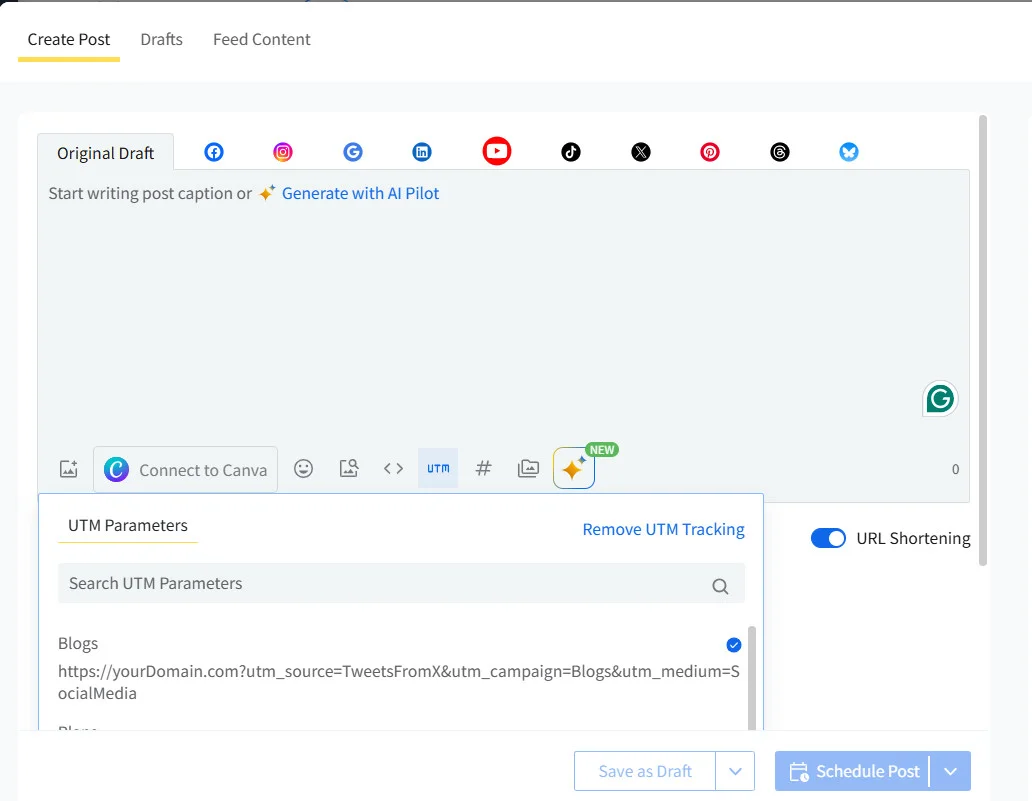
Instead of manually creating UTM links every time, tools like SocialPilot allow you to automatically add UTM parameters to your posts. This makes it easy to track which social platforms, campaigns, or even individual posts are generating the most leads, so you can double down on what actually works.
Start Your 14-day Trial
2. Set Up Conversion Tracking (Meta Pixel, LinkedIn Insight Tag, etc.)
Conversion tracking allows you to monitor specific actions that users take on your website after clicking from social media.
These actions may include:
- Filling out a lead form
- Booking a consultation
- Signing up for a webinar
- Making a purchase
Tools like the Meta Pixel (for Facebook and Instagram) and LinkedIn Insight Tag are small pieces of code installed on your website. Once installed, they track user behavior and report back to the advertising platform.
This tracking allows you to:
- Measure how many leads came from a specific campaign
- Calculate cost per lead
- Build retargeting audiences
- Optimize ads for conversions instead of clicks
Without conversion tracking, you can see traffic, but you cannot accurately measure results.
3. Monitor Platform Analytics Dashboards
Each social media platform provides built-in analytics tools that offer insights into performance. For example:
Instagram & Facebook Insights show:
- Profile visits
- Link clicks
- Engagement rates
- Lead form submissions
LinkedIn Analytics shows:
- Post impressions
- Click-through rate (CTR)
- Lead form completions
- Audience demographics
Monitoring these dashboards helps you identify:
- Which content generates the most clicks
- Which posts drive profile visits
- Which campaigns produce engagement that leads to conversions
Reviewing analytics regularly allows you to adjust your content strategy based on performance rather than assumptions.
4. Track Lead Forms and CRM Integrations
Capturing a lead is only the first step. You also need to track what happens after the form submission.
This is where CRM (Customer Relationship Management) systems become important. A CRM stores lead information and tracks their journey from initial contact to final sale.
Common CRM tools include:
- HubSpot
- Salesforce
- Zoho
- ActiveCampaign
By integrating your social media lead forms with your CRM, you can:
- Automatically store lead data
- Track lead source (Instagram, LinkedIn, etc.)
- Monitor follow-up actions
- Measure how many leads convert into customers
This helps you evaluate not just lead volume, but lead quality.
5. Measure Key Metrics (CPL, Conversion Rate, ROI)
Tracking social media leads is incomplete without measuring performance metrics.
Cost Per Lead (CPL): CPL measures how much you spend to generate one lead. It is calculated by dividing total campaign spend by the number of leads generated. This helps determine whether your campaigns are cost-effective.
Conversion Rate: Conversion rate measures the percentage of website visitors who become leads. It indicates how effective your landing page and offer are. A higher conversion rate typically means your messaging and targeting are aligned.
Return on Investment (ROI): ROI measures how much revenue your campaign generated compared to how much you spent. Even if a campaign produces many leads, it is only successful if it generates profitable returns.
6. Use Marketing Automation Tools for Attribution
Most customers do not convert after a single interaction. They may engage with multiple touchpoints before becoming a lead or making a purchase.
For example:
- Watch a Reel
- Visit your website
- Click a retargeting ad
- Open an email
- Then convert
Marketing automation and attribution tools help you understand which interactions contributed to the final conversion.
These tools allow you to:
- Track multi-step customer journeys
- Assign credit to different touchpoints
- Identify high-performing channels
- Optimize long-term strategy
Attribution prevents you from incorrectly assuming that only the “last click” generated the lead.
Capturing a lead is only the beginning. The real results come from how you manage, nurture, and convert that lead into a paying customer. A strong follow-up system ensures that no opportunity is wasted.
Below are the essential steps businesses should take after generating social media leads.
1. Respond Quickly with an Automated or Personal Follow-Up
When someone submits their information, they are most interested at that exact moment. A fast response builds trust, reinforces credibility, and increases the likelihood of conversion.
To respond effectively:
- Send an instant confirmation email.
- Deliver the promised resource immediately.
- Clearly explain the next step (call booking, demo, reply, etc.).
- For high-intent leads, follow up personally within minutes.
- Use SMS or WhatsApp for urgent or high-ticket inquiries.
The faster the response, the higher the conversion rate.
2. Segment Leads Based on Interest and Behavior
Not every lead is ready to buy. Some are researching, while others are comparing options. Segmenting helps you communicate more effectively by sending relevant messages instead of generic ones.
You can segment leads based on:
- The offer they signed up for.
- Their industry or job role.
- Their location.
- Their behavior (email opens, clicks, page visits).
- Their level of engagement with your content.
Segmentation increases personalization and improves overall conversion rates.
3. Add Leads to Email Nurturing Campaigns
Most leads need time before making a decision. A nurturing sequence helps build trust and educate them about your solution over time.
A typical nurture campaign may include:
- A welcome email introducing your brand.
- Educational content related to their problem.
- Case studies or testimonials.
- Frequently asked questions.
- A clear call-to-action.
Consistent communication keeps your business top-of-mind and moves leads closer to purchase.
4. Personalize Communication
Personalization makes your communication feel human rather than automated. When leads feel understood, they are more likely to engage and convert.
Effective personalization includes:
- Using the lead’s name.
- Referencing the specific resource they downloaded.
- Mentioning their company or industry.
- Addressing their specific pain points.
- Sending customized video or voice messages for high-value prospects.
Even small personalized touches can significantly improve engagement.
5. Score and Qualify Leads
Lead scoring helps you identify which leads are most likely to convert. Instead of treating all leads equally, you prioritize those showing stronger buying signals.
You can score leads based on:
- Job title or decision-making authority.
- Company size or budget.
- Actions taken (demo request, pricing page visit).
- Email engagement.
- Frequency of website visits.
For example:
- Downloaded guide → +5 points
- Visited pricing page → +10 points
- Requested demo → +20 points
Once a lead reaches a certain score, they are considered “sales-ready” and should receive direct attention from your sales team.
6. Hand Off Qualified Leads to the Sales Team
When a lead shows strong purchase intent, a smooth transition from marketing to sales is essential. Poor handoffs often result in lost opportunities.
A proper handoff process includes:
- Automatically assigning the lead in your CRM.
- Sharing previous interaction history.
- Informing the sales team of lead source.
- Setting clear follow-up timelines.
- Tracking follow-up status.
Clear communication between marketing and sales increases closing rates.
7. Continue Retargeting with Relevant Content
Even after capturing a lead, not everyone converts immediately. Retargeting keeps your brand visible while they continue their decision-making process.
Effective retargeting includes:
- Showing testimonial ads.
- Promoting case studies.
- Sharing educational content.
- Offering limited-time incentives.
- Highlighting product benefits.
Retargeting reinforces trust and increases the chances of eventual conversion.
Different social media platforms serve different audiences and business goals. Choosing the right platform depends on your target market, industry, and whether you operate in B2B or B2C. Below are the most effective social media platforms businesses use to generate leads.
1. Facebook
Facebook remains one of the strongest platforms for lead generation, especially for B2C, local businesses, and service providers. Its advanced targeting options and built-in lead tools make it highly effective.
Businesses use Facebook for lead generation through:
- Lead Ads with built-in forms that auto-fill user information.
- Facebook Groups to build communities and capture engaged prospects.
- Retargeting ads to re-engage website visitors and content viewers.
- Event promotions for webinars and workshops.
- Messenger marketing for direct conversations and automation.
Facebook works particularly well for businesses targeting a broad or local audience.
2. Instagram
Instagram is highly visual and engagement-driven, making it powerful for brand awareness and inbound leads. It works well for lifestyle brands, ecommerce, coaches, and service businesses.
Common lead generation methods on Instagram include:
- Stories with link stickers to drive traffic to landing pages.
- Reels that educate or solve problems with a call-to-action.
- Instagram Lead Forms for capturing user information directly.
- DM automation triggered by comments or keywords.
- Profile optimization with a clear offer in the bio.
Instagram excels at building trust quickly through consistent content.
3. LinkedIn
LinkedIn is the leading platform for B2B lead generation. It allows businesses to target professionals based on job title, industry, company size, and seniority.
Businesses generate leads on LinkedIn through:
- Sponsored Content targeting specific professional audiences.
- LinkedIn Lead Gen Forms for frictionless data collection.
- InMail campaigns for direct outreach.
- Organic thought-leadership posts that attract inbound leads.
- Connection-based prospecting and messaging.
LinkedIn is ideal for agencies, consultants, SaaS companies, and high-ticket service providers.
4. TikTok
TikTok has rapidly become a strong lead generation platform, especially for brands targeting younger audiences or leveraging short-form video.
Businesses use TikTok for:
- Educational short-form videos with strong calls-to-action.
- TikTok Lead Ads for in-app lead capture.
- Driving traffic to landing pages via bio links.
- Live sessions to promote offers in real time.
- Retargeting campaigns to engaged viewers.
TikTok performs best when content feels authentic rather than overly promotional.
5. YouTube
YouTube is a powerful long-term lead generation channel. It works well for businesses that can educate, demonstrate, or explain their products or services in depth.
Lead generation strategies on YouTube include:
- Educational or problem-solving videos.
- Strong verbal and visual CTAs.
- Links in descriptions directing landing pages.
- YouTube Ads with lead objectives.
- Pinned comments promoting offers.
Because YouTube content is searchable, it continues generating leads long after publication.
6. X (formerly Twitter)
X is effective for real-time engagement, conversations, and thought leadership. While not traditionally the strongest direct lead platform, it can generate quality inbound leads through visibility and authority.
Businesses use X for:
- Promoted posts to increase visibility.
- Conversation-based marketing by replying to industry discussions.
- Thread content that educates and builds authority.
- Driving traffic to lead magnets via pinned posts.
- Networking with industry professionals.
X works best for brands that consistently share insights and engage in discussions.
Lead Generation & Privacy Laws – What You Need to be Aware of
When collecting leads through social media, businesses must comply with privacy laws to protect user data and avoid legal risks. Key requirements include:
- Comply with major regulations such as GDPR (EU) and CCPA/CPRA (California), which require transparency, user rights access, and data protection.
- Obtain clear, explicit consent before collecting personal information like names, emails, or phone numbers.
- Provide a transparent privacy policy explaining what data you collect, how it’s used, stored, and shared.
- Offer easy opt-out or unsubscribe options for email and SMS marketing (CAN-SPAM, TCPA, GDPR, CCPA).
- Securely store and manage customer data using proper cybersecurity and restricted access controls.
- Follow platform-specific advertising rules (Meta, LinkedIn, TikTok) when using tracking tools or custom audiences.
By being transparent, securing data, and respecting user rights, businesses can stay compliant while building trust with potential customers.
Turning Social Traffic into Leads
Social media lead generation becomes powerful when you treat it like a system, not random posting. When you combine value-driven content, clear CTAs, lead magnets, retargeting, and fast follow-ups, social platforms can consistently generate qualified leads and sales. The key is clarity, consistency, and execution.
To streamline scheduling, engagement, and performance tracking, tools like SocialPilot help manage your entire strategy efficiently at scale.
Start this week by optimizing your bio with one clear offer, creating a simple lead magnet, posting 4–5 value posts with strong CTAs, engaging 20–30 minutes daily, and starting 5 new conversations every day.